
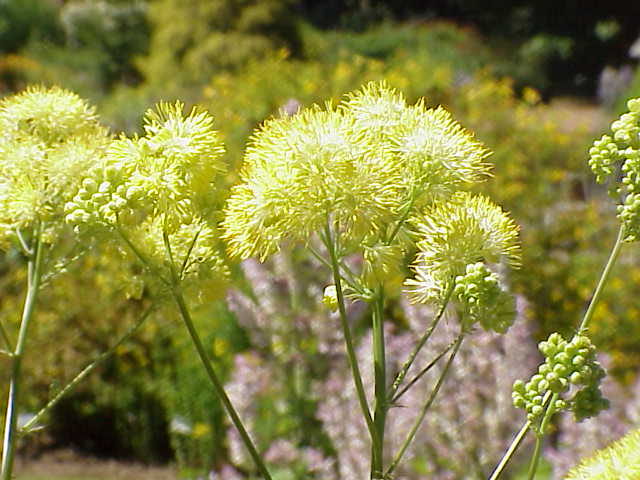
Common Meadow-Rue (Thalictrum flavum) is a perennial member of the buttercup family, Ranunculaceae, known for its tall, upright stems and finely divided, fern-like foliage. It produces clusters of fragrant, pale yellow flowers throughout the summer months.
You will find this plant thrives best in moist, fertile soils that mimic its natural damp meadow habitat. It is an ideal choice for gardeners looking to add vertical structure to the back of a border without needing constant attention.
Key Facts
- Height: reaches 100 cm (39 in) at maturity
- Spread: occupies roughly 45 cm (18 in) of space
- Light: prefers full sun to partial shade
- Water: requires consistently moist, well-draining soil
- Bloom: produces yellow flowers during the summer
Why Grow Common Meadow-Rue in Your Garden
Common Meadow-Rue is a reliable choice for gardeners who want to introduce height and delicate texture to a damp, semi-shaded spot. Unlike many other tall perennials, its stems are sturdy enough to stand without heavy staking in sheltered areas.
The plant provides a soft, airy look that contrasts well with broader-leaved perennials. It serves as a magnet for pollinators in mid-summer, making it a functional addition to a wildlife-friendly garden space.
How to Identify Common Meadow-Rue
You can identify Common Meadow-Rue by its distinctive, glaucous, blue-green foliage that resembles the leaves of a columbine (Aquilegia). The leaves are compound, divided into many small, rounded leaflets that give the plant a fern-like appearance.
- Stems: grow vertically, reaching up to 100 cm (39 in).
- Flowers: appear as fluffy, stamened clusters in shades of pale yellow.
- Fragrance: the blooms carry a faint, sweet scent during warm afternoons.
- Habit: maintains a clump-forming habit that spreads slowly over time.
Site Selection and Planting
Choose a site that receives at least 6 hours of sunlight daily, though it will tolerate partial shade in hotter climates. The soil must remain consistently moist, as the plant will quickly wilt if allowed to dry out completely.
When planting, ensure the crown is level with the soil surface to prevent rot. Adding a layer of organic compost to the planting hole helps retain the moisture this species requires for vigorous growth.
Watering and Feeding Needs
Keep the soil consistently damp throughout the growing season, especially during dry spells in July and August. If the soil surface feels dry to the touch, provide a deep soak to ensure water reaches the root zone.
You can support growth by applying a balanced, slow-release fertiliser in early spring as new shoots emerge. Avoid over-fertilising, as this can lead to weak, leggy stems that require staking.
Pruning and Maintenance
Pruning is minimal for this species, requiring only the removal of spent flower stalks after the summer bloom. Cut the stems back to the base in late autumn once the foliage begins to yellow and die back naturally.
- Spring: clear away old mulch to allow new growth to emerge.
- Summer: deadhead spent flowers if you wish to prevent self-seeding.
- Autumn: cut back all stems to ground level before the first frost.
Propagating Your Meadow-Rue
You can propagate Common Meadow-Rue most effectively by dividing the root clumps in early spring or late autumn. This helps rejuvenate older, congested plants that may have stopped producing as many flowers.
- Step 1: Carefully lift the entire clump using a garden fork.
- Step 2: Use a sharp spade to divide the root mass into smaller, healthy sections.
- Step 3: Replant the divisions immediately into prepared, moist soil.
- Step 4: Water thoroughly to settle the soil around the new roots.
Common Problems and Troubleshooting
The most common issue with this plant is foliage wilting caused by insufficient soil moisture. While generally resilient, it can occasionally attract pests or suffer from fungal issues if air circulation is poor.
- Yellowing leaves: often a sign of waterlogged soil or poor drainage.
- Wilting: indicates the plant is too dry; increase your watering frequency.
- Powdery mildew: occurs in dry, stagnant air; improve spacing between plants.
- Aphids: may cluster on new growth; wash off with a strong jet of water.
Winter Care for Meadow-Rue
Common Meadow-Rue is fully hardy and requires no special protection during the winter months. Once the plant has entered dormancy, the root system remains safe underground as long as the soil does not become excessively waterlogged.
You should leave the root zone undisturbed until spring. If you live in an area with very wet winters, ensure the site has good drainage to prevent the crown from rotting while the plant is dormant.
Common Meadow-Rue Through the Year
| Spring | Apply a layer of compost around the base as growth begins. Divide established clumps if the plant has become too large. |
|---|---|
| Summer | Monitor soil moisture levels closely during hot spells. Remove spent flower stalks if you want to keep the plant tidy. |
| Autumn | Cut back all foliage to the ground once it turns yellow. Clear away debris to prevent fungal issues. |
| Winter | Ensure the site remains free of standing water. No winter protection is required for this hardy perennial. |
What Is Wrong With My Common Meadow-Rue
| What you see | Likely cause | What to do |
|---|---|---|
| Wilting foliage | Drought stress | Water deeply and apply a mulch to retain soil moisture. |
| Powdery white patches on leaves | Powdery mildew | Increase spacing between plants to improve air circulation. |
| Stunted growth | Soil compaction | Amend the soil with organic matter to improve aeration. |
Companion Plants for Your Border
Pair Common Meadow-Rue with plants that share its preference for moist, fertile conditions. Good companions include plants that offer contrasting leaf shapes or flower colours to highlight the airy nature of the meadow-rue.
- Hostas (Hosta): provide excellent contrast with their large, bold leaves.
- Siberian Iris (Iris sibirica): thrives in similar moisture levels.
- Astilbe (Astilbe): complements the feathery texture of the foliage.
- Ferns (Polystichum): enhance the woodland-style aesthetic of the border.
Frequently Asked Questions
How does Common Meadow-Rue differ from Common Rue?
Common Meadow-Rue (Thalictrum flavum) is a tall, moisture-loving perennial with fern-like leaves, whereas Common Rue (Ruta graveolens) is a woody subshrub with thick, aromatic, blue-green foliage that prefers dry, sunny conditions.
Is Common Meadow-Rue toxic to pets?
Yes, it contains compounds that can be mildly toxic to pets if ingested, potentially causing gastrointestinal upset.
Does Common Meadow-Rue need staking?
It generally does not require staking in sheltered locations, but you may need to provide support if the plant is exposed to strong winds.
Can I grow Common Meadow-Rue from seed?
Yes, you can sow seeds in autumn or early spring; they often require a period of cold stratification to germinate successfully.
Sources & Verification
Taxonomy and distribution are checked against the databases below. Care guidance is written for cultivated species only and reviewed by our editor. How We Build Plant Profiles →