
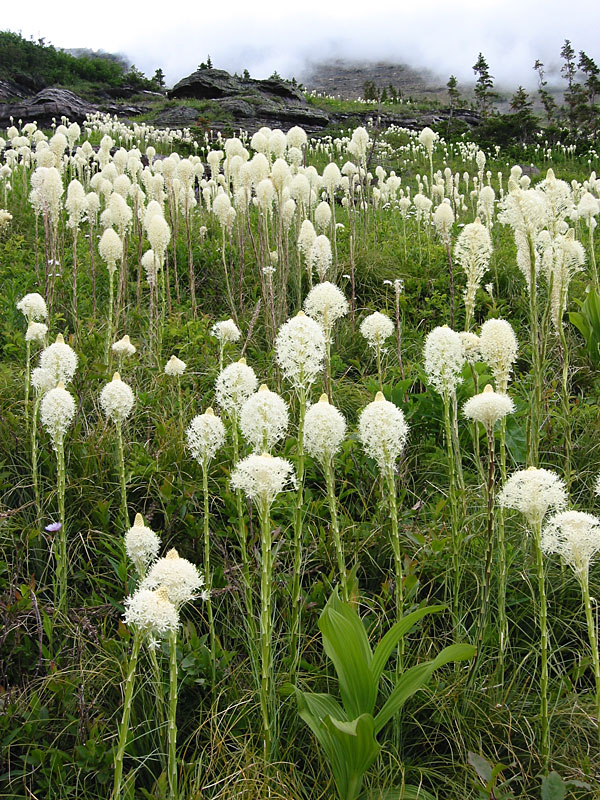
Beargrass (Xerophyllum tenax) is an evergreen, clump-forming perennial in the false hellebore family (Melanthiaceae) native to mountainous regions of western North America. It produces a dense mound of wiry, grass-like leaves topped by a dramatic flowering stalk holding hundreds of tiny, fragrant white florets.
Despite its common name, the plant is neither a true grass nor a true lily, and individual rosettes die after flowering once. It relies on a thick, fire-resistant underground rhizome to survive severe wildfires and regenerate rapidly across open slopes.
Key Facts
- Plant type: evergreen perennial monocot
- Native range: Pacific Northwest and northern Rocky Mountains
- Hardiness zone: USDA zones 4 through 8
- Bloom interval: sporadic mass-blooming every 5 to 7 years
- Family: Melanthiaceae (false hellebore family)
Understanding Beargrass in the Wild
Beargrass is a long-lived montane perennial that does not adapt well to conventional garden cultivation. It establishes deep, woody fibrous rhizomes that resent root disturbance, making mature plants almost impossible to transplant from the wild successfully.
Propagating the plant from seed requires patience, as cold stratification must extend for 12 to 16 weeks at 1 to 4 °C (34-40 °F) before any germination occurs. Seedlings take several years to establish their first dense clump of tough basal foliage.
For hikers and field naturalists, observing it in its native subalpine meadows offers a look at a species that shapes high-elevation ecosystems across the Pacific Northwest.
How to Identify Xerophyllum tenax
You can identify Xerophyllum tenax by its dense tussock of coarse, wiry, razor-sharp leaves and an unbranched summer flower spike reaching 1.2 to 1.8 m (4-6 ft) in height. The basal foliage looks like an oversized clump of stiff ornamental grass, but the leaves belong to an evergreen monocot.
Key botanical features to look for in the field include:
- Foliage: linear, olive-green leaves measuring 30 to 90 cm (1-3 ft) long and 3 to 6 mm wide, with serrated, fibrous margins that can cut bare skin.
- Flower stalk: a stout, erect, leafy stem holding a dense terminal raceme 30 to 50 cm (12-20 in) long.
- Flowers: hundreds of small, creamy white, saucer-shaped blossoms measuring 12 mm (0.5 in) across with six tepals and long stamens.
- Fruit: a three-lobed, papery capsule containing small, brown seeds.
- Rootstock: a tough, short, bulbous rhizome ringed with thick fibrous roots.
Native Range and Growing Habitat
The native range of Xerophyllum tenax extends from British Columbia south through Washington and Oregon to central California, and east into northern Idaho and western Montana. It thrives predominantly in subalpine environments at elevations between 600 and 2,100 m (2,000-7,000 ft).
Typical field habitats include dry ridges, subalpine meadows, open clearings, and light coniferous understories dominated by lodgepole pine (Pinus contorta), Douglas fir (Pseudotsuga menziesii), and subalpine fir (Abies lasiocarpa).
The plant demands coarse, gravelly, acidic soils that drain rapidly. It easily withstands nutrient-poor, rocky scree and relies on winter snowpack to insulate its basal crowns from deep sub-zero freezes.
Fire Ecology and Bloom Cycles
Beargrass is a classic pyrophytic species that survives low-to-moderate intensity wildfires through dormant underground rhizomes. After fire strips the canopy and burns away forest duff, the root crown sprouts vigorous, nutrient-rich basal leaves within weeks.
Bloom events are famously unpredictable and synchronized across mountain ranges:
- Monocarpic rosettes: an individual rosette grows for 5 to 10 years, flowers once, produces seed, and then dies.
- Regional mass blooming: wide areas experience synchronous flowering every 5 to 7 years, triggered by specific cycles of winter snowpack and spring rainfall.
- Wildlife foraging: bighorn sheep and elk browse the protein-packed flower stalks, while bears consume the tender, starchy leaf bases in early spring.
Conservation and Environmental Status
Beargrass holds an official conservation status of Least Concern (LC) across its broader Pacific Northwest range, with robust populations in national parks and wilderness preserves. However, localized populations face stress along highway corridors and in heavily managed timberlands.
Key conservation factors affecting wild stands include:
- Commercial harvesting: florist industry gathering for floral greens requires permits on public lands to prevent overharvesting.
- Fire suppression: long-term exclusion of natural wildfire cycles allows dense tree canopies to shade out historical meadows.
- Invasive competition: encroaching non-native grasses can outcompete slow-growing seedlings on open montane slopes.
Traditional Indigenous Uses of Indian Basket Grass
Indigenous peoples across the Pacific Northwest and northern California traditionally used Xerophyllum tenax as the primary structural and decorative fiber for tight, water-bearing coiled and twined baskets. Groups including the Quinault, Karuk, Yurok, Hupa, and Salish developed precise land stewardship methods around this plant.
Traditional harvesting involved controlled understory burning in late summer to stimulate the growth of supple, slender, pliable leaves in subsequent seasons. Weavers bleached the tough leaves in the sun or dyed them using natural mineral and plant pigments, creating hats, cooking vessels, carrying packs, and intricate ceremonial regalia that remain durable for generations.
Similar Species and Look-Alikes
Field naturalists frequently confuse Xerophyllum tenax with eastern turkeybeard (Xerophyllum asphodeloides) and various western yucca relatives. Observing the native range and flower structure quickly separates them.
Key comparisons include:
- Eastern turkeybeard (Xerophyllum asphodeloides): nearly identical in flower, but strictly limited to pine barrens of the eastern United States, primarily New Jersey, Virginia, and the Carolinas.
- Chaparral yucca (Hesperoyucca whipplei): features rigid, spine-tipped leaves with sharply pointed needles, unlike the pliable, flexible blades of beargrass.
- Common camas (Camassia quamash): shares similar subalpine meadow habitats but produces pale to deep blue blossoms on slender stems from a true underground bulb.
- Smooth sotol (Dasylirion wheeleri): grows in southwestern desert regions and bears distinctly hooked thorns along every leaf edge.
Frequently Asked Questions
How do you pronounce Xerophyllum tenax?
It is pronounced zee-roh-FIL-um TEN-aks. The genus name translates from Greek as 'dry leaf', referencing the wiry, drought-resistant basal foliage.
What plant family does beargrass belong to?
Beargrass belongs to the Melanthiaceae, commonly known as the false hellebore or bunchflower family. Older botanical literature frequently classified it within the lily family (Liliaceae).
What is the hardiness zone for Xerophyllum tenax?
Xerophyllum tenax grows reliably across USDA hardiness zones 4 through 8. It requires substantial winter chilling and tolerates temperatures down to -30 °C (-20 °F) when sheltered by snow.
Do bears actually eat beargrass?
Yes, both black bears and grizzly bears eat the sweet, fleshy bases of young leaves in early spring when emerging from hibernation, although bears do not eat the dried foliage.
Can you grow Xerophyllum tenax from seeds?
Yes, but seeds require at least 90 to 120 days of moist cold stratification to break dormancy. Germination is slow, and seedlings typically take 5 to 7 years to produce their first flowering spike.
Information about traditional or historical uses is provided for educational interest only and is not medical advice. Do not use any plant to treat a condition without speaking to a qualified professional.
Sources & Verification
Taxonomy and distribution are checked against the databases below. Care guidance is written for cultivated species only and reviewed by our editor. How We Build Plant Profiles →
- Kew Plants of the World OnlineTaxonomic status and geographical distribution
- USDA PLANTS DatabaseNorth American distribution and ecological characteristics
- US Forest Service Fire Effects Information SystemDetailed fire ecology and ethnobotanical history
- GBIF — Global Biodiversity Information Facilitytaxonomy, synonyms, occurrence records
- Wikipediageneral reference