
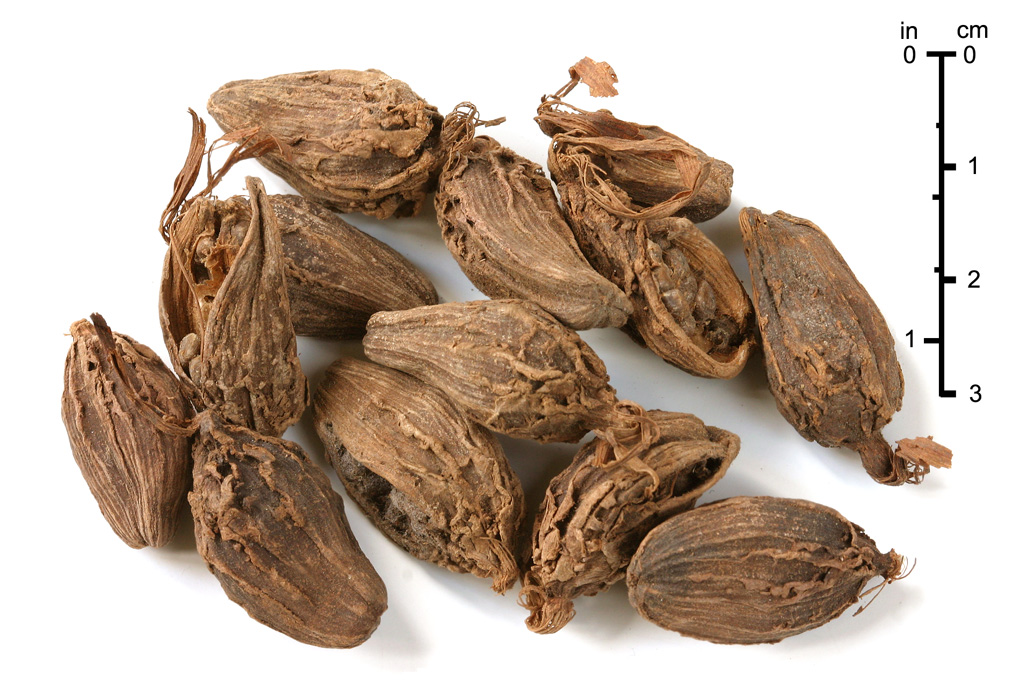
Black cardamom (Amomum subulatum) is a perennial herbaceous spice plant in the family Zingiberaceae native to the damp forest understories of the Eastern Himalayas, including Nepal, Sikkim, and Bhutan. It develops underground rhizomes that send up tall leaf shoots and produces dense flower clusters near ground level that mature into dark reddish-brown seed capsules.
Unlike green cardamom (Elettaria cardamomum), this species requires deep shade, high humidity, and continuous moisture, failing rapidly if exposed to direct hot sunlight or dry soils. Production requires a multi-year commitment, as seedlings typically take 3 to 4 years to produce their first harvestable crop.
Key Facts
- Light: Partial shade to heavy forest shade
- Water: Keep soil constantly moist but drained
- Hardiness: USDA zones 9–11
- Soil pH: Acidic (5.5–6.5)
- First Yield: 3–4 years from planting
Where Black Cardamom Fits in Your Growing Space
Black cardamom thrives best in cool, humid conditions under a partial or canopy shade that mimics its native Himalayan forest ecosystem. It requires annual temperatures between 10–30 °C (50–86 °F) and annual rainfall between 2,000–3,500 mm (78–137 in).
Because it is a large perennial herb reaching 1.5–2.5 m (5–8 ft) tall, you must allocate a dedicated growing footprint of at least 1.5 m (5 ft) per plant. It fits well under fruit tree canopies or along sheltered garden walls where overhead light is filtered.
If you live outside USDA zones 9–11, grow black cardamom in large 50–75 L (13–20 gal) containers so you can move the rhizomes into a heated greenhouse or bright indoor space when winter temperatures drop below 8 °C (46 °F).
Identifying the Black Cardamom Plant, Height, and Flowers
A mature black cardamom plant features leafy pseudostems standing 1.5 to 2.5 m (5 to 8 ft) tall rising from thick, branching underground rhizomes. The lanceolate green leaves measure 30–60 cm (12–24 in) long and 5–11 cm (2–4 in) wide with smooth margins and pointed tips.
The flowers appear from April to May directly at the base of the plant on short, dense spikes near ground level. Each flower has a pale yellow or white tubular corolla with a prominent central labellum marked with pink or yellow veins.
- Pseudostems: Clump-forming, leafy shoots without true wood, 1.5–2.5 m tall
- Leaves: Dark green, smooth, lance-shaped, up to 60 cm long
- Inflorescence: Short spike produced directly from the rhizome base
- Seed Pods: Ovoid, 2–2.5 cm (0.8–1 in) long, dark reddish-brown with longitudinal ridges
Ideal Soil and Light Conditions for Black Cardamom Plantations
Black cardamom requires rich, dark soil with a pH of 5.5 to 6.5 that retains moisture while shedding excess water. Forest loam amended with generous amounts of leaf mold, composted pine bark, and well-rotted manure provides the root structure it needs.
Light levels must be strictly regulated to protect the broad leaves from solar scorch. Exposure to full midday sun causes leaf tips to turn brown and reduces flowering spikes.
- Shade level: 40% to 60% filtered overhead canopy
- Soil texture: Deep, humic loam rich in organic matter
- Drainage: High permeability to prevent standing water around the rhizome
- Relative humidity: Minimum 70% for optimal capsule formation
Sowing Seeds and Planting Black Cardamom Rhizomes
Plant fresh black cardamom rhizome divisions 10–15 cm (4–6 in) deep in late spring for faster establishment than seed propagation. Rhizome pieces should possess at least two viable buds and a section of healthy root tissue.
Starting from seed requires patience, as germination takes 30 to 90 days. Soak fresh seeds in lukewarm water for 24 hours prior to sowing to break seed coat dormancy.
- Seed Sowing Depth: 1 cm (0.4 in) in seedling trays filled with peat and perlite
- Germination Temperature: Maintain 22–26 °C (72–79 °F) continuously
- Rhizome Spacing: 1.5 x 1.5 m (5 x 5 ft) grid pattern in garden beds
- Initial Watering: Saturate soil immediately after planting, then mulch with 5 cm (2 in) of dry leaves
How to Water and Care for Black Cardamom at Home
Supply black cardamom with 2.5–5 cm (1–2 in) of water per week, ensuring the top layer of soil never dries out completely. During hot summer weeks, mist the foliage or increase watering to prevent shoot wilting.
Top-dress the root zone twice a year—once in early spring and once after flowering—with organic compost and well-composted manure. Avoid high-nitrogen chemical fertilizers, which stimulate excess foliage at the expense of floral spikes.
Maintain a constant 7.5 cm (3 in) layer of organic leaf mulch around the base of the shoots. This suppresses weeds, moderates soil temperature, and keeps the shallow feeder roots moist.
Harvesting Black Cardamom Pods
Harvest black cardamom pods in autumn, roughly 3 to 4 years after planting, when the seed capsules at the plant base turn dark reddish-brown. Individual seed heads ripen sequentially from September through November.
Use a sharp knife or curved hand sickle to cut the entire flower spike off right above soil level. Avoid pulling or tearing individual pods by hand, as this damages the underlying rhizome buds scheduled to bloom the following season.
- Harvest Sign: Capsule surface shifts from green to dark maroon or brown
- Seed Check: Interior seeds inside the pod turn shiny black when mature
- Yield: A mature clump yields 200–500 g (0.4–1.1 lb) of dried pods annually
How to Use Black Cardamom Pods in Cooking and Tea
Crushing or cracking open 1 to 2 whole black cardamom pods before adding them to hot oil, stocks, or simmering liquids releases their characteristic smoky flavor. The resinous flavor compounds melt into long-simmered dishes such as pho, stews, curries, and braises.
To make black cardamom tea, crack one pod with a flat side of a knife and simmer it in 500 mL (2 cups) of water alongside black tea leaves and ginger (Zingiber officinale) for 8–10 minutes.
If a recipe calls for ground black cardamom, remove the small sticky black seeds from the outer shell and grind them in a spice grinder just before cooking. The outer fibrous pod skin is discarded after grinding or left whole in broths.
Common Black Cardamom Plant Problems
Fungal leaf blight caused by Pestalotiopsis and rhizome rot caused by Pythium species represent the principal health threats to black cardamom crops. Excess soil moisture paired with cold temperatures accelerates root decay.
Insect pests like cardamom thrips and hairy caterpillars target young shoots and flower stalks. Inspect the underside of leaves and the soil surface near flower spikes weekly.
- Fungal Leaf Spot: Brown oval lesions on foliage; prune affected shoots and reduce overhead watering
- Rhizome Rot: Soft, foul-smelling root base; clear drainage paths and reduce water frequency
- Foorkey Disease: Viral stunting causing bushy, dwarf shoots; dig up and destroy infected plants entirely
Drying and Storing Black Cardamom Pods
Cure freshly harvested black cardamom pods by drying them over a smokeless kiln or food dehydrator at 45–50 °C (113–122 °F) for 24 to 36 hours. Traditional Himalayan curing uses direct wood fires, which infuses the distinct smoky aroma into the capsule skin.
Dry the capsules until their total moisture content falls below 10%, causing the outer skin to feel brittle and coarse. Properly dried pods preserve their aroma for several years.
Store the dried whole pods in airtight glass jars kept in a cool, dark cupboard away from stove heat. Whole pods retain their essential oils for up to 2 years, whereas ground seeds lose flavor within 2 months.
Year-Round Black Cardamom Plant Care
| Spring | Apply a 5 cm (2 in) layer of fresh compost and organic mulch around the plant base. Resume regular irrigation and plant new rhizome divisions once soil temperatures reach 18 °C (64 °F). |
|---|---|
| Summer | Maintain soil moisture with 2.5–5 cm (1–2 in) of water per week and mist foliage during heat spells. Check base flower spikes for thrips and provide overhead shade if temperatures exceed 32 °C (90 °F). |
| Autumn | Harvest mature reddish-brown pod clusters near the soil surface using sharp shears. Dry pods in a dehydrator or drying kiln at 45–50 °C (113–122 °F) for 24–36 hours. |
| Winter | Reduce watering frequency, keeping soil barely damp. Protect outdoor plants from frost with thermal crop covers or move containerized specimens indoors to a spot above 8 °C (46 °F). |
Black Cardamom Plant Problems Solved
| What you see | Likely cause | What to do |
|---|---|---|
| Brown dry leaf tips | Low air humidity or excess direct sunlight | Move plant into deeper shade and mist leaves daily to raise humidity above 70%. |
| Yellowing lower leaves and soft stem base | Rhizome rot from waterlogged soil | Improve drainage, withhold water until top 5 cm (2 in) of soil dries, and apply a copper fungicide. |
| Dwarf bushy shoots with no flowers | Viral Foorkey or Chirke disease | Remove and destroy the infected plant immediately to prevent spreading vectors to healthy clumps. |
| Deformed or empty seed pods | Thrips feeding on flower buds during bloom | Spray flower spikes early in the season with insecticidal soap or neem oil. |
Popular Cultivars of Black Cardamom
- 'Ramsai' – high-altitude variety suited to elevations above 1,500 m, long leaves
- 'Golsey' – compact cultivar yielding rounder, larger capsules at lower elevations
- 'Sawney' – widely grown cultivar producing dense clusters of medium-sized pods
- 'Varlangey' – late-bearing selection with large, high-yielding dark reddish pods
Frequently Asked Questions
What is the HS code for black cardamom?
The international Harmonized System (HS) code for whole black cardamom pods is 090831, while ground or crushed cardamom falls under HS code 090832.
What are the health benefits of black cardamom?
In traditional Ayurvedic and Unani systems, black cardamom was traditionally used to aid digestion, reduce oral bacteria, and relieve respiratory discomfort. Modern culinary usage centers on its rich content of essential oils like cineole.
Can you grow a black cardamom plant at home?
Yes, you can grow black cardamom at home if you maintain rich acidic soil, high humidity, partial shade, and temperatures above 10 °C (50 °F). In cold climates, grow it in a large container to bring indoors for winter.
How do you grind black cardamom seeds?
Crack the outer pod open using a heavy knife or mortar and pestle, remove the sticky dark seeds inside, and process the seeds in a spice or coffee grinder. Discard the outer pod skin or use it whole to flavor soups.
What is the difference between black cardamom and green cardamom?
Black cardamom comes from Amomum subulatum, producing large, dark brown, smoky pods used in savory dishes. Green cardamom comes from Elettaria cardamomum, featuring smaller green pods with a sweet, eucalyptus-like profile used in desserts and chai.
Information about traditional or historical uses is provided for educational interest only and is not medical advice. Do not use any plant to treat a condition without speaking to a qualified professional.
Sources & Verification
Taxonomy and distribution are checked against the databases below. Care guidance is written for cultivated species only and reviewed by our editor. How We Build Plant Profiles →