
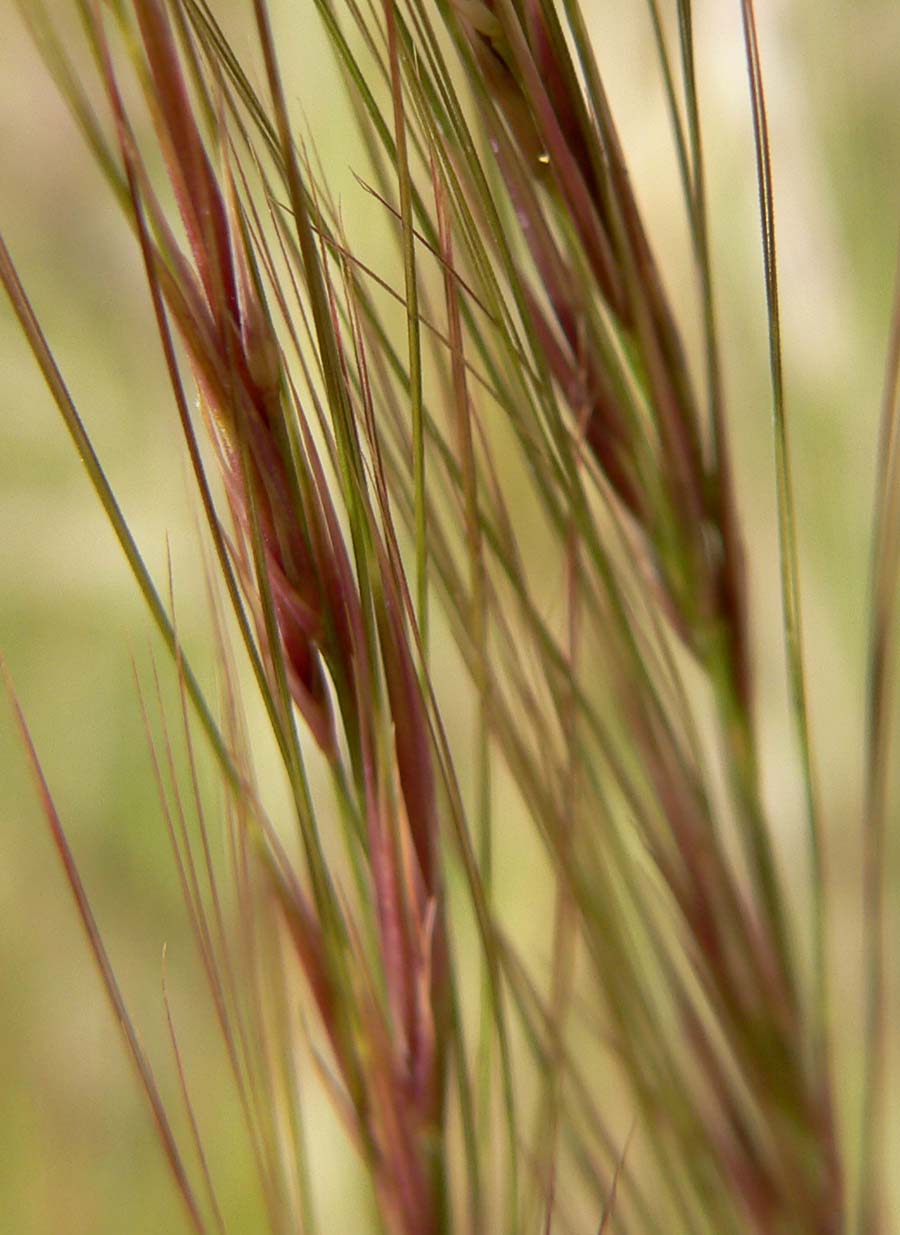
Purple three-awn is a perennial bunchgrass native across North America, belonging to the Poaceae family. You will find Aristida purpurea thriving in dry plains, prairies, and open rocky slopes where most other vegetation struggles.
The defining feature of this grass is its slender, three-pronged seed awns that turn a distinct purple or reddish hue in the late season. It handles severe drought with ease, though its barbed seeds can easily catch on clothing and animal fur.
Key Facts
- Plant Type: Native perennial bunchgrass
- Native Range: North America
- Family: Poaceae
- Flower Color: Purple to reddish
Where Purple Three-Awn Fits in the Landscape
Purple three-awn suits dry, untamed native gardens and ecological restoration projects rather than manicured borders. This grass requires lean, undisturbed soil and intense sun to thrive.
Plant it in areas where irrigation is absent and runoff management is necessary. Its dense root system holds loose soil together on slopes where erosion is a persistent challenge. Avoid placing it near walkways or seating areas, as the sharp awns can catch on fabrics and skin during the late summer months.
How to Identify Aristida purpurea
You can identify Aristida purpurea by its fine, wiry stems and distinct three-pronged seed awns that branch out from each floret. Mature clumps typically reach a height of 20 to 60 cm (8 to 24 in).
- Leaves: Narrow, rolled inward, and distinctly bluish-green or gray-green.
- Awns: Three slender bristles attached to the seed, often measuring 3 to 7 cm (1.2 to 2.8 in) long.
- Color: Stems and seed heads turn a conspicuous purple or reddish shade by mid-summer.
- Growth habit: Forms tight, upright tufts rather than spreading via rhizomes.
Natural Habitat of Purple Three-Awn Grass
Purple three-awn grows wild across diverse arid and semi-arid regions of North America, spanning from southern Canada down through the United States into northern Mexico. It dominates sites receiving as little as 20 cm (8 inches) of annual precipitation.
Look for this grass in shortgrass prairies, desert grasslands, sagebrush steppes, and rocky limestone outcrops. It tolerates extreme heat and poor nutrient availability far better than most introduced turfgrasses. Heavy clay soils or wet, waterlogged conditions will quickly cause root rot and plant decline.
Ecology and Wildlife Value
Purple three-awn provides vital ecological functions in dry grassland ecosystems by stabilizing fragile soils and supporting local fauna. Ground-nesting birds and small mammals utilize the dense bunchgrass clumps for cover and nesting material.
- Seed consumption: Small granivorous birds eat the mature grains during autumn and winter.
- Forage value: Livestock and native herbivores graze the young spring shoots when they are tender.
- Soil protection: Roots prevent wind and water erosion on exposed slopes.
- Biodiversity: Acts as a structural component in native prairie plant communities.
Conservation Status of Aristida purpurea
Purple three-awn maintains a secure population status across its native range and is classified as Least Concern. Its adaptability to disturbed soils helps it persist despite habitat fragmentation.
While individual populations face local pressures from overgrazing and urban expansion, the species as a whole remains widespread. Conservation efforts rarely target this grass directly because of its robust natural abundance in dry western and central regions.
Traditional Uses and Benefits
Historically, indigenous peoples and early settlers found practical applications for the tough stems of wiregrass. The wiry culms were traditionally bundled together and used to construct primitive brooms and brushes.
While not a primary forage crop due to the prickly awns that can injure livestock mouths at maturity, young spring growth offered valuable early grazing. Today, ecological restorationists utilize seed collected from wild stands to re-establish native shortgrass prairies.
Similar Grasses to Aristida purpurea
Purple three-awn is often confused with other fine-textured native grasses sharing similar dry habitats. Examining the seed head for the characteristic three bristles separates this genus from look-alikes.
- Side-oats grama (Bouteloua curtipendula): Features small oats hanging from one side of the stem rather than three-pronged awns.
- Blue grama (Bouteloua gracilis): Displays curved, eyebrow-like seed spikes instead of wiry purple bristles.
- Sand dropseed (Sporobolus cryptandrus): Produces an open, pyramidal panicle with tiny grains lacking long awns.
- Needle and thread grass (Hesperostipa comata): Bears a single, long, twisted awn per seed rather than three distinct branches.
Frequently Asked Questions
What is Democrat grass?
Democrat grass is a regional common name for purple three-awn (Aristida purpurea), derived from old local folklore in parts of the American West.
What is the common name for Aristida purpurea?
The primary common name for Aristida purpurea is purple three-awn, though it is also known as red threeawn, wiregrass, and Democrat grass.
How big does Aristida purpurea get?
Aristida purpurea typically grows to a mature height of 20 to 60 cm (8 to 24 in) with a clump spread of 15 to 45 cm (6 to 18 in).
What family does Aristida purpurea belong to?
Aristida purpurea belongs to the Poaceae family, which comprises all true grasses.
Where is Aristida purpurea native to?
Aristida purpurea is native to North America, ranging across the United States, northern Mexico, and southern Canada.
Where can I buy Aristida purpurea seeds?
Aristida purpurea seeds are available through specialty native plant nurseries and regional prairie restoration seed suppliers.
Sources & Verification
Taxonomy and distribution are checked against the databases below. Care guidance is written for cultivated species only and reviewed by our editor. How We Build Plant Profiles →