
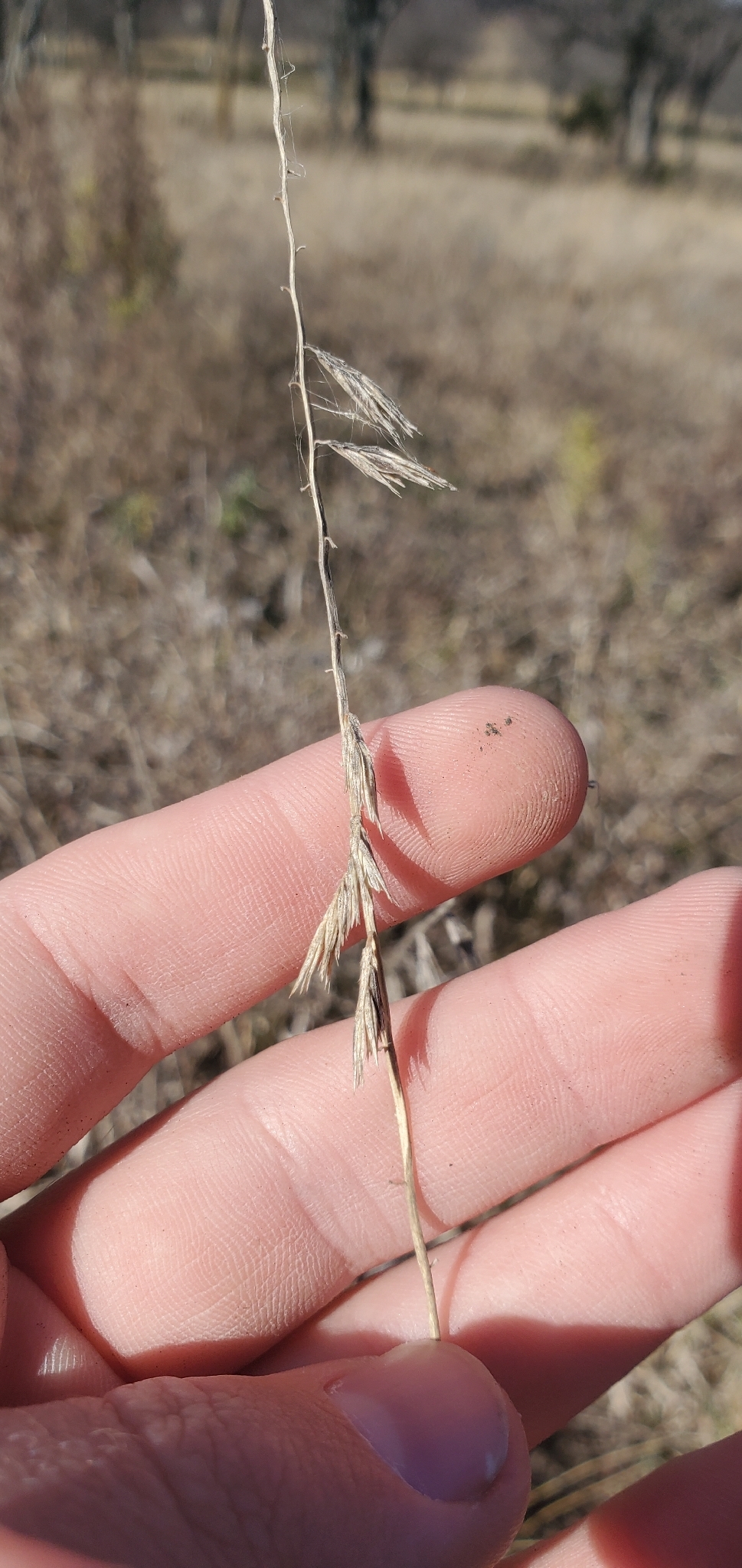
Sideoats grama (Bouteloua curtipendula) is a warm-season perennial bunchgrass belonging to the grass family Poaceae. Native from southern Canada through the United States and Mexico down to Argentina, it forms upright clumps and dominates dry upland prairies.
This grass thrives in full sun and well-drained soils, reaching a mature height of 30-90 cm (12-36 inches). It serves as a primary forage grass for livestock and supports native pollinators and ground-nesting birds.
Key Facts
- Type: Perennial grass
- Height: 30-90 cm (12-36 in)
- Native Range: Canada to Argentina
- Light: Full sun
- Soil: Well-drained, rocky or sandy
Why Grow Sideoats Grama
Sideoats grama fits well into native prairie restorations, low-maintenance landscapes, and naturalistic gardens. It requires virtually no supplemental irrigation once established. Gardeners and restorationists appreciate its tolerance of rocky, poor soils and its ability to prevent soil erosion on slopes.
You can plant it alongside other drought-tolerant native species to create resilient meadow plantings. It adds fine-textured foliage to garden beds while remaining tough enough to withstand heavy foot traffic and grazing pressure.
How to Identify Sideoats Grama
Sideoats grama is easily identified by its unique seed arrangement where 20 to 80 tiny, purplish oat-like spikelets dangle uniformly from one side of the flowering stalk. The mature plant reaches a height of 30-90 cm (12-36 inches) with blue-green leaves that measure 15-30 cm (6-12 inches) long.
- Leaves curl and turn a distinctive coppery-brown colour after the first autumn frost.
- Stems grow upright in loose clumps, sometimes spreading slowly via short rhizomes.
- Anthers are bright orange or red, adding a brief flash of colour during the summer bloom period.
Bouteloua curtipendula Native Range
Sideoats grama occupies a massive natural distribution spanning the entire Western Hemisphere. Its native range extends from central Alberta in Canada south through every US state except Alaska, continuing deep into Mexico and down through Central America to Argentina.
Within this vast territory, the grass adapts to varied elevations from sea level up to 2,300 m (7,500 ft). Herbarium records and occurrence databases like GBIF log over 29,000 observations, confirming its widespread presence across diverse regional climates.
Habitat and Ecology
Sideoats grama thrives primarily in dry prairies, limestone glades, open oak savannas, and rocky hillsides. It demands soils with rapid drainage and cannot survive in waterlogged or boggy environments.
- Prefers calcareous or neutral to slightly alkaline soils.
- Acts as a dominant or co-dominant species in mixed-grass and tallgrass prairie remnants.
- Provides essential winter cover and nesting material for grassland birds.
- Serves as a larval host plant for several species of skipper butterflies.
Conservation Status
Sideoats grama is classified globally as Least Concern due to its vast geographic distribution and large population numbers. While widespread, local populations in the eastern edges of its US range have declined due to agricultural conversion and urban sprawl.
Protection of native prairie remnants remains the primary method for preserving wild genetic strains. Seed banks and native plant nurseries routinely propagate wild-collected germplasm for restoration projects.
Traditional and Ecological Uses
Sideoats grama has a long history of utility in North American grassland ecosystems. Livestock and wild ungulates readily graze the foliage, finding it highly palatable throughout the growing season.
- Traditionally used in ecological engineering projects to stabilize highway embankments and eroded slopes.
- Valued in modern xeriscaping as a drought-tolerant turf alternative or accent grass.
- Utilized by conservation groups to rebuild degraded wildlife habitats across the Great Plains.
Similar Species
Sideoats grama shares its habitat with several related grasses that require careful observation to separate. Blue grama (Bouteloua gracilis) features curved, eyebrow-shaped seed heads rather than the dangling side-pendant spikes of Bouteloua curtipendula. Hairy grama (Bouteloua hirsuta) possesses hairy glumes and a more compact growth habit. Little bluestem (Schizachyrium scoparium) grows taller and produces fluffy, silvery-white seed tufts in autumn.
Frequently Asked Questions
How tall does Bouteloua curtipendula grow?
Sideoats grama grows to a mature height of 30-90 cm (12-36 inches). The flowering stalks add the upper half of this height during the summer months.
Where can I find Bouteloua curtipendula seeds?
Sideoats grama seeds are widely available through native plant nurseries and specialized prairie restoration seed suppliers. Harvest wild seeds in late autumn when the spikelets turn straw-coloured.
What is the difference between sideoats grama and blue grama?
Sideoats grama features dozens of tiny oat-like seeds hanging from one side of a tall stem, whereas blue grama (Bouteloua gracilis) has short, horizontal, eyebrow-shaped seed spikes.
Is sideoats grama a perennial?
Yes, sideoats grama is a warm-season perennial bunchgrass that goes dormant in winter and resprouts from its root crown each spring.
Sources & Verification
Taxonomy and distribution are checked against the databases below. Care guidance is written for cultivated species only and reviewed by our editor. How We Build Plant Profiles →
