
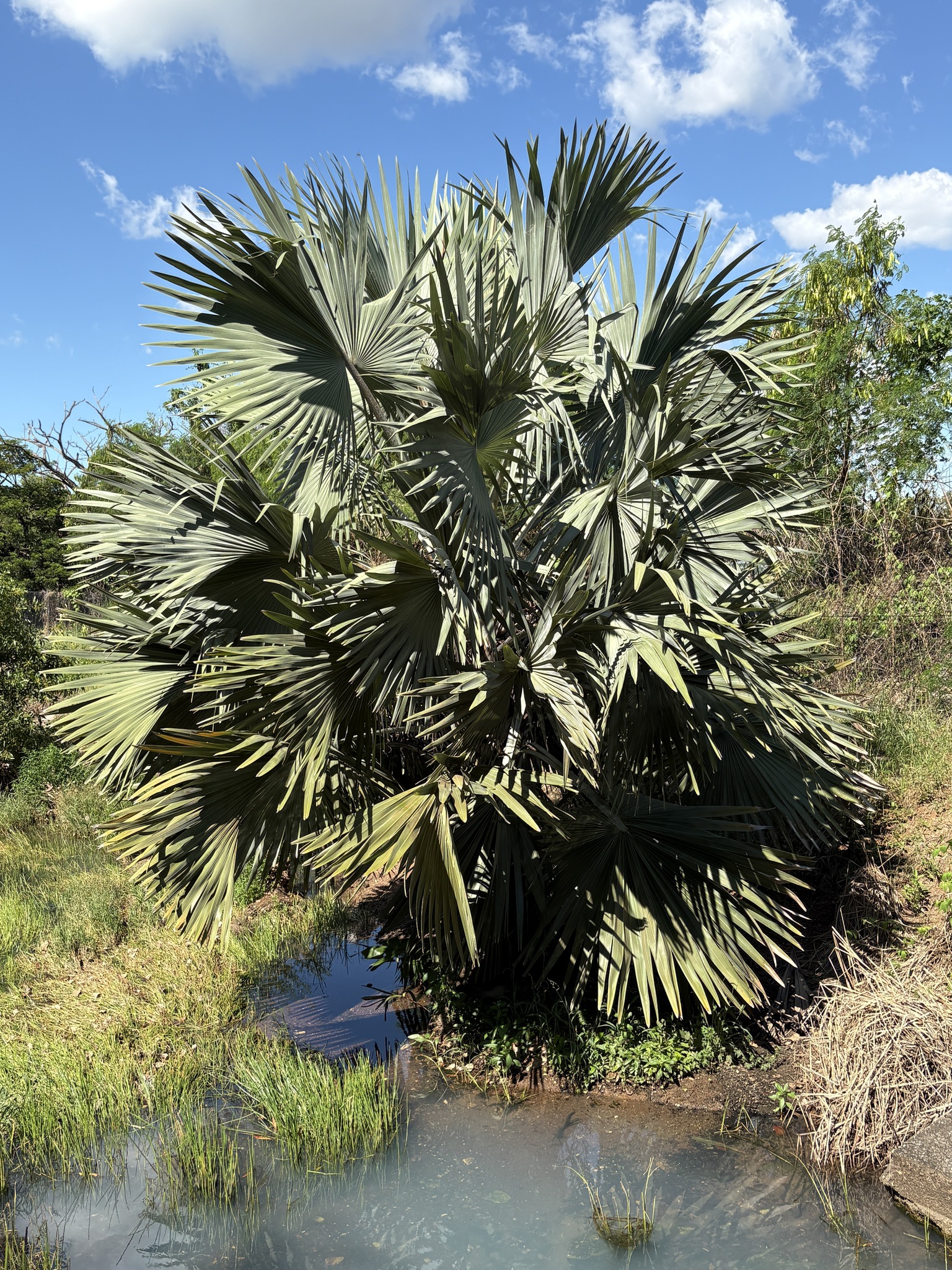
The Bismarck palm (Bismarckia nobilis) is a massive canopy palm native to the open grasslands of western and northern Madagascar. It produces giant silver-blue costapalmate fronds that spread 3 m (10 ft) across on a single stout trunk.
This palm requires a planting location with at least 6 m (20 ft) of clearance on all sides to accommodate its lateral spread. Its deeply sensitive root system makes mature palms almost impossible to transplant successfully once established in the ground.
Key Facts
- Height: 12-18 m (40-60 ft) at maturity
- Spread: 4-6 m (13-20 ft) wide
- Sunlight: Full sun required
- Water: Low once established
- Hardiness: USDA zones 10-11
- Growth Rate: Slow to moderate
Is Bismarck Palm Suitable for Your Garden
The Bismarck palm requires a broad, open space that allows a mature crown spread of 6 m (20 ft) without structural interference. It suits large residential landscapes, golf courses, and parkways in warm regions like Florida and Southern California.
Because it grows a thick grey trunk reaching up to 45 cm (18 in) in diameter, you must avoid planting it near roof eaves, power lines, or narrow walkways. Indoor growing is only feasible for young seedlings in bright conservatories, as mature specimens quickly outgrow residential interior spaces within 3-4 years.
How to Identify Bismarck Palm Tree
Bismarck palm tree features massive costapalmate fronds that range from 2 to 3 m (6.5 to 10 ft) wide and carry a heavy silvery-blue waxy coating. The petioles extend 1.5-2 m (5-6.5 ft) long and possess smooth margins with teeth at the base.
This species is dioecious, producing male and female flowers on separate trees during spring. Female trees bear brown, egg-shaped fruit measuring 3-4 cm (1.2-1.6 in) long that ripen to a dark plum color.
- Fronds: 20 to 30 active silver fan blades per crown
- Trunk: Smooth grey stem marked by ringed leaf scars
- Fruit: Dark brown or plum drupes containing a single hard seed
Bismarck Palm Growth Rate and Size
The Bismarck palm grows at a slow to moderate speed of 30-60 cm (12-24 in) of trunk trunk height per year under full sun and regular irrigation. Young plants spend several years establishing a underground root system and broad frond crown before trunk elevation accelerates.
In landscape settings across USDA zone 10b and 11, specimens top out at 12-18 m (40-60 ft) tall. Fronds extend outwards horizontally to form a symmetrical rounded canopy up to 6 m (20 ft) wide.
Best Planting Site and Light Requirements
Plant your silver Bismarck palm in a site that receives a minimum of 6 hours of direct sun daily. Full sun exposure triggers the production of the silver epicuticular wax that protects fronds from heat stress.
Shaded conditions cause fronds to turn dull green, droop, and grow unusually elongated petioles. Ensure the soil profile drains rapidly, as standing water around the root plate leads to lethal bud rot caused by Phytophthora pathogens.
How to Plant a Bismarck Palm Tree
Planting a Bismarck palm requires digging a hole twice as wide as the root ball and equal to its depth. Never bury the root crown deeper than it grew in its original container.
Because root breakage causes severe transplant shock and frond drop, keep the root ball intact when removing the container. Water thoroughly immediately after backfilling with native soil blended with coarse sand.
- Spacing: Space trees at least 5-6 m (16-20 ft) from buildings
- Soil backfill: Use native soil mixed with 20% organic compost
- Mulching: Apply a 7.5 cm (3 in) bark layer, keeping 10 cm (4 in) clear of the trunk
Bismarckia Palm Care: Watering and Fertilizer
Water a established Bismarck palm deeply once every 10 to 14 days during rainless periods. Young trees require supplemental water twice weekly during their first six months in the ground.
In regions like Florida with sandy alkaline soils, apply a slow-release palm fertilizer with an 8-2-12-4Mg ratio three times per year in spring, summer, and autumn. Prevent deficiency symptoms by ensuring the fertilizer contains micronutrients such as manganese, boron, and iron.
- Spring application: March with 8-2-12-4Mg formula
- Summer application: July with micro-element coverage
- Autumn application: October prior to cool winter weather
How to Trim Bismarck Palm Fronds
Trim only fronds that have turned completely brown and dead below the horizontal 9 o’clock and 3 o’clock positions. Removing green or yellowing fronds strips the palm of vital potassium reserves and weakens the canopy.
Cut fronds 10 cm (4 in) away from the trunk base using clean, disinfected pruning saws. Avoid pulling or tearing leaf bases from the stem, which creates open wounds that invite trunk decay fungi.
Bismarck Palm Problems and Pest Control
Palmetto weevils (Rhynchophorus cruentatus) pose a severe threat to stressed or recently transplanted Bismarck palms. Infestations lead to collapsed central spears and top death within weeks.
Nutritional deficiencies are common in sandy soils. Potassium deficiency causes brown necrotic spots on older leaves, while manganese deficiency causes frizzled new fronds known as frizzle top.
- Palmetto Weevil: Drench crown with systemic imidacloprid if present nearby
- Ganoderma Butt Rot: Prevent trunk wounds; no chemical cure exists
- Boron Deficiency: Correct with small doses of agricultural borax
Cold Hardiness and Winter Care
The silver Bismarck palm withstands short cold snaps down to -4 °C (25 °F) with minimal frond damage once established. Green leaf forms are less cold tolerant and suffer injury at -2 °C (28 °F).
If freezing conditions threaten young palms, protect the central growing point by wrapping the upper trunk and bud spear with frost cloth. Reduce watering during winter months to minimize the risk of root rot while growth halts.
Landscaping Uses and Fiber Yields
In tropical and subtropical landscapes, the Bismarck palm functions primarily as a stand-alone focal specimen or accent plant along broad driveways. Its metallic silver canopy creates contrast when underplanted with dark foliage species like cabbage palm (Sabal palmetto) or firebush (Hamelia patens).
In its native Madagascar habitat, local communities harvest the trunks for building construction and split the leaves for roof hatting and basket weaving. The leaf stalks produce coarse fibers historically used to construct ropes and mats.
Bismarck Palm Through the Seasons
| Spring | Apply a specialized 8-2-12-4Mg palm fertilizer around the drip line at a rate of 700 g (1.5 lb) per 10 sq m. Resume regular irrigation as new frond emergence accelerates. |
|---|---|
| Summer | Provide deep watering every 7 to 10 days during dry spells. Apply a second round of slow-release palm fertilizer in midsummer and inspect the central spear for pest activity. |
| Autumn | Distribute the final seasonal application of palm fertilizer in October. Trim off fully dead, brown fronds near the base of the crown before cool weather sets in. |
| Winter | Cut back irrigation to once every 3 weeks unless prolonged drought occurs. Wrap the crown of young trees if temperatures drop below -2 °C (28 °F). |
Bismarck Palm Leaf and Health Problems
| What you see | Likely cause | What to do |
|---|---|---|
| Frizzled, distorted new leaves emerging from the top | Manganese deficiency (frizzle top) | Apply manganese sulfate to the soil around the drip line twice per year. |
| Translucent yellow or brown spots on mature fronds | Potassium deficiency | Feed with controlled-release 8-2-12 palm fertilizer containing added potassium. |
| Central spear collapses and pulls out easily | Palmetto weevil infestation or spear rot fungus | Drench crown with broad-spectrum insecticide or systemic fungicide immediately. |
| Bent leaf tips hooking into a zig-zag shape | Boron deficiency | Drench soil with a mild solution of solubor or borax powder. |
Bismarck Palm Color Forms
- Silver Form – deep icy silver-blue fronds, higher drought and cold hardiness
- Green Form – dark olive-green leaves, native to humid valleys, less cold tolerant
Frequently Asked Questions
How to grow bismarck palm from seed?
Soak clean seeds in warm water for 48 hours, changing the water daily, then plant them 2.5 cm (1 in) deep in a free-draining sandy mix kept at 30-35 °C (86-95 °F). Seeds typically germinate within 6 to 12 weeks.
How to transplant a bismarck palm?
Root-prune the palm 3-4 months prior to moving, dig a root ball at least 1 m (3 ft) wide, and avoid disturbing the taproot during transfer. Transplanting mature Bismarck palms carries a high risk of failure due to root sensitivity.
Can you keep a Bismarck palm indoors?
Bismarck palm indoor care is difficult because the plant requires full sun and expands fronds up to 3 m (10 ft) across. Young potted seedlings can survive indoors near south-facing windows for 2-3 years before needing outdoor planting.
Is Bismarck palm fruit edible?
Bismarck palm fruit is non-toxic to humans and animals but is tough, fibrous, and inedible. Wildlife such as birds and small mammals occasionally feed on the fallen pulp.
How fast does a Bismarck palm grow in Florida?
In Florida landscapes, Bismarck palm growth rate is slow while young, gaining 15-30 cm (6-12 in) of trunk annually, but speeds up once the trunk forms to add up to 60 cm (24 in) per year.
Sources & Verification
Taxonomy and distribution are checked against the databases below. Care guidance is written for cultivated species only and reviewed by our editor. How We Build Plant Profiles →