
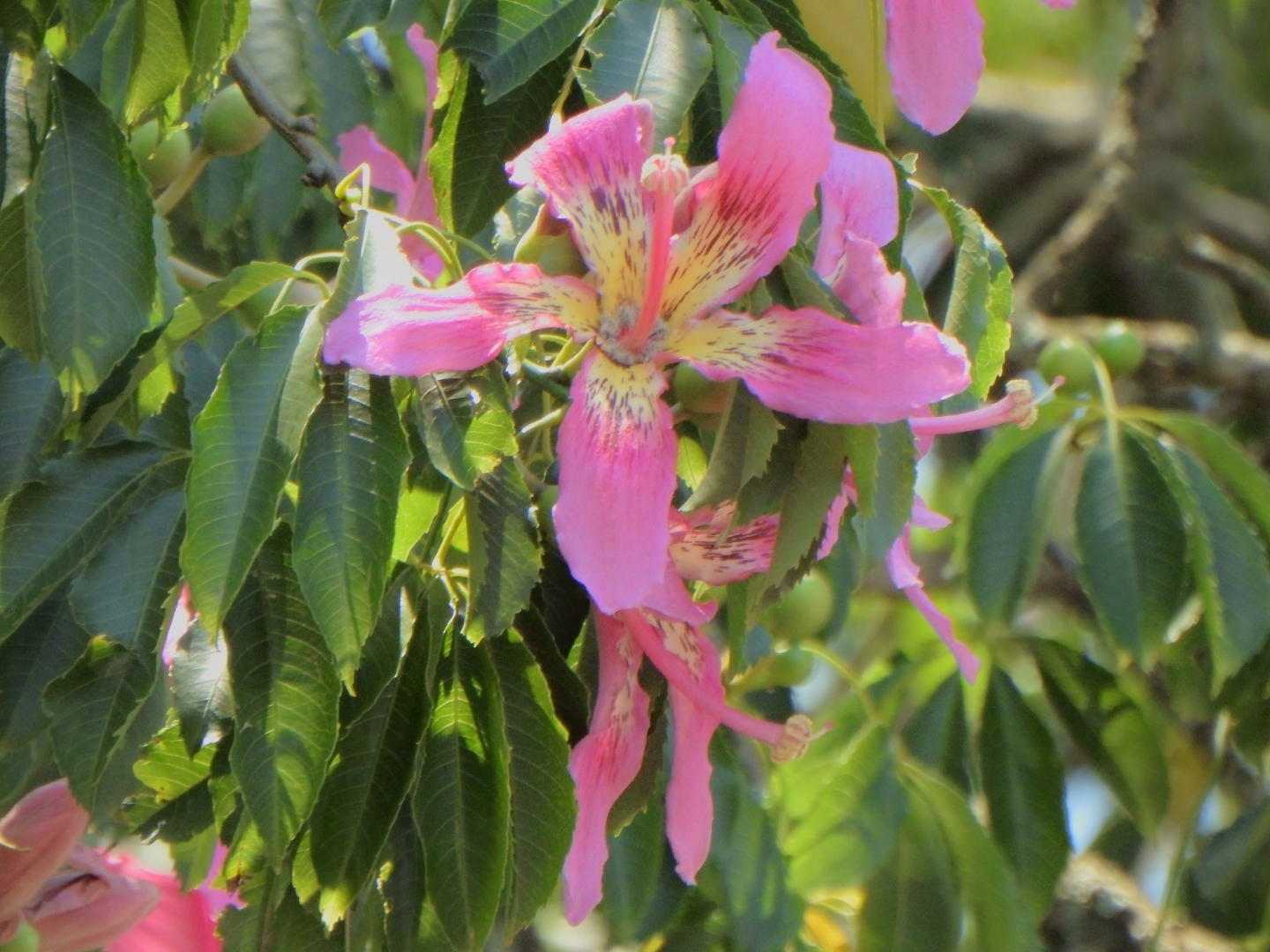
The Silk Floss Tree (Ceiba speciosa) is a large deciduous tree native to the tropical and subtropical forests of South America, including Brazil, Paraguay, and Argentina. It is easily distinguished by its green, bottle-shaped trunk covered in thick, conical thorns that store water for dry periods.
You will find this species thrives in frost-free climates such as Southern Florida, Australia, and parts of India where it is used as a specimen tree. It produces large, lily-like flowers in autumn followed by woody pods filled with a cotton-like fiber known as kapok.
Key Facts
- Light: Requires at least 6-8 hours of direct full sun
- Hardiness: Best suited for USDA zones 9b through 11
- Growth Rate: Fast, often exceeding 90 cm (3 ft) per year
- Size: Reaches heights of 15-25 m (50-80 ft) at maturity
- Water: High tolerance for drought once the root system is established
Is the Silk Floss Tree Right for Your Garden
You should only plant a Silk Floss Tree if you have a minimum of 10 meters (33 feet) of clearance from buildings, sidewalks, and underground pipes. The aggressive, wide-spreading root system can lift pavement and damage foundations as the tree matures and the trunk girth increases.
This tree is ideal for large parks or expansive residential estates where its unique silhouette can be appreciated from a distance. Because of the sharp, conical thorns that arm the trunk, avoid planting it near narrow walkways, play areas, or spots where people might accidentally brush against the bark. It requires a climate that remains above -5 °C (23 °F) to survive without significant dieback.
Identifying Silk Floss Tree Features
The Silk Floss Tree is identified by its palmate leaves containing 5 to 7 leaflets and a trunk that turns from bright green to grey as it ages. The green bark of younger trees contains chlorophyll, allowing the tree to photosynthesize even when it has dropped its leaves during the dry season.
- Trunk: Swollen, bottle-shaped base used for water storage.
- Thorns: Thick, woody, triangular spines covering the main stem and branches.
- Flowers: Five-petaled blooms measuring 10-15 cm (4-6 in) across with creamy-white centers.
- Fruit: Pear-shaped woody pods 20 cm (8 in) long that split to reveal white fluff.
- Leaves: Alternate arrangement with serrated edges on individual leaflets.
How Large Does a Silk Floss Tree Grow
A mature Silk Floss Tree typically reaches a height of 15 to 25 meters (50 to 80 feet) with a canopy spread that can equal its height. In urban environments, it often stays at the lower end of this range, but in fertile, open ground, it expands rapidly.
The trunk itself can grow to a diameter of 1-2 meters (3-6 feet) at the base. This significant bulk means you must plan for long-term space requirements. The growth rate is exceptionally fast in the first 10 years, often putting on 1 meter (3.3 feet) of height annually if provided with consistent summer moisture and full sun exposure.
Best Growing Conditions and Climate
The Silk Floss Tree requires full sun and a frost-free environment to produce its characteristic heavy autumn bloom. While it is native to South America, it has become a staple in landscapes across Southern California, Florida, and Mediterranean climates worldwide.
It is highly adaptable to various soil types, including sandy or clay-heavy soils, provided they do not hold standing water. In regions with high humidity, like Florida or coastal India, the tree grows vigorously but may be more susceptible to fungal leaf spots. In drier climates like Australia, the bottle-shaped trunk becomes more pronounced as the tree stores water to survive seasonal droughts.
How to Plant Silk Floss Tree Seeds and Saplings
You can grow a Silk Floss Tree from seed by soaking the hard black seeds in warm water for 24 hours before planting. Place them 2 cm (0.8 in) deep in a well-draining seed-starting mix and maintain a temperature of 21-25 °C (70-77 °F) for germination, which usually occurs within 2 to 6 weeks.
When transplanting nursery-grown saplings, dig a hole twice as wide as the root ball but no deeper. Ensure the flare at the base of the trunk is slightly above the soil line to prevent bark rot. Stake young trees for the first two years to protect the brittle wood from high winds until the trunk thickens and the root system anchors the plant firmly.
Watering and Feeding Your Tree
You should water young trees once a week during the first two growing seasons to ensure the root system establishes deeply. Once the tree reaches a height of 3-4 meters (10-13 feet) and develops its swollen trunk, it becomes remarkably drought-tolerant and rarely needs supplemental irrigation except during extreme heatwaves.
Apply a balanced 10-10-10 fertilizer in early spring and again in mid-summer to support the rapid growth of the canopy. Avoid high-nitrogen fertilizers in late summer, as this can encourage soft new growth that may be damaged by early winter frosts. If the tree is planted in a lawn, the fertilizer applied to the grass is usually sufficient for the tree’s needs.
When and How to Prune Ceiba speciosa
The best time to prune a Silk Floss Tree is in late winter or early spring while the tree is deciduous and the branch structure is visible. Because the wood is relatively brittle, structural pruning is necessary to remove narrow V-shaped crotches that are prone to splitting during storms.
- Safety: Always wear thick leather gloves and eye protection to guard against the sharp trunk thorns.
- Thinning: Remove crossing or rubbing branches to improve airflow through the canopy.
- Heading: Cut back overly long, lanky branches to encourage a denser, more rounded crown.
- Cleaning: Remove dead or diseased wood annually to prevent the spread of fungal pathogens.
Silk Floss Tree Pests and Leaf Issues
The most common problem for the Silk Floss Tree is root rot, caused by planting in poorly drained soil or overwatering mature specimens. If you notice the leaves turning yellow and dropping prematurely in summer, check the soil moisture levels and reduce watering immediately.
Scale insects and mealybugs occasionally infest the soft new growth and the undersides of leaves. These can be managed with neem oil or insecticidal soap, though large trees may require professional treatment. In very humid climates, leaf spot fungi can cause small brown lesions on the foliage, but this is rarely fatal and is typically managed by removing fallen leaf debris from the base of the tree.
Traditional Uses and Landscape Value
The Silk Floss Tree was traditionally used for its fibrous seed pods, which contain a silk-like material used to stuff pillows, life jackets, and mattresses. While this fiber is similar to the commercial kapok from Ceiba pentandra, it is generally considered slightly lower in quality but serves the same purpose for local insulation and padding.
In modern landscapes, it is valued primarily as an ornamental specimen for its dramatic floral display. The wood is lightweight and soft, sometimes used in the past for making paper or light crates. In South American folklore, the tree is often associated with protection and refuge, particularly the “Toborochi” name used in Bolivia which translates to “tree of refuge.”
Year-Round Silk Floss Tree Maintenance
| Spring | Apply a balanced granular fertilizer at the drip line. Monitor for new growth and check for scale insects as temperatures rise. |
|---|---|
| Summer | Water young trees deeply once a week during dry spells. Ensure mulch is 5-10 cm (2-4 in) deep but not touching the trunk bark. |
| Autumn | Enjoy the peak flowering period. Reduce watering as the tree prepares for dormancy and begins to drop its leaves. |
| Winter | Perform structural pruning while the canopy is bare. Protect young saplings if temperatures are forecasted to drop below -2 °C (28 °F). |
Common Silk Floss Tree Problems
| What you see | Likely cause | What to do |
|---|---|---|
| Yellowing leaves in summer | Poor drainage or overwatering | Reduce irrigation and ensure the soil is not compacted or waterlogged. |
| Lack of flowers | Insufficient sunlight | Ensure the tree receives at least 6 hours of direct sun; prune overhanging branches from other trees. |
| Small brown spots on leaves | Fungal leaf spot | Clear away fallen leaves and avoid overhead watering to reduce humidity in the canopy. |
| Splitting branches | Weak branch unions or wind damage | Thin the canopy in winter to reduce wind resistance and remove narrow-angled stems. |
Popular Silk Floss Tree Cultivars
- ‘Majestic Beauty’ – A cultivar known for being nearly thornless on the trunk.
- ‘Los Angeles Beautiful’ – Produces exceptionally large, deep pink flowers.
- ‘Monsa’ – A cultivar with a more upright, narrow growth habit.
- ‘White’ – A rare form featuring pure white flowers instead of pink.
Frequently Asked Questions
How long does a Silk Floss Tree live?
A healthy Silk Floss Tree can live for 60 to 100 years when grown in the correct climate and provided with ample space for its root system.
Are the thorns on a Silk Floss Tree dangerous?
Yes, the thorns are very sharp and woody, capable of puncturing skin or clothing, so the tree should be planted away from high-traffic areas.
Can you grow a Silk Floss Tree in a pot?
You can grow young trees in large containers for 3-5 years, but they eventually require planting in the ground due to their massive mature size and aggressive roots.
Why is it called a Silk Floss Tree?
The name comes from the white, cotton-like fibers that surround the seeds inside the large woody pods, which look like silk floss when the pods burst open.
Is Ceiba speciosa the same as the Kapok tree?
They are related and both produce floss, but the true Kapok is Ceiba pentandra, which grows much larger and is more strictly tropical than the Silk Floss Tree.
Sources & Verification
Taxonomy and distribution are checked against the databases below. Care guidance is written for cultivated species only and reviewed by our editor. How We Build Plant Profiles →
