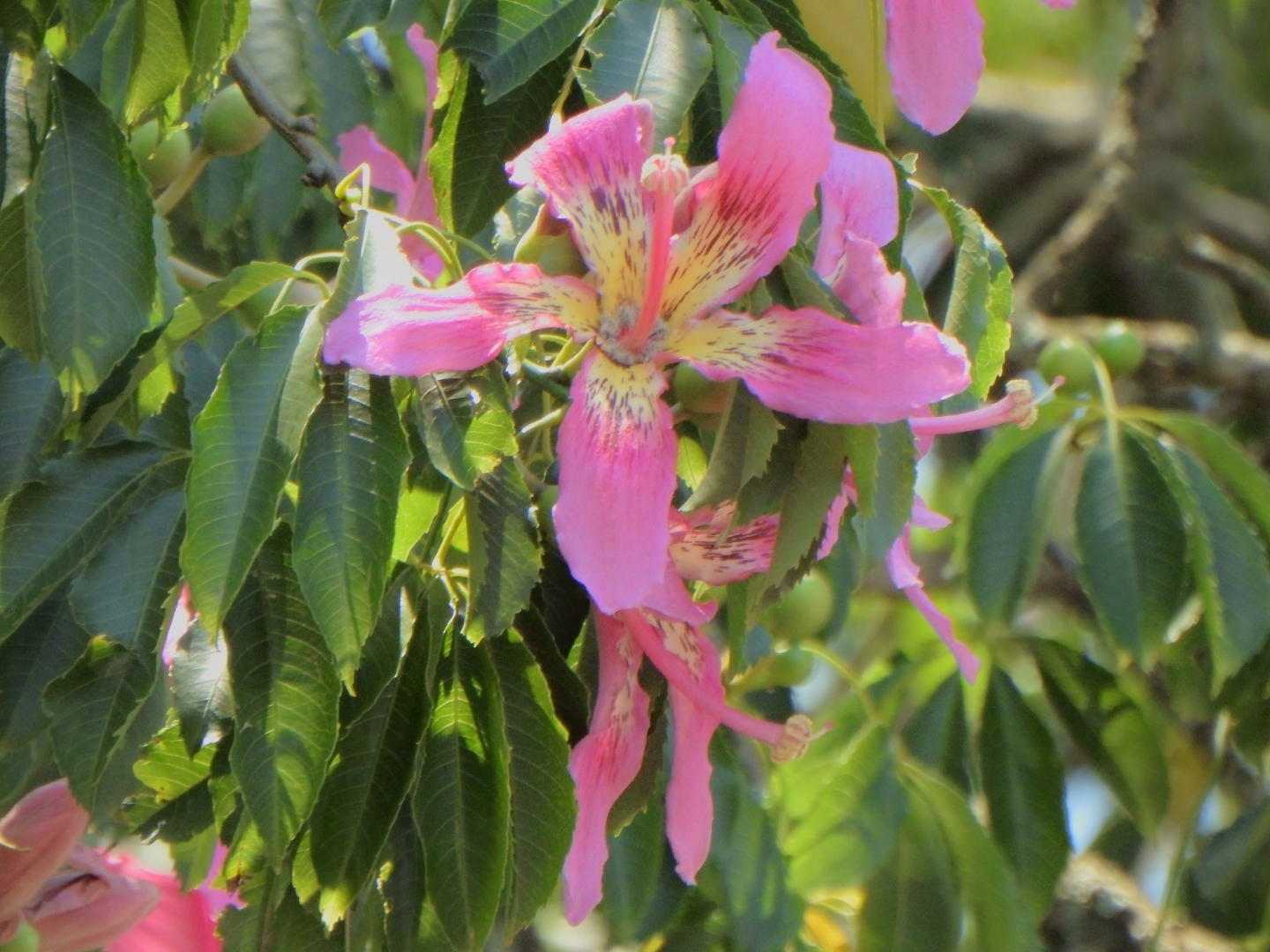
Kapok (Ceiba pentandra) is a massive deciduous canopy tree native to tropical America and West Africa, recognised for its swollen trunk, heavy buttresses, and pods lined with silky fluff.
You should only plant this species if you have broad acreage, as mature specimens exceed 30 m (100 ft) in height and produce surface roots strong enough to fracture pavement and foundations.
Key Facts
- Mature Height: 25–60 m (80–200 ft) outdoors
- Light: Full, unobstructed tropical sun
- Hardiness: USDA Zones 10b to 12
- Water: Deep soaking when young; drought-tolerant when mature
- Soil: Deep, well-draining sandy loam or clay
- Fiber: Water-resistant floss harvested from dried pods
Is the Kapok Tree Right for Your Garden?
Kapok is suitable only for large botanical parks, rural acreages, and agricultural estates due to its immense proportions. A standard urban garden or suburban boundary cannot support its invasive root architecture or wide canopy.
Young saplings grow at rates exceeding 1.5 m (5 ft) per year under warm tropical conditions, developing conical prickles that cover the trunk. In small spaces, these thorns pose a physical danger, while the dense root flares will lift paved driveways, break drainage lines, and crowd out neighboring species like royal palm (Roystonea regia) or mango (Mangifera indica).
Identifying the Kapok Tree: Bark, Leaves, and Flowers
You can identify kapok by its smooth green trunk studded with sharp, conical gray spines during its juvenile stage, which transitions to gray fissured bark with massive root buttresses as it ages.
The foliage is palmately compound, consisting of 5 to 9 lanceolate leaflets arranged in a star pattern, each leaf measuring 10–20 cm (4–8 in) long. The flowers emerge on bare branches in late winter before the leaf flush:
- Flower structure: Five creamy-white or pale pink petals measuring 3–4 cm (1.2–1.6 in) long with prominent, protruding stamens.
- Scent: Strong, musty, nocturnal fragrance designed to attract fruit bats.
- Fruit pod: Oblong, woody capsule 10–26 cm (4–10 in) long, filled with downy, yellowish-white cottony floss and dark brown seeds.
Kapok Tree Mature Size and Root Architecture
In cultivation, kapok reaches a typical height of 25 to 40 m (80 to 130 ft), while wild emergent specimens in Amazonian rain forests can exceed 60 m (200 ft). The horizontal canopy often extends 20 to 35 m (65 to 115 ft) in spread.
The root system is famous for developing plank-like buttress roots that flare up to 3 to 9 m (10 to 30 ft) outward from the central trunk. These roots stay near the soil surface to anchor the colossal crown against tropical storms. Plant this tree no closer than 20 m (65 ft) to any house, swimming pool, septic tank, or underground utility.
Choosing the Best Site for Planting
Plant kapok in an open position that receives at least 8 hours of direct, unfiltered sunlight daily. Specimens placed in shade will lean aggressively toward light gaps, creating hazardous structural imbalances as the trunk widens.
The tree thrives in deep, fertile soils ranging from alluvial silts to porous volcanic loams. It tolerates seasonal soil saturation during tropical monsoon cycles, but the ground must dry between deluges; constant standing water causes seedling collar rot. Avoid shallow limestone shelves where taproots cannot gain purchase.
How to Plant a Kapok Tree and Grow from Seed
The most reliable method to propagate kapok is by soaking fresh seeds in warm water (40 °C / 104 °F) for 24 hours before planting them 1 cm (0.4 in) deep in warm soil.
Seeds germinate within 7 to 14 days when kept at 25–30 °C (77–86 °F). To establish your seedling:
- Pot seedlings into deep taproot containers containing a mix of equal parts coarse sand and compost.
- Dig a planting hole twice as wide as the root mass when the sapling reaches 45 cm (18 in) tall.
- Backfill with native soil without adding synthetic chemical fertilizers directly into the root zone.
- Water with 20 L (5 gal) of water immediately after backfilling to eliminate air pockets.
Kapok Tree Care: Water and Fertilizer Schedule
Young saplings need weekly deep irrigations during dry spells for their first three years, after which established trees rely entirely on rainfall. Once rooted deeply, kapok tolerates several months of complete winter drought.
Feed saplings once in spring and once in midsummer using a balanced granular fertilizer (such as 10-10-10) applied at 100 g (3.5 oz) per tree, distributed evenly along the drip line. Cease fertilizing by the fourth year; excessive feeding accelerates wood growth without adding density, making the giant branches prone to wind damage.
Pruning and Structural Training
Train kapok during its first five years by maintaining a single dominant central leader and pruning out competing secondary trunks. Never top or pollard an established tree, as the resulting water sprouts form weakly attached limbs that break under their own weight.
Inspect the scaffolding branches annually in late autumn. Remove branches that show narrow crotch angles or bark inclusions, as well as dead wood shed during dry-season dormancy. Always sterilise large pruning saws with 70% isopropyl alcohol between cuts to prevent fungal wood cankers.
Cold Tolerance and Winter Protection
Kapok survives temperatures down to 0 °C (32 °F) for only brief hours, and young branches suffer severe tip dieback below 4 °C (40 °F). It is strictly limited to frost-free regions in USDA Zones 10b through 12.
In subtropical winters, the tree naturally drops its leaves as temperatures dip and rainfall declines. Do not increase watering to revive shedding foliage during cool months; cold, soggy soil will kill the fine feeder roots. If light frosts threaten a small sapling, wrap the trunk in horticultural fleece and mulch the base with 10 cm (4 in) of wood chips.
Common Pests and Structural Problems
The primary threat to mature kapok trees is branch shear and wind throw caused by internal heart rot, rather than leaf-eating insects. Weakened branch unions break easily during severe squalls.
Watch for these common issues:
- Damping off: Fungal pathogens collapse tender seedlings kept in wet, cold potting media.
- Termites: Subterranean colonies invade hollowed central trunks through unhealed pruning scars.
- Limb drop: Sudden branch loss occurs during extended dry spells as the tree sheds mass to conserve moisture.
- Spider mites: Sap-sucking colonies turn foliage dull bronze during dry, hot container culture.
Kapok Fiber Harvest and Uses
The seed pods produce kapok fiber, an exceptionally lightweight, water-repellent, buoyant cellulose material that has historically been stuffed into life jackets, pillows, and thermal mattresses.
Unlike cotton from Gossypium hirsutum, kapok floss cannot easily be spun into yarn because its smooth, hollow fibers lack tensile grip; it is instead blended or used as raw loft fill. Traditional medicine documented in West Africa and Central America used decoctions of the astringent bark and young leaves to soothe coughs and skin inflammation. Woodcarvers harvest the soft, lightweight wood for making dugout canoes and lightweight crates, similar to balsa (Ochroma pyramidale).
Kapok Tree Seasonal Care Schedule
| Spring | Apply a balanced organic fertilizer around the drip line of young trees. Check for emerging leaf buds and clear weeds within 1 m (3 ft) of the trunk. |
|---|---|
| Summer | Soak young saplings deeply every 10–14 days if rainfall falls below 25 mm (1 in) per week. Inspect foliage for spider mite webbing during dry, hot weather. |
| Autumn | Prune out dead, damaged, or crossing branches before seasonal winds begin. Reduce irrigation gradually as the tree prepares for winter leaf drop. |
| Winter | Halt all fertilizer applications and reduce water. Collect fallen seed pods from the ground once they split open to harvest the raw kapok floss. |
Kapok Health and Structural Issues
| What you see | Likely cause | What to do |
|---|---|---|
| Seedlings rotting and falling over at soil line | Fungal damping-off from cold, wet soil | Use sterile seed-starting mix, ensure drainage, and keep ambient temperature above 24 °C (75 °F). |
| Total leaf drop in late winter | Natural deciduous dormancy triggered by dry or cool weather | Withhold extra water and wait for new growth to push as temperatures rise in spring. |
| Yellowing leaves with fine webbing on undersides | Spider mite infestation during dry heat | Spray the foliage with strong water jets or treat with insecticidal soap. |
| Large branches splitting at trunk unions | Poor branch crotch angle under excessive limb weight | Thin outer canopy growth and remove competing secondary leaders when the tree is young. |
Frequently Asked Questions
What is kapok fiber used for?
Kapok fiber is used as natural, hypoallergenic stuffing for pillows, mattresses, and life vests because it is lightweight, hollow, and eight times more buoyant than cork. It resists water and clumping, though it cannot be spun easily into fabric without blending.
How do you grow a kapok tree from seed?
Soak seeds in warm water for 24 hours, then sow them 1 cm (0.4 in) deep in moist, sandy seed mix kept at 25–30 °C (77–86 °F). Seedlings germinate in roughly one to two weeks in bright, indirect light.
What is the cultural meaning of the kapok tree?
In ancient Maya cosmology, the kapok tree (known as the Yaxche) was revered as the sacred World Tree connecting the underworld, terrestrial realm, and heavens. Similar spiritual reverence exists in traditional West African folklore, where massive trees are protected as village gathering sanctuaries.
Are kapok pillows safe and beneficial?
Kapok pillows are non-toxic, chemical-free, and naturally dust-mite resistant, providing breathable support comparable to down feathers. However, handling raw, uncarded kapok fiber can release fine airborne lint that causes temporary respiratory irritation in sensitive individuals.
Can you grow kapok in a container or indoors?
Kapok can only be grown in a pot for its first two years as an indoor curiosity. Its fast taproot quickly binds in containers, and the tree must either be planted into open ground in a frost-free zone or trained heavily as a bonsai.
Information about traditional or historical uses is provided for educational interest only and is not medical advice. Do not use any plant to treat a condition without speaking to a qualified professional.
Sources & Verification
Taxonomy and distribution are checked against the databases below. Care guidance is written for cultivated species only and reviewed by our editor. How We Build Plant Profiles →