
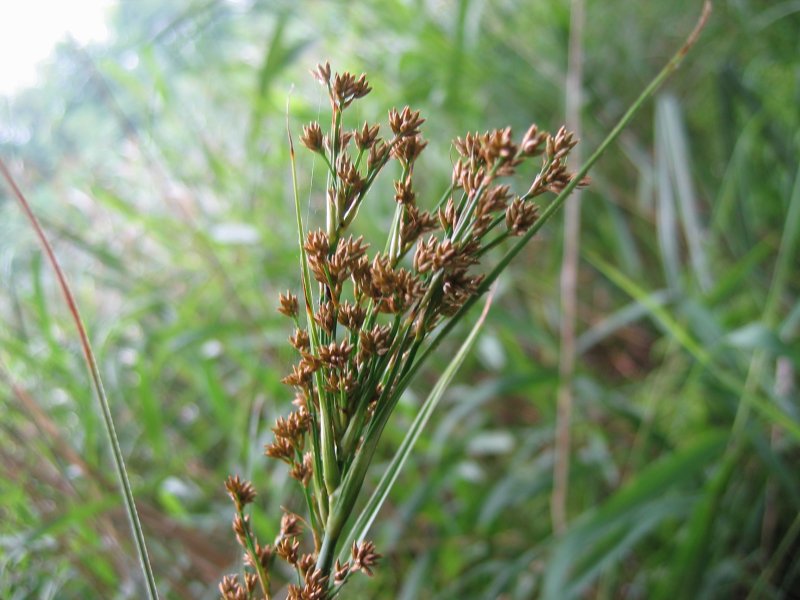
Great fen-sedge (Cladium mariscus) is a tall perennial sedge in the Cyperaceae family native to alkaline fens and lake margins across Europe, Asia, and North Africa.
Its leaves possess razor-sharp serrated margins capable of inflicting deep lacerations on unprotected skin. Reaching heights of 2.5 m (8 ft 2 in), it forms dense monospecific beds that trap organic sediment and drive wetland peat accumulation.
Key Facts
- Plant Type: Evergreen perennial sedge
- Height: 1.5–2.5 m (5–8 ft)
- Habitat: Calcium-rich fens and lake margins
- Leaf Feature: Sharply serrated saw-like leaf margins
- Native Range: Europe, temperate Asia, North Africa
- Soil pH: 7.0–8.5 (alkaline to neutral)
Where Great Fen-Sedge Fits in Wetland Ecosystems
Great fen-sedge acts as a late-successional dominant species in calcium-rich wetland habitats, forming expansive monospecific beds known as Cladieta.
Because its tough, silica-rich foliage decays slowly, dead leaves accumulate to build thick peat layers in calcareous fens. This accumulation alters water flow and raises the ground level over decades, paving the way for wet woodland scrub. In alkaline fens, few other species can outcompete its subterranean creeping rhizomes once established.
How to Identify Cladium mariscus
You can identify Cladium mariscus by its stiff, keeled V-shaped leaves with razor-sharp downward-facing serrations along the margins and central midrib.
The flowering stems are rounded, hollow, and grow up to 2.5 m (8 ft 2 in) tall, ending in a panicle of dense, dark brown spikelets from June to August. Unlike true grasses, sedges have solid or chambered stems, and fen sedge features large leafy bracts beneath its branched flower cluster.
- Leaves: Grey-green, 1–2 m (3–6 ft) long, 7–15 mm wide, with forward-pointing microscopic teeth.
- Stems: Stout, cylindrical, 10–25 mm thick at the base, reaching 2.5 m in height.
- Inflorescence: Repeatedly branched panicle 30–50 cm (12–20 in) long with clusters of 2–3 mm brown spikelets.
- Fruit: Shiny, egg-shaped brown achene 3 mm long with a pointed tip.
Great Fen-Sedge Natural Habitat and Requirements
Great fen-sedge requires perennially saturated, lime-rich peat or silt with high calcium bicarbonate levels and stable water tables.
It colonizes shallow margins of marl lakes, base-rich fens, and spring-fed mires where water depth fluctuates between 10 cm (4 in) above ground to 20 cm (8 in) below ground level. It demands full sun exposure and fails to flower or set seed when shaded by encroaching trees.
The substrate must maintain a pH of 7.0 to 8.5. Acidic peat bogs inhibit root elongation, restricting the species exclusively to mineral-rich fenland systems.
Ecological Role and Wildlife Value of Saw Sedge
Saw sedge beds provide essential nesting shelter and winter cover for specialized wetland insects, birds, and amphibians.
Dense stand architecture protects rare fen fauna from predators and wind, creating a sheltered microclimate near the water line. Old leaf bases hold standing water, supporting aquatic larvae and specialized invertebrates throughout dry spells.
- Insects: Serves as a primary larval shelter in European fens for specialized invertebrates.
- Birds: Provides nesting cover for Eurasian bitterns (Botaurus stellaris) and marsh harriers (Circus aeruginosus).
- Orthoptera: Inhabited by wetland crickets such as the short-winged conehead (Conocephalus dorsalis).
Conservation Status and European Distribution
Globally ranked as Least Concern (LC) on the IUCN Red List, great fen-sedge is nevertheless threatened locally across Western Europe due to drainage and fen neglect.
In Great Britain, historical draining of the Fenland basin reduced its range by over 80 percent since the 17th century. Traditional fen management through summer cutting on a 3- to 5-year rotation prevents scrub invasion and maintains open saw-sedge communities.
Abandonment of traditional harvesting allows grey willow (Salix cinerea) to invade, shading out low-growing fen flora and drying the peat surface.
Historical Uses of Saw Sedge
Historically, rural communities harvested saw sedge as a premium ridge-thatching material that lasted up to 25 years on cottage roofs.
Workers cut the tough stems in winter using long-handled scythes while wearing thick leather gloves to avoid lacerations from leaf serrations. The cut sedge was tied into bundles called shofts and dried before application to roof ridges where flexibility was required.
In eastern England, harvesters also used dried leaves as fuel for bread ovens because the high silica content produced intense, rapid heat without excessive smoke.
Similar Sedge Species and Lookalikes
Great fen-sedge is distinguished from lookalikes by its serrated leaf edges, cylindrical stems, and 2.5 m stature, which surpass most native temperate sedges.
While sharing wetland habitats with several large graminoids, close inspection reveals clear structural differences in leaf margins, stem cross-sections, and inflorescence shape.
- Common reed (Phragmites australis): Has round hollow stems with smooth-edged flat leaves and feathery purple-brown seed plumes.
- Everglades sawgrass (Cladium jamaicense): A closely related American taxon often classified as Cladium mariscus ssp. jamaicense, featuring wider leaves and larger panicles in subtropical wetlands.
- Greater tussock-sedge (Carex paniculata): Forms dense raised hummocks with three-angled stems and smooth leaf undersides under 1.5 m tall.
- Broadleaf cattail (Typha latifolia): Possesses spongy, smooth leaves and distinct cylindrical brown flower spikes rather than branched panicles.
Frequently Asked Questions
What is the common name for Cladium mariscus?
The primary common name for Cladium mariscus is Great Fen-Sedge, though it is also widely known as saw-sedge, swamp sawgrass, or fen sedge.
Where is Sedge Fen?
Sedge Fen is a rural hamlet and wetland area in Suffolk, England, located near Lakenheath, Brandon, and Mildenhall within the historic Fenland basin named after its native beds of Cladium mariscus.
How does Cladium mariscus differ from Cladium mariscus ssp. jamaicense?
Cladium mariscus ssp. jamaicense (or Cladium jamaicense) is the American subspecies that dominates the Florida Everglades, growing in warm subtropical climates compared to the temperate Eurasian nominate species.
What are the historical uses of Cladium mariscus?
Harvested saw-sedge was traditionally used as durable roofing thatch for ridge caps on buildings and as quick-burning fuel for bakery ovens due to its high silica content.
What insects live in fen sedge beds?
Fen sedge beds support specialized wetland insects including the short-winged conehead cricket (Conocephalus dorsalis) and provide larval shelter for fen butterflies.
Sources & Verification
Taxonomy and distribution are checked against the databases below. Care guidance is written for cultivated species only and reviewed by our editor. How We Build Plant Profiles →