
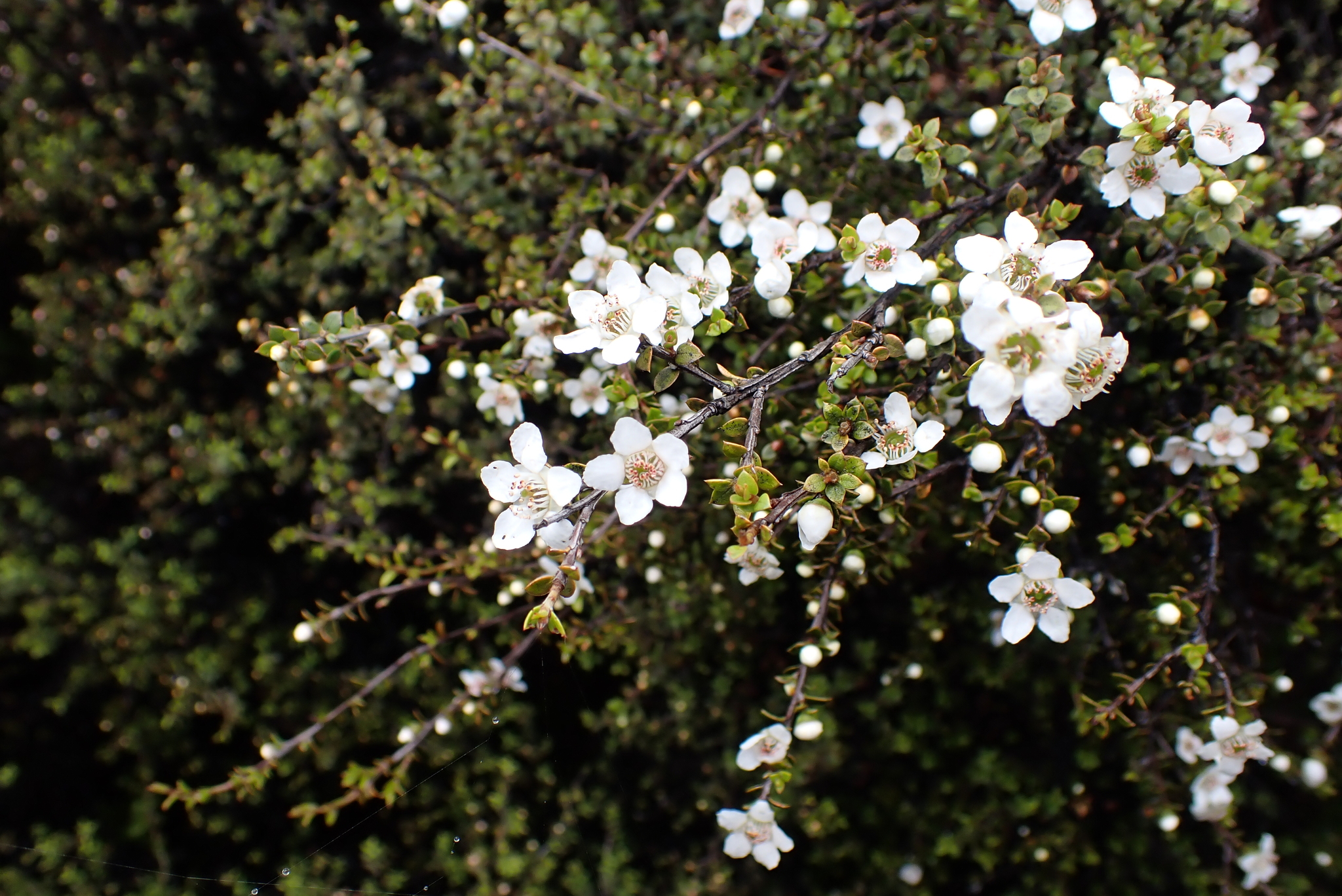
Manuka (Leptospermum scoparium) is an evergreen shrub or small tree native to New Zealand and southeastern Australia. It forms a dense canopy of aromatic, narrow foliage and produces profuse five-petaled white, pink, or red blooms in late spring.
Root systems fail rapidly if soil dries out completely, making moisture consistency critical during summer spells. Honeybees forage its nectar to create unique manuka honey containing high levels of methylglyoxal.
Key Facts
- Light: Full sun to light partial shade
- Water: Consistent moisture in well-drained acidic soil
- Hardiness: USDA zones 9 to 11 (tolerates -5 °C)
- Height: 2 to 4 m (6.5 to 13 ft)
- Bloom time: Late spring to mid-summer
Is Manuka Right for Your Garden
Manuka grows best in mild coastal or warm temperate landscapes within USDA zones 9 through 11 where temperatures remain above -5 °C (23 °F). It suits gardeners who can maintain steady soil humidity without allowing standing water around the roots.
This shrub offers reliable drought tolerance once established in ground soil, but container specimens require regular attention. It fits well in Mediterranean beds alongside companion species such as common myrtle (Myrtus communis) and bottle brush (Callistemon citrinus).
- Requires 6 or more hours of sun daily for heavy flowering
- Thrives in acidic soil with a pH of 5.0 to 6.5
- Resists coastal salt winds along shorelines
Identifying Manuka Plants
You can identify Manuka by its sharp, lance-shaped leaves measuring 7 to 20 mm (0.28 to 0.79 in) long that release an aromatic tea scent when crushed. The bark is light brown and sheds in long, thin papery strips along woody stems.
Solitary flowers measure 8 to 15 mm (0.31 to 0.59 in) in diameter, featuring five rounded petals surrounding a dark central disc. Seed capsules are woody, reddish-brown, five-valved domes that remain attached to branches for years.
- Foliage: Evergreen, dark green or bronzed, prickly tips
- Flowers: Single or double, white, pale pink, or crimson
- Similar species: Kanuka (Kunzea ericoides) has soft, non-prickly leaves and smaller flowers
Mature Height and Growth Rate
Unpruned Manuka grows to a mature height of 2 to 4 m (6.5 to 13 ft) with a canopy spread of 1.5 to 3 m (5 to 10 ft). Dwarf cultivars stay under 1 m (3.3 ft), whereas wild New Zealand specimens occasionally reach 8 m (26 ft).
In favorable conditions with acidic soil, branches lengthen by 20 to 40 cm (8 to 16 in) per season. Growth slows significantly in heavy clay soils or cold inland regions.
Where to Plant Manuka
Select a site that receives full direct sunlight for 6 to 8 hours daily to ensure heavy blooming and strong stem structure. Shaded locations reduce flower density and increase vulnerability to powdery mildew.
Position plants away from low-lying frost pockets. Manuka adapts well to sloping ground, raised beds, or coastal rock gardens where drainage is swift.
- Avoid heavy clay that retains standing water in winter
- Provide shelter from dry, freezing winter winds
- Space 1.5 to 2 m (5 to 6.5 ft) from structures for air circulation
How to Plant Manuka Shrubs
Plant young shrubs in early autumn or mid-spring when soil temperatures range between 12 and 18 °C (54 and 64 °F). Dig a hole twice as wide as the root ball and equal in depth.
Mix eroded peat or pine bark into alkaline soils to lower pH before backfilling. Water thoroughly with 10 liters (2.6 gal) immediately after planting to eliminate air pockets around fine feeder roots.
- Keep root crown level with surrounding soil surface
- Apply a 5 cm (2 in) mulch layer of leaf mold or pine needles
- Avoid disturbing root balls during transplanting
Watering and Soil Care for Manuka
Water young plants weekly during their first summer, giving 5 to 8 liters (1.3 to 2.1 gal) per shrub whenever rainfall drops below 25 mm (1 in) per week. Established shrubs require supplemental water only during dry heat waves above 30 °C (86 °F).
Feed in early spring using a low-phosphorus fertilizer designed for Australian and New Zealand native species. Excessive nitrogen suppresses flower formation and causes weak, leggy stems.
Pruning Manuka Shrubs
Prune Manuka lightly in late spring immediately after flowers fade, removing no more than 20 to 30 percent of new green growth. Never cut back into old grey wood, as bare wood lacks dormant buds and will not regrow.
Tip-pinch young plants in autumn to promote dense branching. Remove dead or crossed stems annually to allow sunlight into the center of the canopy.
Manuka Pests and Diseases
Scale insects and sooty mold are the most common maintenance issues affecting Manuka plants. Root rot fungi (Phytophthora) attack specimens kept in waterlogged soil during winter months.
Inspect leaf axils regularly for scale insects that secrete sticky honeydew. Treat infestations with horticultural oil or insecticidal soap before mold forms.
- Scale insects: Small brown bumps on stems; spray with neem oil
- Root rot: Yellowing leaves and stem dieback; improve drainage
- Yellow foliage: Iron chlorosis from soil pH above 7.0; apply chelated iron
Winter Care for Manuka Plants
Protect plants with fleece or hessian wrap when temperatures drop below -5 °C (23 °F) for consecutive nights. Container-grown shrubs should be moved into an unheated greenhouse or porch kept between 2 and 8 °C (36 and 46 °F).
Reduce watering in winter, allowing top soil to dry slightly while keeping the root ball barely damp. Avoid winter fertilization completely until new shoots emerge in spring.
Honey Production and Traditional Uses of Manuka
Honeybees forage nectar from Manuka blossoms during a brief 2 to 6 week blooming window each summer. The resulting honey contains high concentrations of methylglyoxal (MGO), giving it distinct antibacterial qualities documented in medical research.
Historically, Maori communities used boiled leaves and bark in topical preparations. Today, specialized medical-grade manuka honey is incorporated into sterile wound dressings and skin care creams for minor cuts and burns.
- Leaves were brewed as a tea substitute by early European settlers
- Wood was traditionally crafted into tools and paddles
- Honey is graded by MGO rating or Unique Manuka Factor (UMF)
Manuka Through the Seasons
| Spring | Apply a low-phosphorus native plant fertilizer in early spring. Check for scale insects on new growth and maintain consistent soil moisture as temperatures rise. |
|---|---|
| Summer | Prune light branch ends by 20 percent immediately after flowering finishes. Water container shrubs daily during hot weather above 28 °C (82 °F). |
| Autumn | Apply a fresh 5 cm (2 in) mulch layer of acid-rich organic matter over the root zone. Reduce irrigation frequency as growth slows down. |
| Winter | Protect outdoor shrubs from hard frosts below -5 °C (23 °F) using horticultural fleece. Keep potted plants frost-free in a cold frame or cool porch. |
Common Manuka Plant Problems Explained
| What you see | Likely cause | What to do |
|---|---|---|
| Yellowing leaves with green veins | High soil pH causing iron chlorosis | Drench soil with chelated iron and apply elemental sulfur to lower soil pH below 6.5. |
| Black coating on stems and leaves | Sooty mold growing on scale insect honeydew | Spray stems with horticultural soap to eliminate scale insects, then wash foliage with soft water. |
| Sudden wilting and stem dieback | Phytophthora root rot from excess soil water | Stop watering, improve surrounding soil drainage, or relocate the plant to raised soil. |
| Sparse flowering and leggy branches | Insufficient sunlight or high nitrogen fertilizer | Move plant to a full sun site and switch to low-phosphorus fertilizer. |
Popular Manuka Cultivars to Grow
- ‘Red Damask’ – double crimson-red flowers, dark reddish foliage
- ‘Apple Blossom’ – double soft-pink blossoms with dark centers
- ‘Kiwi’ – dwarf compact growth under 1 m (3.3 ft), deep pink flowers
- ‘Keatleyi’ – large single pale pink flowers up to 20 mm wide
- ‘Snow Flurry’ – double white flowers on upright woody stems
Frequently Asked Questions
What makes manuka honey different from standard honey?
Manuka honey is derived from the nectar of Leptospermum scoparium and contains high natural levels of methylglyoxal (MGO). This organic compound gives the honey enhanced antibacterial properties compared to standard floral honeys.
How do you care for a manuka plant in a pot?
Keep potted manuka in full sun and water as soon as the top 2 cm (0.8 in) of potting soil dries. Use an acidic ericaceous potting mix and fertilize lightly in spring with a low-phosphorus formula.
Is manuka toxic to dogs or cats?
Manuka foliage, flowers, and honey are non-toxic to dogs and cats. However, essential oils distilled from the plant should not be applied directly to pets' skin.
How hard can you prune manuka?
Prune manuka lightly by trimming current season green shoots right after flowering. Never cut into old bare wood, because hard wood will not produce new buds.
How is manuka used in skin care?
Medical-grade manuka honey is incorporated into skin care creams and hydrogel wound dressings to moisturize tissue and help support clean recovery of minor abrasions.
Information about traditional or historical uses is provided for educational interest only and is not medical advice. Do not use any plant to treat a condition without speaking to a qualified professional.
Sources & Verification
Taxonomy and distribution are checked against the databases below. Care guidance is written for cultivated species only and reviewed by our editor. How We Build Plant Profiles →