
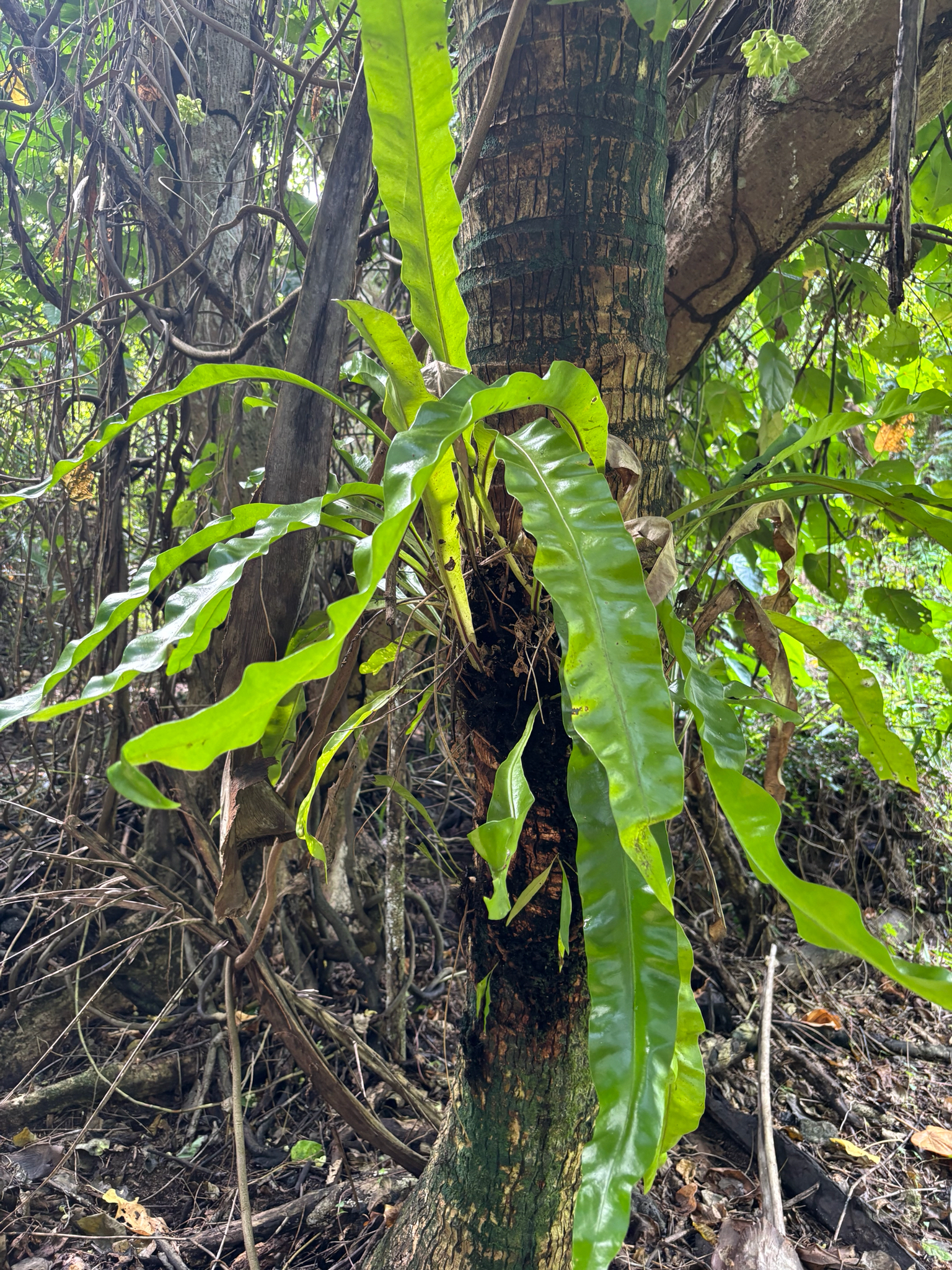
Climbing bird’s nest fern (Microsorum punctatum) is an epiphytic tropical fern native to rainforest habitats across tropical Africa, Asia, Australia, and the Pacific Islands. It anchors to tree trunks and rock faces using creeping rhizomes while sending up leathery, arching fronds.
In home collection environments, this species demands high air humidity and a loose, fast-draining bark mix to prevent root rot. Direct sunlight scorches the foliage rapidly, so position it in steady diffused light.
Key Facts
- Light: Bright indirect light or diffused shade
- Water: Water when top 2.5 cm (1 in) dries
- Humidity: 50% to 80% relative humidity
- Temperature: 18-28 °C (65-82 °F)
- Substrate: Epiphytic orchid bark mix, pH 5.5-6.5
- Toxicity: Non-toxic to cats, dogs, and humans
Is Climbing Bird’s Nest Fern Right for Your Space?
Climbing bird’s nest fern suits indoor spaces with warmth above 15 °C (59 °F) and humidity near 50% or higher. Bathrooms with bright windows, warm plant cabinets, and shaded sunrooms offer ideal living conditions for this epiphytic fern.
Unlike ground-dwelling ferns that rot in heavy soils, this species grows naturally attached to trees. It tolerates brief dry spells better than thin-leaved ferns due to its thick, fibrous leaf tissue.
- Fits warm spaces maintaining 18-28 °C (65-82 °F) year-round
- Requires a chunky bark substrate rather than standard potting dirt
- Prefers medium to bright indirect window lighting
How to Identify Microsorum punctatum
Microsorum punctatum produces erect, leathery fronds measuring 30-100 cm (12-40 in) long and 3-8 cm (1.2-3.1 in) wide from a creeping, scaly rhizome. The species form features simple, strap-shaped fronds with smooth margins and dark green surfaces.
Spores develop on the underside of mature upper fronds, forming small, round, reddish-brown dots called sori. Cultivars like ‘Grandiceps’ (commonly sold as Mermaid Tail or Dragon’s Wing) display heavily branched frond tips that split into crested, fan-shaped ends.
- Rhizome: short-creeping, covered in dark brown scales
- Fronds: stiff, oblanceolate or strap-like, glossy dark green
- Sori: tiny dots scattered randomly across the upper leaf underside
- Cultivars: crested fronds (‘Grandiceps’), ruffled edges (‘Green Flame’, ‘Serratum’)
How Much Light Does Microsorum punctatum Need?
Provide 1,000-2,500 lux of bright, indirect sunlight daily for healthy frond development. Position the plant 1-2 m (3-6 ft) away from an east- or west-facing window protected by a sheer curtain.
Direct summer sunlight causes irreversible brown scorch marks across the glossy foliage. Extended low light halts rhizome growth and causes new fronds to emerge thin, pale, and weak.
- East window: ideal morning sun with bright indirect ambient light
- South window: place 2 m (6 ft) back or use sheer screening
- North window: supplemental LED grow lights needed in winter
How Often to Water Climbing Bird’s Nest Fern
Water climbing bird’s nest fern when the top 2.5 cm (1 in) of the potting medium feels dry. Saturate the medium thoroughly until water drains freely from the base of the pot, then empty the drainage saucer.
Use room-temperature rain water, distilled water, or filtered water. Tap water rich in chlorine, fluoride, or calcium causes leaf margin necrosis and white crusting along the rhizome bark.
- Spring and summer: water roughly every 5-7 days
- Autumn and winter: extend interval to every 10-14 days
- Always discard standing saucer water after 15 minutes
The Best Soil Mix for Strapleaf Ferns
Plant in a chunky epiphytic potting mix formulated with coarse orchid bark, perlite, and coarse peat moss at a 2:1:1 ratio. Maintain a slightly acidic substrate pH between 5.5 and 6.5.
Standard potting soils pack down around the roots, excluding oxygen and triggering fungal root rot within weeks. Incorporating 10% horticultural charcoal keeps the root zone fresh and prevents souring.
- 50% fine to medium pine or fir orchid bark
- 25% perlite or pumice for aeration
- 15% sphagnum peat moss or coarse coco coir
- 10% horticultural charcoal chunks
Meeting Humidity and Temperature Needs
Maintain relative humidity levels between 50% and 80% and indoor temperatures between 18 °C and 28 °C (65-82 °F). Nighttime temperatures should not drop below 12 °C (54 °F).
Dry air below 40% humidity causes the tips of the fronds to dry out, curl, and turn brittle. Running a cool-mist humidifier nearby prevents foliage browning during indoor winter heating periods.
- Target humidity: 60% ambient relative humidity
- Minimum winter temperature: 12 °C (54 °F)
- Keep away from cold air drafts and radiator blowers
How and When to Fertilize Fishtail Fern
Feed every 4 weeks from April through September using a liquid houseplant fertilizer diluted to half strength (NPK 10-10-10). Pause all feeding during late autumn and winter when growth slows.
Salt accumulation from concentrated synthetic fertilizers burns sensitive epiphytic roots. Flush the pot with clear water every third watering to wash away excess mineral deposits.
- Frequency: monthly during active spring/summer growth
- Dilution: half of the manufacturer’s recommended dose
- Winter feeding: none required from October through March
How to Propagate Climbing Bird’s Nest Fern
Propagate climbing bird’s nest fern by dividing the creeping rhizome during spring repotting. Ensure each divided section contains at least 2-3 healthy fronds and a cluster of viable fibrous roots.
Cut the rhizome cleanly using a sharp, sterilized knife. Mount the division onto a piece of tree-fern fiber or pot it directly into fresh orchid bark mix, keeping it warm at 22-25 °C (72-77 °F) until new roots anchor.
- Division season: early spring (March to May)
- Minimum cut size: 5-8 cm (2-3 in) rhizome with active growth points
- Settling environment: warm, shaded space with high humidity
Troubleshooting Common Frond and Root Issues
Yellowing lower fronds paired with soft rhizomes indicate overwatering and poor root drainage. Cut back on watering immediately and inspect the roots for dark brown decay.
Brown frond tips suggest low air humidity or hard mineral buildup from tap water. Scale insects and mealybugs occasionally settle along the central frond vein; remove them manually with a cotton swab dipped in 70% isopropyl alcohol.
- Brown brittle tips: air humidity under 45% or tap water salts
- Yellow drooping fronds: saturated soil mix and root suffocation
- Browning frond bases: crown rot from overhead watering
- White cottony spots: mealybug infestation on under-leaves
Is Climbing Bird’s Nest Fern Safe for Pets?
Microsorum punctatum is non-toxic to dogs, cats, and horses according to ASPCA safety standards. Ingesting large quantities of plant material may still cause mild stomach upset in curious pets.
Place pots out of reach or hang fronds high in plant baskets to prevent pets from chewing the long, strap-shaped foliage. Non-toxic status applies across cultivars including ‘Grandiceps’ and ‘Green Flame’.
- ASPCA toxic status: safe / non-toxic
- Human toxicity: non-toxic to children and adults
- Action if chewed: provide fresh water and observe pet
Year-Round Care for Climbing Bird’s Nest Fern
| Spring | Repot dense plants using fresh epiphytic bark mix. Resume monthly half-strength fertilizer applications as new fronds emerge from the rhizome. |
|---|---|
| Summer | Check moisture levels every 5 days. Shield fronds from direct sunlight and keep room humidity near 60% with a humidifier or pebble tray. |
| Autumn | Reduce watering frequency as daylight hours decrease. Cease fertilizer applications by late October and check leaves for scale insects. |
| Winter | Keep temperatures above 15 °C (59 °F). Water only when top 3 cm (1.2 in) of mix dries, and move plant away from cold window glass and heaters. |
Climbing Bird’s Nest Fern Troubleshooting Guide
| What you see | Likely cause | What to do |
|---|---|---|
| Brown dry tips on frond edges | Low humidity or high mineral content in tap water | Switch to distilled or rain water and raise humidity above 50%. |
| Yellowing fronds and mushy rhizome | Overwatering or waterlogged soil mix | Repot into a chunky orchid bark substrate and allow top soil to dry before watering. |
| Bleached, pale, or crispy dry patches | Excessive direct sunlight exposure | Move plant to a location receiving diffused, indirect light. |
| Sticky sap and brown bumps on veins | Scale insect infestation | Wipe fronds clean with isopropyl alcohol and treat with horticultural oil. |
Popular Cultivars of Microsorum punctatum
- ‘Grandiceps’ – crested frond tips splitting like a mermaid tail or dragon wing
- ‘Green Flame’ – compact growth habit with ruffled, upright fronds
- ‘Serratum’ – fronds displaying jagged, cut margins along the foliage
- ‘Variegated’ – rare form featuring cream and pale yellow foliage streaking
Frequently Asked Questions
What is the common name for Microsorum punctatum?
The primary common name is climbing bird's nest fern. It is also frequently sold as fishtail fern, strapleaf fern, or wart fern depending on the variety.
What does Microsorum punctatum L Copel mean?
It represents the formal botanical citation. The 'L.' stands for Carl Linnaeus, who originally described the species, and 'Copel.' refers to Edwin Copeland, who transferred it to the genus Microsorum.
How does climbing bird's nest fern differ from common bird's nest fern?
Climbing bird's nest fern grows along a long-creeping rhizome with strap fronds, whereas common bird's nest fern (Asplenium nidus) forms a tight, rosette-shaped central bowl.
Why is my fishtail fern not splitting into mermaid tails?
Frond cresting occurs reliably in mature specimens of specific cultivars like 'Grandiceps'. Young fronds or lighting conditions below 1,000 lux produce simpler foliage.
Is Microsorum punctatum used in traditional medicine?
Yes, frond extracts of this fern were traditionally used in herbal preparations across parts of tropical Asia and Africa as a folk remedy for fever and as a mild diuretic.
Information about traditional or historical uses is provided for educational interest only and is not medical advice. Do not use any plant to treat a condition without speaking to a qualified professional.
Sources & Verification
Taxonomy and distribution are checked against the databases below. Care guidance is written for cultivated species only and reviewed by our editor. How We Build Plant Profiles →