

The bull pine, known scientifically as Pinus ponderosa, is a massive evergreen conifer native to the mountainous regions of western North America. It is the most widely distributed pine species on the continent, ranging from British Columbia down to Mexico.
This tree is recognized by its thick, orange-brown bark that develops deep fissures and plate-like scales as it matures. Younger specimens often have darker, nearly black bark, which is why they are frequently called blackjack pines or bull pines before they reach their yellow-barked adult phase.
Key Facts
- Needles: Bundles of 3, 12-25 cm (5-10 in) long
- Bark: Smells of vanilla or butterscotch when warmed
- Cones: 7-15 cm (3-6 in) with sharp, outward-pointing prickles
- Lifespan: Can live for 400 to 600 years
- Fire Resistance: Thick bark protects the cambium from heat
Is Bull Pine Right for Your Property?
You need a minimum of 10 meters (33 feet) of clearance from any building to safely grow a bull pine. This tree is suited for large landscapes, acreages, or rural properties where its massive root system and height will not interfere with foundations or power lines. It thrives in open spaces where it can receive unobstructed sunlight for the majority of the day.
Because it develops a deep taproot early in life, it is difficult to transplant once it exceeds 1 meter (3 feet) in height. You should choose a permanent location from the start. It is an excellent choice for erosion control on slopes and serves as a windbreak in exposed western gardens.
- Requires at least 6 hours of direct sun daily
- Not suitable for small urban yards or containers
- Highly drought-tolerant once the taproot is established
- Provides significant shade and privacy
How to Identify a Bull Pine Tree
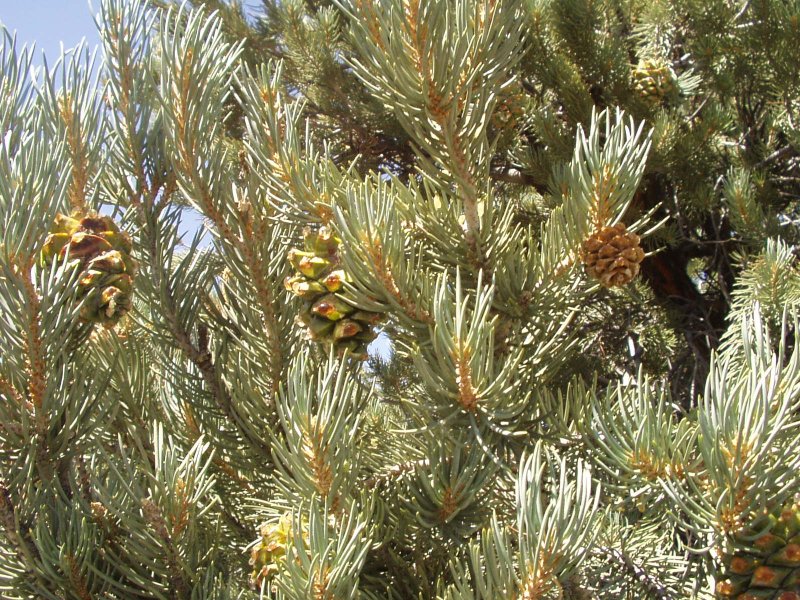
Identify this tree by its needles which grow in bundles of three and reach lengths of 12-25 cm (5-10 in). These needles are concentrated at the ends of branches, giving the tree a tufted or pom-pom appearance. The needles are typically olive-green to yellowish-green and feel stiff to the touch.
The bark is another primary identifier; on mature trees, it forms large, flat plates that look like jigsaw puzzle pieces. If you put your nose to the crevices of the bark on a warm day, you will detect a distinct scent of vanilla or butterscotch. The cones are egg-shaped and possess a sharp prickle on each scale that points outward, which distinguishes it from the Jeffrey pine (Pinus jeffreyi).
- Needles usually in 3s (rarely 2s in some subspecies)
- Bark changes from black-brown to yellow-orange with age
- Cones are 7-15 cm (3-6 in) long
- Twigs are stout and smell like turpentine when broken
How Big Does a Bull Pine Grow?
Expect a mature height of 18 to 30 meters (60-100 feet) in a landscape setting, though wild specimens in the Pacific Northwest can exceed 70 meters (230 feet). The trunk diameter can reach 1 to 2 meters (3-6 feet) at breast height. In its youth, the tree maintains a narrow, pyramidal shape, but it broadens into a cylindrical or flat-topped crown as it reaches maturity.
The growth rate is moderate, typically adding 30-60 cm (1-2 feet) of height per year under ideal conditions. The spread of the branches usually reaches 7-10 meters (23-33 feet). Because of this size, the tree produces a significant amount of needle litter and large cones annually.
- Landscape height: 18-30 m (60-100 ft)
- Wild height: up to 72 m (235 ft)
- Trunk diameter: 90-150 cm (3-5 ft)
- Crown spread: 7-10 m (23-33 ft)
Best Site Conditions for Western Yellow Pine
Select a location with full sun and deep, well-drained soil to accommodate the massive taproot. Bull pine is adapted to a variety of soil types, including sandy, loamy, and rocky soils, provided they do not hold standing water. It is particularly successful in the arid climates of the American West where other conifers might struggle.
The tree prefers a soil pH between 6.0 and 7.0 but can tolerate slightly alkaline conditions. It is frequently found growing alongside Douglas fir (Pseudotsuga menziesii) and incense cedar (Calocedrus decurrens) in its native habitat. Avoid low-lying areas where frost pockets form or where the soil remains saturated during the winter months.
- Full sun is mandatory for healthy growth
- Avoid heavy clay that restricts drainage
- Tolerates wind and high-elevation exposure
- Thrives in USDA zones 3 through 7
Planting Your Ponderosa Pine
Plant saplings in early spring before the new growth, known as candles, begins to elongate. Dig a hole twice as wide as the root ball but no deeper, ensuring the root flare is level with the soil surface. If you are planting a bare-root seedling, ensure the long taproot is positioned vertically and not “J-rooted” (bent upward), which will stunt the tree.
Backfill the hole with the native soil rather than heavily amended potting mix to encourage the roots to move into the surrounding ground. Water the tree immediately after planting to settle the soil and remove air pockets. Spacing between multiple trees should be at least 6-8 meters (20-26 feet) if you are creating a screen or windbreak.
- Plant in spring for best establishment
- Do not add high-nitrogen fertilizer to the planting hole
- Mulch with 5-10 cm (2-4 in) of wood chips to retain moisture
- Protect young trees from deer with a wire cage
Bull Pine Care and Maintenance
Provide 20 liters (5 gallons) of water per week during the first two growing seasons to ensure establishment. Once the tree has developed its deep taproot, it becomes exceptionally drought-tolerant and rarely requires supplemental watering except during extreme multi-year droughts. Over-watering is a common cause of root rot in this species.
Fertilization is generally unnecessary for bull pines planted in their native range or in appropriate soil. If growth appears stunted or needles are pale, a slow-release, low-nitrogen fertilizer can be applied in early spring. Avoid fertilizing in late summer, as this can stimulate soft growth that will be damaged by winter freezes.
- Water deeply but infrequently
- No regular pruning required for health
- Keep the area under the canopy free of competing weeds
- Monitor for needle cast during exceptionally wet springs
Pruning and Managing Growth
Remove only the lower branches up to a height of 2 meters (6 feet) to reduce fire ladders and improve visibility. Pruning should be performed during the dormant winter season to minimize the risk of attracting bark beetles, which are drawn to the scent of fresh resin in spring and summer. Bull pines naturally self-prune their lower limbs in forest settings as they grow taller.
If you need to manage the size of a younger tree, you can pinch back the “candles” (new growth tips) by half in late spring. This will result in a denser, more compact habit. For mature trees, any significant pruning or removal of large limbs should be handled by a professional tree service due to the height and weight of the branches.
- Prune in December or January
- Never remove the central leader (top) of the tree
- Use clean, sharp saws to prevent jagged wounds
- Dispose of pruned branches to avoid pest infestations
Common Bull Pine Tree Problems
Watch for the western pine beetle, which creates pitch tubes (popcorn-like resin clumps) on the trunk as it bores into the wood. These beetles are the most significant threat to bull pines, especially during periods of drought. If you see fine sawdust (frass) in the bark crevices along with pitch tubes, the tree may be infested and require professional treatment.
Other issues include western gall rust, which causes spherical swellings on branches, and various needle cast fungi that turn needles brown in sections. While the tree is fire-resistant, excessive accumulation of dry needles at the base can still pose a risk. Ensure the tree has adequate airflow to prevent fungal issues in humid climates.
- Western pine beetle: look for 1-2 cm resin tubes
- Pine needle scale: white flecks on the needles
- Elytroderma needle cast: causes “witches’ brooms”
- Drought stress: causes premature needle drop
Winter Hardiness and Protection
This species survives temperatures as low as -34 °C (-30 °F) without requiring any supplemental protection. It is well-adapted to heavy snow loads; its flexible branches and downward-sloping limb structure allow snow to slide off before causing breakage. However, young saplings can be crushed by heavy drifts or ice accumulation.
In areas with severe winter winds, young trees may experience “winter burn,” where the needles turn brown due to desiccation. Applying a thick layer of mulch in late autumn helps keep the ground from freezing too deeply, allowing the roots to continue absorbing moisture. Once the tree is mature, it is one of the most winter-hardy pines in the landscape.
- Hardy to USDA Zone 3
- Mulch root zone in late autumn
- Avoid using de-icing salts near the root zone
- Shake heavy, wet snow off young saplings gently
Is Bull Pine Good Firewood and Other Uses?
Use the wood as firewood for a heat value of approximately 15.2 million BTUs per cord. While it is a decent fuel source, it contains high amounts of resin, which causes it to pop and throw sparks; it is best used in enclosed wood stoves rather than open fireplaces. The resin also leads to creosote buildup in chimneys, so regular cleaning is required.
Historically, the wood was used for everything from railroad ties to fruit crates. Today, it is a major source of dimension lumber for construction and millwork. The large, prickly cones are often used in crafts, and the seeds (pine nuts) provide an essential food source for squirrels, chipmunks, and birds like the Clark’s nutcracker (Nucifraga columbiana).
- Firewood: burns hot and fast
- Timber: used for knots-in paneling and trim
- Wildlife: provides nesting sites for hawks and owls
- Resin: traditionally used as a waterproof sealant
Year-Round Maintenance for Bull Pine
| Spring | Plant new saplings and monitor for western pine beetle pitch tubes. Pinch back candles by half if a denser shape is desired. |
|---|---|
| Summer | Water young trees deeply once a week during dry spells. Check for needle scale or fungal spots on the foliage. |
| Autumn | Apply a 10 cm (4 in) layer of wood chip mulch around the base. Rake up and dispose of excessive needle litter to reduce fire risk. |
| Winter | Perform any necessary structural pruning while the tree is dormant. Gently remove heavy ice or snow from the branches of young trees. |
Common Bull Pine Problems and Solutions
| What you see | Likely cause | What to do |
|---|---|---|
| Popcorn-like resin clumps on trunk | Western pine beetle attack | Consult an arborist immediately for possible insecticide or pheromone treatment. |
| Yellowing needles in the center of the tree | Natural seasonal needle drop | No action needed; pines naturally shed 2-3 year old needles in autumn. |
| Brown needle tips in spring | Winter desiccation or wind burn | Increase mulching in autumn and ensure deep watering before the ground freezes. |
| Spherical woody knots on branches | Western gall rust | Prune out infected branches several inches below the gall during winter. |
Subspecies of Pinus ponderosa
- var. ponderosa – The Pacific form, largest size and longest needles.
- var. scopulorum – Rocky Mountain form, smaller and more cold-hardy.
- var. brachyptera – Southwestern form with shorter needles.
- var. benthamiana – Found in California, known for very long needles.
Frequently Asked Questions
Is bull pine good firewood?
Yes, it provides about 15.2 million BTUs per cord and burns hot, but its high resin content causes sparking and creosote buildup.
What is the difference between bull pine and ponderosa pine?
They are the same species, but 'bull pine' is a common name often used for younger trees with dark, furrowed bark before they turn yellow-orange.
How can you tell a bull pine from a Jeffrey pine?
The prickles on bull pine cones point outward and feel sharp, while Jeffrey pine (Pinus jeffreyi) prickles point inward and feel smooth.
Are bull pine needles toxic to dogs?
They are generally non-toxic but can cause mild stomach upset or physical irritation if chewed due to their sharp, stiff nature.
Is the bull pine related to the bull snake?
No, but they share a habitat; the thick, flaky bark of the bull pine provides excellent cover for snakes like the pine snake (Pituophis melanoleucus).
Information about traditional or historical uses is provided for educational interest only and is not medical advice. Do not use any plant to treat a condition without speaking to a qualified professional.
Sources & Verification
Taxonomy and distribution are checked against the databases below. Care guidance is written for cultivated species only and reviewed by our editor. How We Build Plant Profiles →
More in Pinus

Virginia Pine
Pinus virginiana
☀️ Full Sun 💧 Low
Japanese Black Pine
Pinus thunbergii
☀️ Full Sun 💧 Moderate

California Foothill Pine
Pinus sabiniana
☀️ Full Sun 💧 Low

Stone Pine
Pinus pinea
☀️ Full Sun 💧 Low

Mexican Nut Pine
Pinus cembroides
☀️ Full Sun 💧 Low
Single-Leaf Pinyon
Pinus monophylla
☀️ Full Sun 💧 Low