
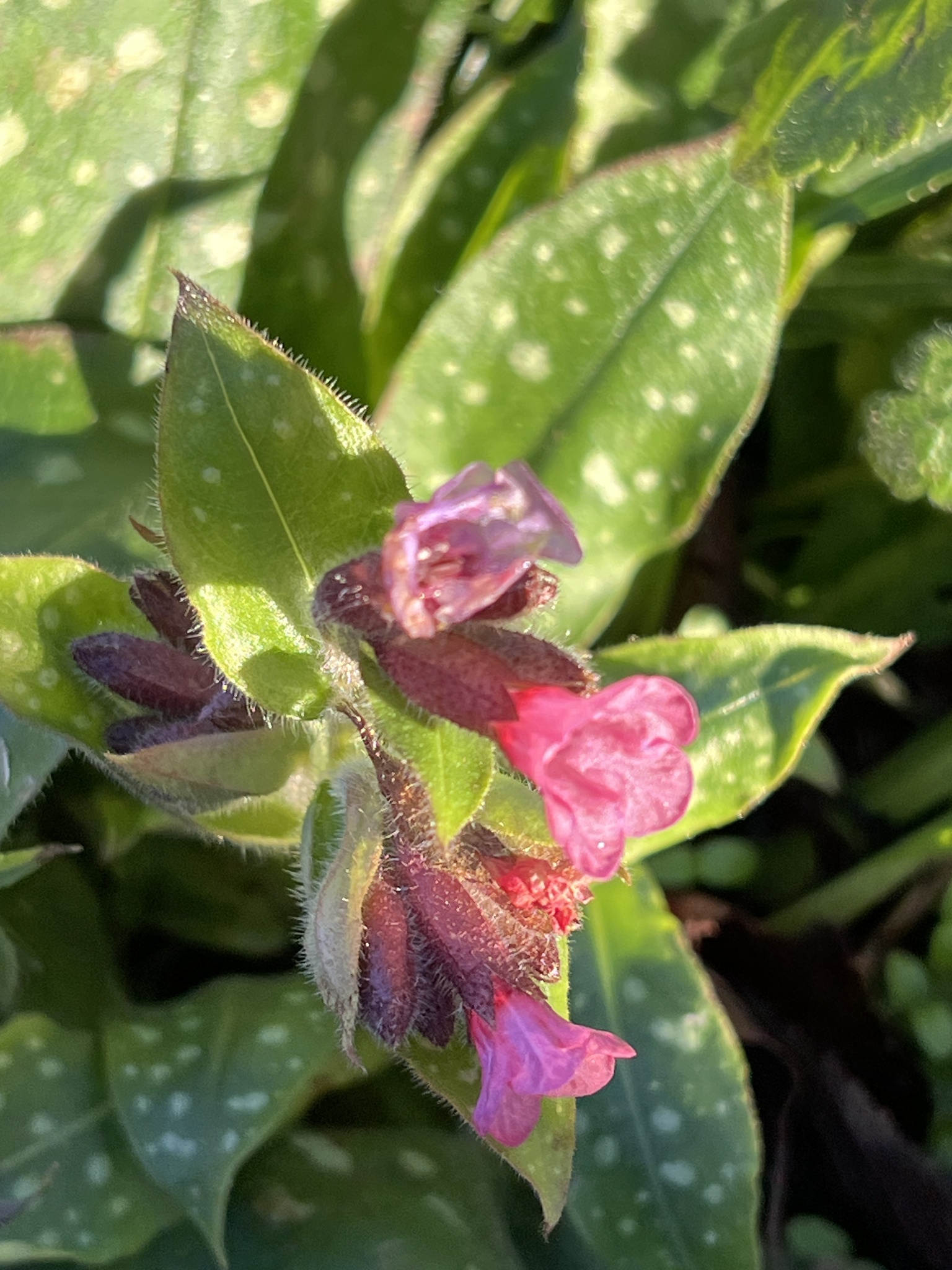
Pulmonaria officinalis is a low-growing perennial from Europe, easily recognized by its bristly, white-spotted foliage and early spring blooms. This member of the Boraginaceae family spreads via rhizomes to form a dense carpet in woodland settings.
It thrives in cool, damp shade where most flowering plants struggle. Use it to cover bare ground under deciduous trees before the canopy fills in, providing one of the season’s first nectar sources for bees.
Key Facts
- Light: Partial to full shade
- Water: Keep soil consistently moist at all times
- Bloom: Early spring flowers change from pink to blue
- Hardiness: Survives winter in USDA zones 3 to 8
- Height: Reaches 20-30 cm (8-12 in) tall
Where Lungwort Fits in Your Garden
Lungwort thrives in damp, shady corners where other perennials might rot or fail to bloom. It acts as an early-season nectar source for long-tongued bees, such as the hairy-footed flower bee (Anthophora plumipes). You should choose this plant if you have heavy soil that stays cool throughout the summer months.
It is particularly effective in woodland gardens or on the north side of a building where light is limited. Because it blooms as early as March, it provides color when most of the garden is still dormant. Its spreading habit makes it a reliable choice for suppressing weeds beneath taller shrubs like common lilac (Syringa vulgaris).
Identifying Lungwort by Leaf and Flower
This species forms a spreading mound of 25-30 cm (10-12 in) in height with a slightly wider spread. The basal leaves are ovate-cordate, reaching up to 15 cm (6 in) long, and are covered in stiff hairs and distinct silver-white spots. In early spring, terminal cymes produce funnel-shaped flowers that are initially rose-pink before maturing to a deep violet-blue.
The stems are unbranched and slightly hairy, emerging directly from a creeping rhizome system. As the season progresses, the flower stems elongate, but the plant maintains a low, mounded habit. The spots on the leaves are actually air pockets that help cool the leaf surface in humid conditions.
The Best Site and Soil for Pulmonaria
Lungwort requires partial to full shade to prevent the foliage from scorching or wilting in the afternoon sun. It is a classic woodland edge plant that prefers a spot that mimics the forest floor with dappled light. The soil should be rich in organic matter and capable of retaining moisture without becoming waterlogged.
- Avoid south-facing walls or open, windy sites.
- Target an area with 2-4 hours of morning sun at most.
- Provide shelter from drying winds that can tatter the large leaves.
- Test for a soil pH between 6.0 and 7.5 for optimal nutrient uptake.
How to Plant Lungwort
Space individual plants 30-45 cm (12-18 in) apart to allow for their natural spreading habit. Planting is best done in early autumn or early spring when the soil is naturally moist and temperatures are cool. This allows the root system to establish before the stress of summer heat or winter freezes.
- Dig a hole twice the width of the root ball.
- Incorporate a shovelful of well-rotted leaf mold or compost into the hole.
- Set the plant so the crown is level with the soil surface.
- Firm the soil gently to remove large air pockets around the roots.
- Water immediately with at least 5 liters (1.3 gallons) of water.
Watering and Feeding Instructions
Give the plant 2.5 cm (1 in) of water every week to maintain the lushness of the spotted foliage. Lungwort is not a drought-tolerant species; if the soil dries out completely, the leaves will turn brown at the edges and eventually collapse. Maintaining consistent moisture is the most effective way to prevent disease.
- Apply water at the base of the plant to keep foliage dry.
- Use a soaker hose to prevent splashing soil onto the leaves.
- Mulch annually with 5 cm (2 in) of organic matter to lock in moisture.
- Apply a slow-release balanced fertilizer in early spring as new growth appears.
Pruning and Maintenance After Flowering
Cut the flower stalks back to the base immediately after the blooms fade in late spring. This prevents the plant from wasting energy on seed production and encourages a fresh flush of healthy, mildew-resistant leaves. If the foliage looks ragged by mid-summer, you can shear the entire plant back to ground level.
- Remove any tattered or winter-damaged leaves in March.
- Wear gloves while pruning, as the sap and hairs can irritate skin.
- Deadhead individual spent flowers to keep the plant looking tidy.
- Clear away fallen tree leaves from the crown in autumn to prevent rot.
Propagating Lungwort by Division
Divide the rhizomatous root clumps every 3 to 4 years during the autumn or immediately after flowering. This prevents the center of the plant from becoming woody and unproductive. Division is the most reliable way to maintain the specific leaf patterns of named cultivars.
- Lift the entire clump with a garden fork in late summer.
- Pull the rhizomes apart by hand or use a sharp knife.
- Ensure each new section has at least one healthy leaf bud.
- Replant immediately at the same depth as the original plant.
- Keep new divisions shaded and well-watered for the first month.
Lungwort Winter Care and Seasonal Needs
Lungwort is hardy down to -35 °C (-30 °F), making it suitable for very cold northern climates. In most regions, the foliage will die back significantly or turn mushy after the first hard frost. It does not require significant winter protection in zones 5 through 8, but a mulch layer helps in colder areas.
- Clear away dead foliage in late autumn to prevent crown rot.
- Apply a 5-10 cm (2-4 in) layer of straw or bark mulch in zone 3.
- Avoid over-watering in winter, as cold, wet soil can kill the rhizomes.
- Watch for early emerging buds as soon as the ground thaws in spring.
Common Lungwort Problems and Pests
Powdery mildew is the most frequent issue, appearing as a white, dusty coating on the leaves during dry spells. This fungus often attacks the plant when the soil dries out or air circulation is poor around the base. Stress from lack of water makes the plant much more susceptible to infection.
- Increase spacing between plants to improve airflow.
- Remove and destroy any leaves showing white fungal patches.
- Check for slugs and snails during wet spring evenings.
- Watch for vine weevil larvae, which may chew the roots of container plants.
Year-Round Care for Lungwort
| Spring | Remove dead winter leaves in March. Apply a balanced fertilizer and mulch with compost. Divide large clumps after flowers fade. |
|---|---|
| Summer | Water twice weekly during dry spells to provide 2.5 cm (1 in) of moisture. Cut back foliage if powdery mildew appears. |
| Autumn | Plant new specimens or move existing ones. Clear away fallen tree leaves to prevent the crown from rotting in wet weather. |
| Winter | Apply a protective mulch in zones 3-4. Monitor for early growth during late winter thaws and avoid walking on frozen soil. |
Why Is My Lungwort Dying? Quick Diagnosis
| What you see | Likely cause | What to do |
|---|---|---|
| White dusty spots on leaves | Powdery mildew | Improve air circulation and keep soil consistently moist. |
| Wilting or drooping leaves | Drought stress | Deeply water the plant immediately and apply mulch. |
| Irregular holes in foliage | Slugs or snails | Apply organic slug pellets or remove pests by hand at night. |
| Brown, crispy leaf edges | Sun scorch | Move the plant to a shadier location or provide temporary cover. |
Popular Lungwort Cultivars Compared
- ‘Sissinghurst White’ – pure white flowers, heavily spotted leaves
- ‘Cambridge Blue’ – sky-blue flowers on compact mounds
- ‘Blue Mist’ – pale blue blooms, very early flowering
- ‘Raspberry Splash’ – upright habit, raspberry-pink flowers
- ‘Mrs. Moon’ – classic variety with large silver spots
Best Companion Plants for Shade
Pair Lungwort with shade-loving perennials that share its preference for moist, organic soils. Because it blooms early, it bridges the gap between winter bulbs and summer-flowering shade plants. It looks best when contrasted with plants that have smooth or glossy leaves.
- Plant alongside hostas (Hosta species) which hide fading lungwort foliage.
- Combine with coral bells (Heuchera) for contrasting leaf colors.
- Interplant with Lenten roses (Helleborus orientalis) for spring color.
- Use Bethlehem lungwort (Pulmonaria saccharata) for intense leaf spotting.
- Add ferns like the Japanese painted fern (Athyrium niponicum) for texture.
Frequently Asked Questions
Why is it called Lungwort?
The name comes from the 'Doctrine of Signatures,' a historical belief that a plant's appearance indicated its use; the spotted leaves were thought to resemble diseased lungs.
Is Lungwort the same as Lungwort Lichen?
No, common lungwort is a flowering plant, while lungwort lichen (Lobaria pulmonaria) is a fungus-alga symbiont that grows on tree bark.
Can you drink lungwort tea?
While traditionally used in herbalism for respiratory issues, it contains small amounts of pyrrolizidine alkaloids which can be harmful if consumed in large quantities.
Is Pulmonaria toxic to cats and dogs?
It is considered mildly toxic; the saponins and bristly hairs can cause stomach upset and mouth irritation if pets chew on the leaves.
Does lungwort spread aggressively?
It spreads slowly via rhizomes to form a tidy groundcover but is not considered invasive in most garden settings.
Information about traditional or historical uses is provided for educational interest only and is not medical advice. Do not use any plant to treat a condition without speaking to a qualified professional.
Sources & Verification
Taxonomy and distribution are checked against the databases below. Care guidance is written for cultivated species only and reviewed by our editor. How We Build Plant Profiles →