
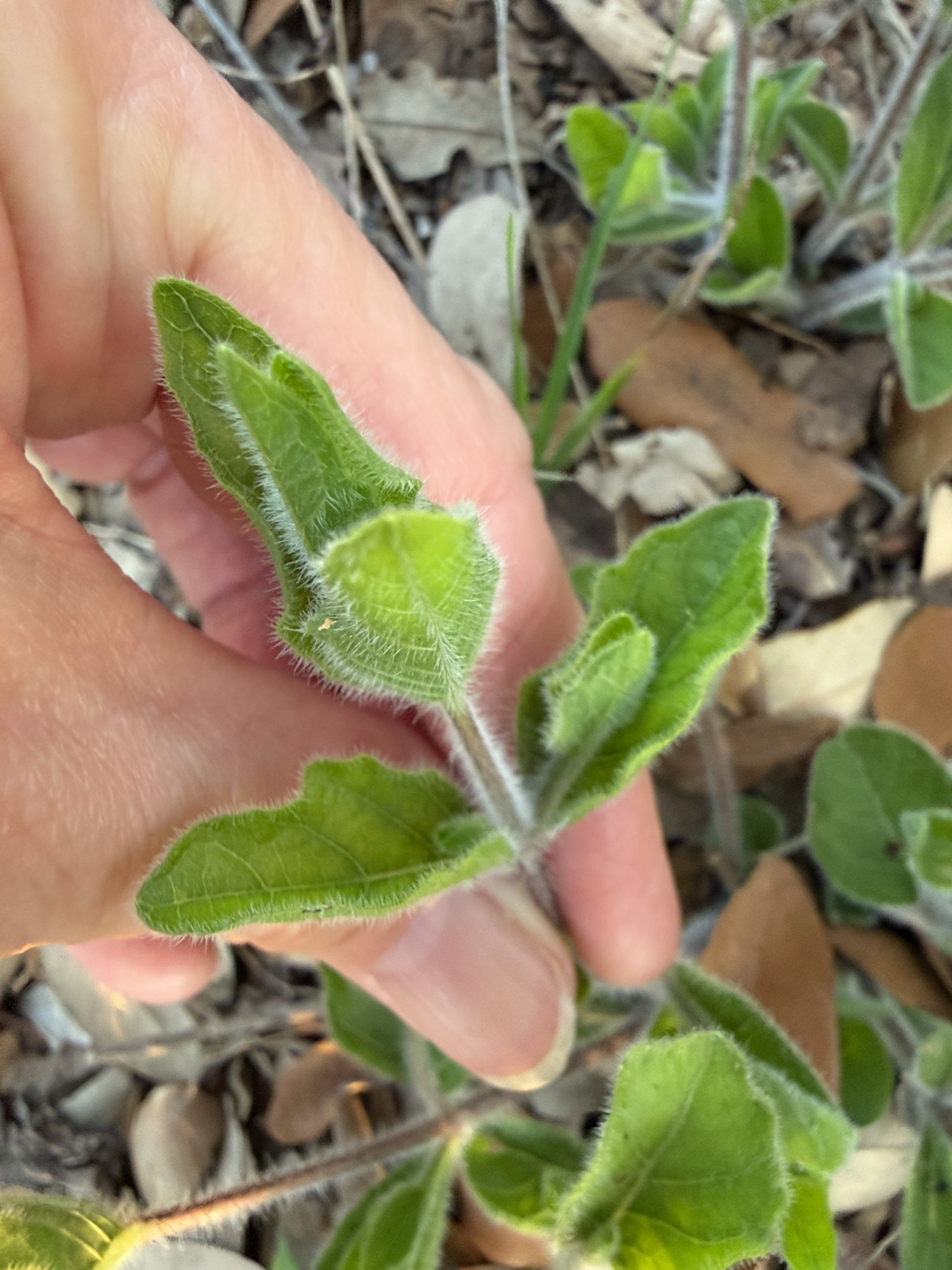
Fringeleaf wild petunia is a low-growing perennial native to the prairies and open woodlands of the eastern and central United States. Known scientifically as Ruellia humilis, this species is recognized by its olive-green, hairy leaves and pale violet flowers that resemble true petunias but belong to the Acanthaceae family.
This plant is a reliable choice for dry, sunny spots where other perennials struggle to survive. It reaches a height of 30-60 cm (1-2 ft) and spreads slowly through self-seeding, making it useful for naturalistic meadows or rock gardens in USDA zones 4 through 8.
Key Facts
- Water: Low to moderate; extremely drought-tolerant once established
- Light: Full sun to partial shade for best flowering
- Height: Typically 30-60 cm (12-24 in) tall
- Spread: Clumps expand to 30-45 cm (12-18 in) wide
- Bloom: Lavender-blue flowers from June to September
- Hardiness: Reliable in USDA zones 4 to 8
Is Fringeleaf Wild Petunia Right for Your Garden?
Fringeleaf wild petunia is a low-maintenance native perennial that thrives in challenging conditions where many garden hybrids fail. It is particularly suited for gardeners in the Midwest and Eastern US who want to support local ecology without the constant watering required by traditional bedding plants. Unlike the invasive Mexican petunia (Ruellia simplex), this species is well-behaved and stays within its localized clump, though it will drop seeds to fill in gaps over time.
You should choose this plant if you have rocky, dry, or poor soil that drains quickly. It is an excellent choice for prairie restorations, rock gardens, or the front of a sunny border. Because it is a host plant for the Common Buckeye butterfly (Junonia coenia), it is a functional addition to any pollinator-focused landscape.
- Thrives in dry, poor, or limestone-heavy soils
- Supports native butterfly and bee populations
- Requires almost no supplemental water after the first year
- Non-invasive compared to its tropical relatives
Identifying Ruellia humilis by Its Look
Fringeleaf wild petunia is characterized by its distinctly hairy stems and leaf margins, which give the plant a soft, fuzzy appearance. The leaves are sessile, meaning they attach directly to the stem without a stalk, and are arranged oppositely in pairs. Each leaf is lance-shaped to ovate, measuring 3-8 cm (1.2-3.1 in) in length, and often displays a dusty olive-green color that helps it blend into naturalistic settings.
The flowers are funnel-shaped and five-lobed, measuring roughly 5 cm (2 in) across. They appear in the leaf axils rather than on tall spikes, sitting close to the foliage. While the flowers look like those of the common garden petunia (Petunia x atkinsiana), the square-ish stems and specialized seed pods reveal its true identity as a member of the acanthus family.
- Stems are noticeably hairy and somewhat square in cross-section
- Lavender to pale violet flowers with five distinct lobes
- Seed pods are small, smooth, and turn brown when ripe
- Mature habit is mounded and compact, rarely exceeding 60 cm (2 ft)
Choosing the Best Site for Wild Petunia
For the most prolific blooming, place your fringeleaf wild petunia in full sun to very light partial shade. While it can survive in shaded areas, the stems will likely become leggy and the flower production will drop significantly. In its native habitat, it is often found in glades, prairies, and open woods where it receives at least 6 hours of direct sunlight daily.
Soil drainage is the most critical environmental factor for this species. It prefers dry to medium-moisture soils and is highly adapted to calcareous or limestone-rich earth. Avoid low-lying areas of the garden where water collects, as prolonged saturated soil can lead to root rot during the dormant winter months.
- Select a site with excellent drainage to prevent winter rot
- Full sun is required for a compact, mounded shape
- Tolerates high pH and rocky, shallow soils with ease
- Avoid heavily amended, rich garden beds which cause flopping
How to Plant Ruellia humilis Seeds and Seedlings
The best time to plant fringeleaf wild petunia seeds is in the late autumn or early winter to allow for natural cold stratification. If you are starting seeds indoors, they require a period of 60 days of cold, moist stratification at 4 °C (40 °F) before they will germinate reliably. Surface-sow the seeds, as they require light to break dormancy, and keep the soil consistently moist until the first true leaves appear.
When transplanting nursery-grown seedlings, space them 30-45 cm (12-18 in) apart to allow for their mature spread. Dig a hole twice as wide as the root ball but no deeper, ensuring the crown of the plant sits level with the soil surface. Water thoroughly immediately after planting to settle the soil around the roots, but reduce frequency once you see new green growth.
- Sow seeds in autumn for natural spring germination
- Indoor seeds need 60 days of cold stratification
- Space plants at 30-45 cm (12-18 in) intervals
- Do not bury seeds deeply; they need light to sprout
Watering and Feeding for Best Growth
You should water newly planted fringeleaf wild petunia once or twice a week during its first growing season. Once the root system is established, the plant is remarkably drought-tolerant and typically only needs supplemental water during extreme heatwaves or prolonged dry spells lasting more than three weeks. Over-watering is a common mistake that leads to weak stems and fewer blooms.
Fertilizer is generally unnecessary for this native species and can actually be detrimental. High-nitrogen fertilizers encourage rapid, lush foliage growth that lacks the structural integrity to stay upright, resulting in a messy, sprawling plant. If your soil is extremely depleted, a thin layer of compost applied in early spring is more than sufficient for its needs.
- Water deeply but infrequently once established
- Avoid high-nitrogen fertilizers to prevent flopping
- Mulch with gravel or light wood chips to retain minimal moisture
- Monitor for yellowing leaves, which may indicate over-watering
Pruning and Managing Self-Seeding
Pruning requirements for fringeleaf wild petunia are minimal, but you should cut the dead stems back to the ground in late winter or very early spring before new growth emerges. This clears the way for the fresh spring shoots and keeps the garden looking tidy. During the growing season, you can shear the plant back by one-third after the first flush of flowers to encourage a second, smaller bloom in late summer.
This plant uses a mechanism called explosive dehiscence to spread its seeds, where the pods burst open and fling seeds several feet away. If you want to prevent self-seeding in a formal garden, you must remove the spent flower heads before the green pods turn dark brown and dry out. However, in a meadow setting, allowing this process to occur helps create a dense, naturalized groundcover.
- Cut back old stems to 5 cm (2 in) in late February
- Shear mid-summer to refresh foliage and promote reblooming
- Deadhead early to stop the “explosive” seed dispersal
- Wear gloves if you have sensitive skin, as the hairs can be irritating
How to Propagate Wild Petunia
The most effective way to propagate fringeleaf wild petunia is through seed collection or basal cuttings. To collect seeds, wait for the pods to turn a dark, brittle brown, but act quickly before they burst. Place the pods in a paper bag in a dry location; you will likely hear them “popping” as they release the seeds. These seeds can be stored in a cool, dry place until the following autumn sowing.
Basal cuttings can be taken in late spring when the new growth is roughly 10-15 cm (4-6 in) tall. Select a healthy stem, cut it just below a leaf node, and remove the lower leaves before inserting it into a moist, sandy potting mix. Division is also possible in early spring, though the woody taproot of older plants can make this process difficult and less successful than seeding.
- Collect seeds when pods turn dark brown and brittle
- Use paper bags for seed drying to catch “exploding” seeds
- Take basal cuttings in May or June for best rooting success
- Divide only young plants to avoid damaging the taproot
Common Pests and Problems
Fringeleaf wild petunia is largely resistant to serious pests and diseases, making it a very hardy choice for organic gardens. You may notice some leaf damage from caterpillars, specifically the Common Buckeye, but this should be tolerated as the plant is a vital host for this species. The plant will quickly recover from minor defoliation once the caterpillars pupate.
The most frequent problem is powdery mildew, which can occur if the plant is grown in a site with poor air circulation or excessive shade. If you see a white, flour-like dusting on the leaves, thin out surrounding plants to improve airflow. Root rot is the only fatal issue, usually caused by planting in heavy clay or low spots that remain wet during the winter months.
- Buckeye butterfly larvae may eat some foliage; this is normal
- Powdery mildew appears in humid, stagnant conditions
- Flopping stems indicate too much shade or fertilizer
- Root rot occurs in poorly drained, soggy winter soils
Winter Care and Hardiness
In USDA zones 4 through 8, fringeleaf wild petunia is entirely cold-hardy and requires no special protection. The top growth will turn brown and die back completely after the first hard frost. It is a late-riser in the spring, so do not be alarmed if you don’t see new shoots until the soil has thoroughly warmed in late April or May.
Avoid applying heavy, moisture-retaining mulch like shredded bark directly over the crown of the plant in winter. This can trap moisture against the dormant roots and lead to rot. A light covering of fallen leaves is acceptable, but the plant is naturally adapted to survive the cold winters of the American Midwest without human intervention.
- Plant is hardy down to -34 °C (-30 °F)
- Die-back is complete; remove dead stems in spring
- Avoid heavy winter mulching to prevent crown rot
- Mark the location, as it emerges late in the spring season
Managing the Long Bloom Season
The lavender flowers of the fringeleaf wild petunia typically open in the morning and fall by evening, but the plant produces a steady succession of new buds for several months. The primary bloom period is from June through August, though it can extend into September if the weather remains mild. This long flowering window makes it a valuable nectar source for long-tongued bees and butterflies throughout the summer.
To maximize the floral display, ensure the plant is not crowded by taller, more aggressive perennials that might shade it out. While individual flowers are short-lived, a healthy clump can produce dozens of blooms simultaneously. If the plant looks spent by mid-August, a light trim and a deep watering can often trigger a final flush of flowers before the autumn dormancy begins.
- Individual flowers last only 24 hours
- Continuous bud production ensures a 3-month bloom window
- Attracts bumblebees, clearwing moths, and butterflies
- Late-season blooms provide critical forage for migrating insects
Year-Round Care for Fringeleaf Wild Petunia
| Spring | Cut back old, woody stems to the ground in late March. Watch for new shoots to emerge late in the season, typically in May. |
|---|---|
| Summer | Monitor for Buckeye butterfly caterpillars. Provide deep water only if there has been no rain for 3 weeks. Shear back by one-third in July to refresh foliage. |
| Autumn | Collect seeds from dark brown pods before they burst. Leave the remaining foliage to protect the crown from early frosts. |
| Winter | Ensure the site remains well-drained and free of standing water. Do not apply heavy mulch over the dormant crown. |
Common Wild Petunia Problems and Solutions
| What you see | Likely cause | What to do |
|---|---|---|
| Stems falling over | Too much shade or fertilizer | Move to a sunnier spot and stop all fertilization. |
| White powder on leaves | Powdery mildew from poor airflow | Thin out nearby plants and avoid overhead watering. |
| Holes in leaves | Buckeye butterfly larvae feeding | No action needed; the plant is a host and will recover. |
| Plant fails to emerge in April | Naturally late spring emergence | Wait until late May before assuming the plant has died. |
Best Companion Plants for Fringeleaf Wild Petunia
When choosing companions for Ruellia humilis, look for other drought-tolerant US natives that share its love for well-drained soil and full sun. It pairs beautifully with short-statured prairie grasses like Little Bluestem (Schizachyrium scoparium) or Side-oats Grama (Bouteloua curtipendula), which provide a fine-textured backdrop for the petunia’s broader, hairy leaves.
For a color-coordinated pollinator garden, plant it alongside Pale Purple Coneflower (Echinacea pallida) or Butterfly Milkweed (Asclepias tuberosa). These species bloom around the same time and offer contrasting flower shapes. Avoid planting it next to aggressive spreaders like Mint (Mentha) or large, shading shrubs that will outcompete this low-growing perennial for light and space.
- Little Bluestem (Schizachyrium scoparium) for winter interest
- Pale Purple Coneflower (Echinacea pallida) for height contrast
- Butterfly Milkweed (Asclepias tuberosa) for vibrant orange color
- Prairie Dropseed (Sporobolus heterolepis) for a soft, airy texture
Frequently Asked Questions
Is Ruellia humilis aggressive or invasive?
No, it is a well-behaved native plant that stays in clumps, though it will self-seed nearby. It is not invasive like the Mexican petunia (Ruellia simplex).
What is the difference between Ruellia humilis and Ruellia caroliniensis?
Ruellia humilis is shorter with very hairy leaves and stems, while Ruellia caroliniensis is taller, less hairy, and prefers moister, more acidic soils.
Is wild petunia deer resistant?
Yes, the hairy texture of the leaves makes it unpalatable to deer and rabbits in most garden settings.
Can I grow fringeleaf wild petunia in a container?
Yes, provided the container has excellent drainage and is placed in full sun, though it may require more frequent watering than in the ground.
How far do the seeds travel when the pods burst?
The explosive pods can fling seeds up to 3 meters (10 ft) away from the parent plant.
Sources & Verification
Taxonomy and distribution are checked against the databases below. Care guidance is written for cultivated species only and reviewed by our editor. How We Build Plant Profiles →
