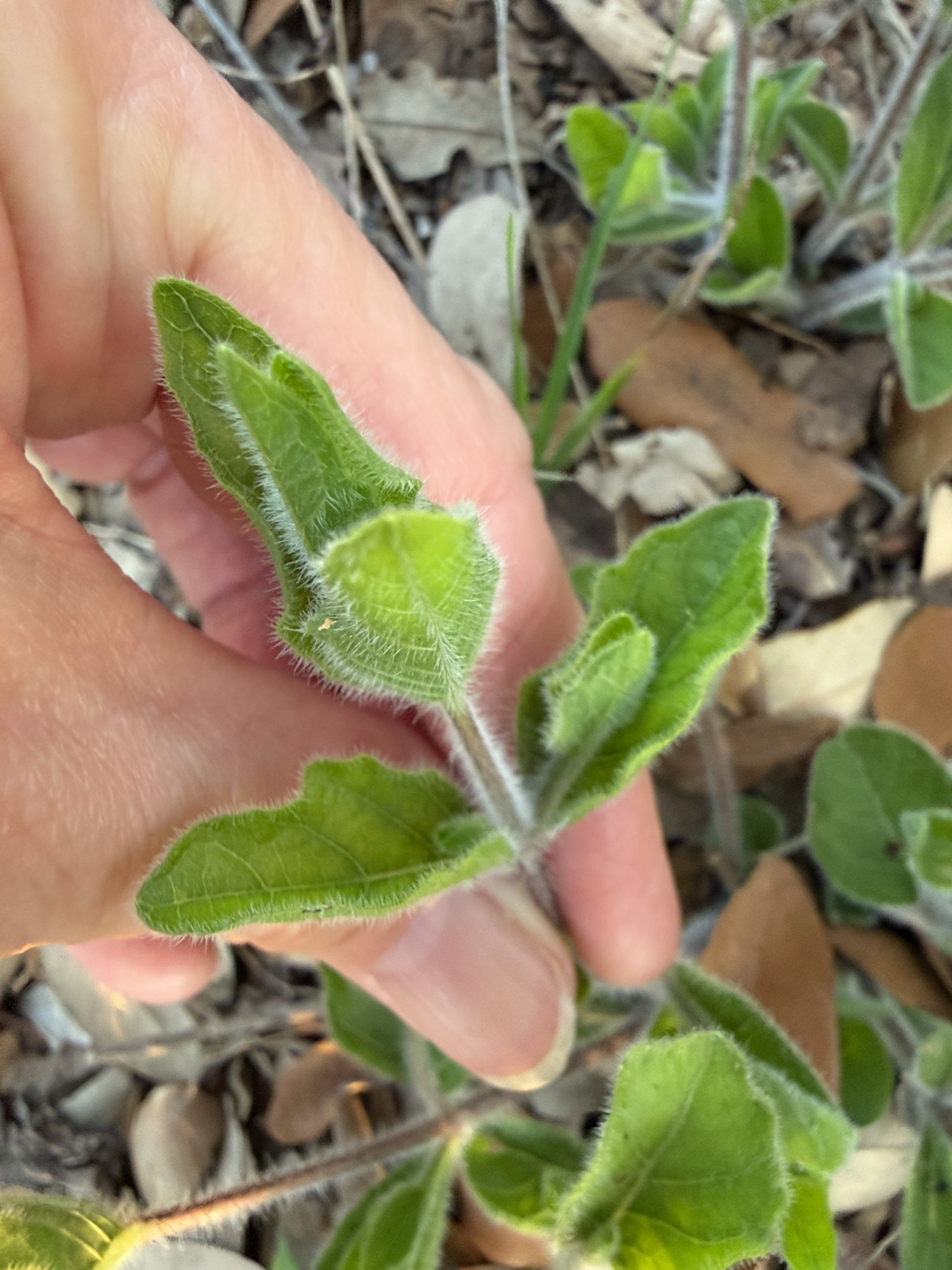
Minnieroot (Ruellia tuberosa) is a tropical herbaceous perennial in the family Acanthaceae, native to Central America and the Caribbean. It reaches 30 to 60 cm (12 to 24 in) in height and produces violet-blue trumpet flowers.
Dry seed capsules pop open forcefully when moistened, throwing seeds several meters away. Thick elongated root tubers allow the plant to survive extended dry periods in disturbed tropical soils.
Key Facts
- Plant Family: Acanthaceae
- Native Range: Central America and the Caribbean
- Plant Height: 30-60 cm (12-24 in)
- Root Structure: Elongated finger-like tubers
- Seed Dispersal: Explosive pod dehiscence upon contact with water
- Animal Forage: Fresh leaves gathered as feed for rabbits
Where Minnieroot Grows and How It Behaves
Minnieroot forms low clumps of erect stems growing 30 to 60 cm (12 to 24 in) tall from a central cluster of thick, tuberous roots. It colonizes disturbed ground, roadside margins, pastures, and urban waste spaces across tropical climates.
The plant thrives in sun-exposed sites and withstands dry periods by dropping leaves while relying on energy stored in its swollen roots. In agricultural settings and lawns across Colombia and Southeast Asia, it forms persistent patches that re-emerge quickly after cutting.
How to Identify Ruellia tuberosa
Minnieroot produces opposite, oblong-elliptic leaves measuring 6 to 12 cm (2.4 to 4.7 in) long with smooth or slightly wavy margins on short petioles. The five-lobed trumpet flowers measure 3 to 5 cm (1.2 to 2 in) across and display a bright purple to bluish-violet color with a dark throat.
Key structural traits for identification include:
- Stems: Four-angled, green to reddish-purple, slightly hairy near the nodes.
- Roots: Fleshy, spindle-shaped tubers growing 5-10 cm (2-4 in) long in tight clusters.
- Floral Diagram Structure: Bisexual, zygomorphic flowers with 5 fused sepals, 5 petals forming a funnelform corolla, and 4 stamens.
- Fruit: Cylindrical brown capsule containing 20-30 flat, orbicular seeds.
Native Range and Growing Habitat
Minnieroot originates in Central America, South America, and the Caribbean islands, where local populations often refer to it as batatilla or batatilla de Indias. It has naturalized across tropical regions of Africa, South Asia, and Southeast Asia.
The species grows from sea level up to 1,200 m (3,900 ft) elevation in open environments. It occupies sandy riverbanks, fallow fields, coastal scrubland, and altered urban soils receiving 800 to 2,500 mm (31 to 98 in) of annual rainfall.
Seed Dispersal and Ecological Role
Minnieroot relies on ballochory, a mechanical seed projection method triggered by liquid moisture. When rain drops touch dry brown seed pods, internal structural tension breaks the capsule open, firing seeds up to 3 m (10 ft) away.
The nectar-rich flowers attract bees, butterflies, and long-tongued pollinators throughout the warm season. The seeds feature fine hygroscopic hairs that swell when wet, anchoring the seed securely to soil particles upon landing.
Weed Behavior and Environmental Control
Minnieroot acts as an agricultural weed (maleza) and opportunistic colonizer in tropical pastures and turf. Its underground tuberous roots make physical removal challenging once established.
Managing wild patches requires target strategies:
- Manual Digging: Tuberous roots must be excavated completely, as root fragments sprout new shoots.
- Mowing: Repeated cutting limits seed production but leaves the subterranean root tubers intact.
- Herbicides: Systemic treatments applied to active leafy growth before pod maturation provide control.
Traditional Uses and Benefits of Minnieroot
Traditional practitioners in Central America and Asia historically prepared decoctions from root tubers and leaves. In rural areas of South America, farmers harvest fresh batatilla leaves as supplemental fodder for domestic rabbits (conejos) and livestock.
Laboratory evaluations confirm the presence of flavonoids, steroids, and apigenin in leaf and root extracts. Historical folk applications record its use in cooling infusions for fever and urinary tract discomfort.
Similar Species and Look-Alikes
Minnieroot resembles several related plants in the Acanthaceae family but is distinguished by its swollen root tubers and explosive brown seed pods. Comparable species include:
- Mexican Petunia (Ruellia simplex): Taller habit up to 1 m (3.3 ft), narrow lanceolate leaves, and no underground tubers.
- Carolina Wild Petunia (Ruellia caroliniensis): Native to the southeastern United States with hairy stems and fibrous roots.
- Creeping Ruellia (Ruellia squarrosa): Low prostrate habit under 15 cm (6 in) tall with smaller flowers.
- Blue Blechum (Blechum pyramidatum): Dense green overlapping floral spikes with smaller pale flowers.
Frequently Asked Questions
What is the common name of Ruellia tuberosa?
Ruellia tuberosa is commonly known as minnieroot, cracker plant, fever root, duppy gun, snapdragon root, and batatilla.
What is batatilla used for?
Batatilla (Ruellia tuberosa) has traditional uses in folk medicine for cooling teas, and rural farmers harvest its fresh leaves as green forage for rabbits and domestic animals.
Why is Ruellia tuberosa called cracker plant or duppy gun?
The names cracker plant and duppy gun describe the dry seed pods, which crack open with a popping sound when exposed to water or moisture.
Can rabbits eat batatilla leaves?
Yes, fresh batatilla foliage is routinely gathered in tropical rural regions as palatable feed for domestic rabbits.
How does Ruellia tuberosa spread so fast?
Ruellia tuberosa spreads rapidly using explosive seed capsules that fling seeds up to 3 m (10 ft) when wet, combined with persistent underground root tubers.
What family does Ruellia tuberosa belong to?
Ruellia tuberosa belongs to the Acanthaceae family, characterized by opposite leaves, tubular violet flowers, and explosive seed capsules.
Information about traditional or historical uses is provided for educational interest only and is not medical advice. Do not use any plant to treat a condition without speaking to a qualified professional.
Sources & Verification
Taxonomy and distribution are checked against the databases below. Care guidance is written for cultivated species only and reviewed by our editor. How We Build Plant Profiles →