
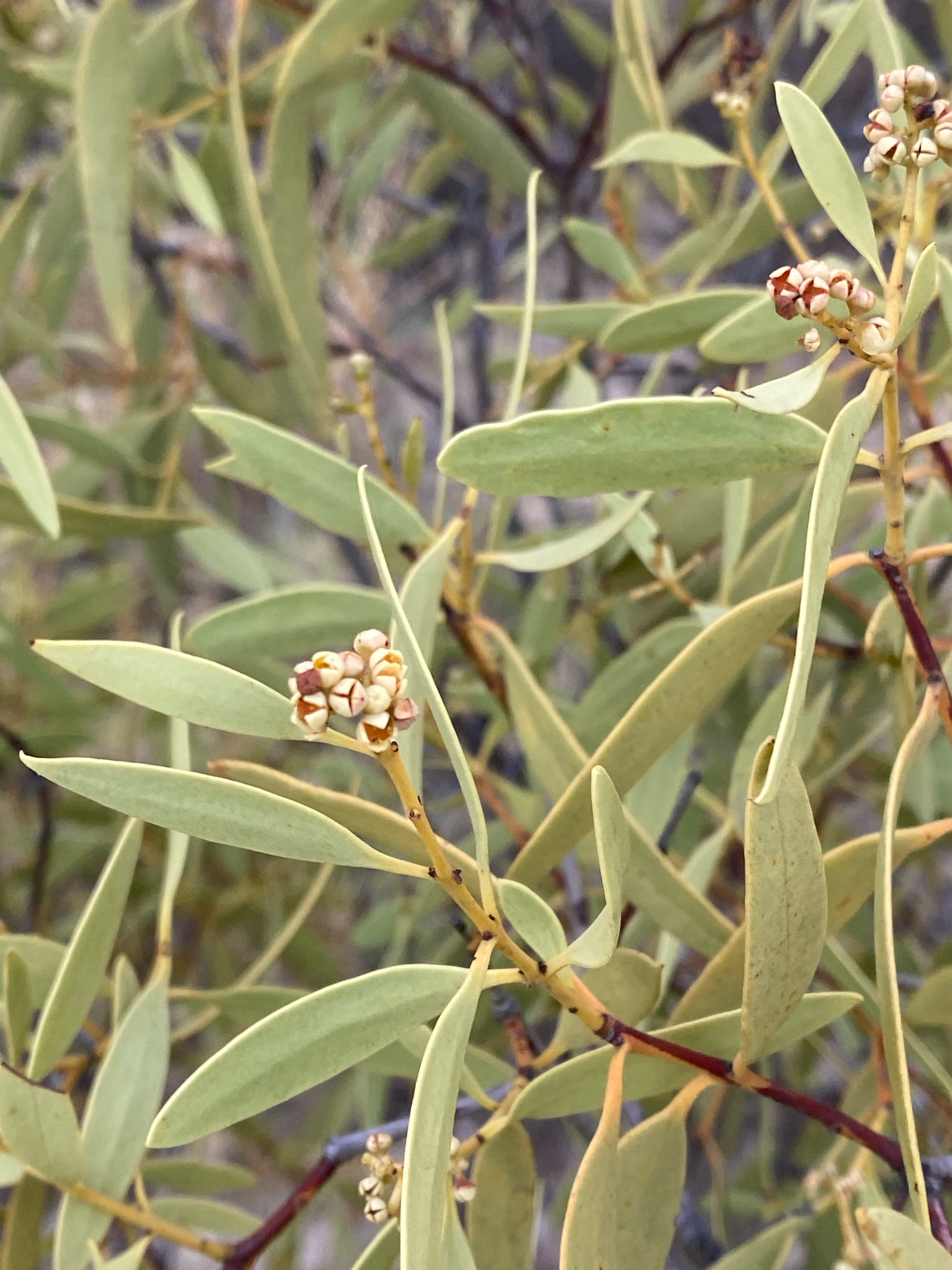
Desert peach, botanically known as Santalum acuminatum, is an evergreen hemiparasitic tree native to the arid central and southern regions of Australia. It belongs to the sandalwood family Santalaceae and produces bright red, edible fruits containing a hard, deeply pitted shell.
Successful establishment relies on proximity to a living host plant such as Acacia to supply moisture and soil minerals. The woody seeds require scarification to break dormancy after 12 to 18 months in the wild.
Key Facts
- Plant Type: Hemiparasitic evergreen tree
- Native Range: Central and southern Australia
- Fruit Size: 15 to 25 mm (0.6 to 1 in) diameter
- Host Plants: Requires host roots like Acacia
- Edibility: Tart red flesh and edible kernel
Growing Desert Peach: What to Know Before Planting
Desert peach trees require a living host plant within 1 to 2 m (3.3 to 6.6 ft) of their root zone to absorb nutrients and water. As an obligate hemiparasite, the roots form specialized connections called haustoria that tap into neighboring root systems.
Nitrogen-fixing shrubs like golden wattle (Acacia pycnantha) or myall (Acacia sowdenii) serve as effective host species in sandy or calcareous soils. Untreated quandong seeds exhibit germination rates under 5 percent due to their thick, woody endocarp.
- Plant host saplings 6 to 12 months before introducing quandong seed or seedlings.
- Select a site with full sunlight and annual rainfall between 200 and 500 mm (8 and 20 in).
- Provide deep, well-draining sand to prevent root rot in young trees.
Identifying Desert Quandong Leaves, Flowers, and Fruit
Desert quandong grows as a small tree 2 to 6 m (6.5 to 20 ft) tall with pale green drooping foliage and bright red fruit. The leaves are smooth, lanceolate, and measure 45 to 90 mm (1.8 to 3.5 in) long by 3 to 12 mm (0.1 to 0.5 in) wide.
Small cream or pale yellow flowers with 4 petals form in dense terminal clusters from December to April. The fruit matures between August and October, turning from dull green to glossy red with a soft, sour outer pulp.
- Leaves: Olive-green to pale yellow-green, curving downward with a tiny hooked tip.
- Flowers: 2 to 3 mm (0.08 to 0.12 in) wide, fragrant, four-lobed.
- Fruit: Round drupe 15 to 25 mm (0.6 to 1 in) in diameter.
- Nut: Hard spherical shell marked with deep brain-like convolutions.
Native Range and Growing Environment of Desert Peach
Desert quandong is native across southern Australia, ranging from Western Australia to South Australia, Victoria, and western New South Wales. It colonizes inland sand dunes, coastal scrub, rocky hills, and open mallee woodlands.
The tree thrives in alkaline sands, loams, and limestone soils with pH values ranging from 6.5 to 8.5. It survives extreme summer conditions above 45 °C (113 °F) and tolerates light winter frosts down to -5 °C (23 °F).
- Deep red sand plains and calcareous dunes.
- Mallee scrubland with low soil phosphorus content.
- Arid areas with erratic annual rainfall under 400 mm (16 in).
Hemiparasitic Ecology and Host Relationships
Desert peach extracts up to 15 percent of its water and mineral supply from neighboring plant roots via haustorial root attachments. While the foliage contains chlorophyll for photosynthesis, the root system lacks true root hairs for direct soil absorption.
More than 80 native Australian species serve as host plants, though legume shrubs in the genus Acacia yield the strongest growth rates. Native birds and emus (Dromaius novaehollandiae) ingest the fruits whole, helping scarify seeds as they pass through the digestive system.
- Haustoria penetrate host root bark without severing water transport.
- Emus disperse seeds over large distances across arid scrubland.
- Native mistletoe species (Amyema) occasionally parasitize the quandong canopy itself.
Conservation Status and Wild Population Health
Wild stands of desert quandong maintain stable distribution patterns, though feral animal browsing limits natural regeneration in pastoral zones. Rabbits, feral goats, and camels selectively consume young seedlings and suckers.
In South Australia and Western Australia, commercial collection of wild fruit requires state permits to avoid depletion of natural seed banks. Revegetation projects integrate host wattles with quandong plantings to restore degraded inland ecosystems.
Culinary, Traditional, and Commercial Uses of Santalum acuminatum
The red flesh of desert peach contains twice the vitamin C content of an orange per 100 grams of fruit. Indigenous Australians traditionally consumed the fruit raw or dried into preserved cakes for seasonal travel.
The oily seed kernel was traditionally ground into salves to relieve skin irritation and joint discomfort. Today, desert quandong fruit is harvested for gourmet jams, chutneys, and sauces, while Santalum acuminatum fruit extract is used in cosmetic antioxidant serums. The deeply pitted nuts are dried and polished for desert peach earrings, craft beads, and traditional board game counters.
- Culinary: Tart pies, jams, meat glazes, and dried fruit snacks.
- Cosmetics: Skin cleansers and creams featuring quandong extract.
- Crafts: Polished seed kernels used in desert peach jewelry and artisan craft work.
- Wood: Hard, pale timber historically used for small carved implements.
Distinguishing Desert Quandong from Similar Species
Desert quandong is identified by its scarlet, edible fruit and heavily pitted spherical nut. It differs from closely related sandalwood species in fruit color, flesh edibility, and leaf curvature.
Bitter quandong (Santalum murrayanum) bears brownish-red fruit with bitter, unpalatable flesh and a smoother nut shell. Sandalwood (Santalum spicatum) produces non-edible brown fruit and is cultivated primarily for its aromatic heartwood oil.
Desert peach should not be confused with the fruit tree cultivar Desert Gold peach (Prunus persica ‘Desert Gold’). Desert Gold peach is a conventional stone fruit cultivar producing large, fuzzy yellow peaches on non-parasitic roots without requiring host plants.
- Bitter quandong (Santalum murrayanum): Yellow-brown fruit, bitter taste, narrow leaves.
- Sandalwood (Santalum spicatum): Brown non-edible fruit, fragrant timber.
- Desert Gold peach (Prunus persica ‘Desert Gold’): Deciduous fruit tree, fuzzy sweet peaches, standard root system.
Frequently Asked Questions
Is desert peach edible?
Yes, the bright red fruit flesh of desert peach is edible with a sharp, tart flavor similar to rhubarb or sour plum. The roasted inner seed kernel is also edible once the hard outer shell is cracked open.
What is the difference between desert peach and Desert Gold peach?
Desert peach (Santalum acuminatum) is a wild Australian hemiparasitic tree producing small, smooth red fruits with a hard pitted nut. Desert Gold peach (Prunus persica 'Desert Gold') is a conventional stone fruit cultivar that grows large, fuzzy yellow peaches on standard non-parasitic roots.
How do you germinate Santalum acuminatum seeds?
Germination requires cracking or nicking the hard woody outer shell and soaking the inner kernel in water or gibberellic acid solution before planting. The seedling must be planted within 1 m (3.3 ft) of an established host plant like an Acacia species for long-term survival.
What is Santalum acuminatum fruit extract used for?
Santalum acuminatum fruit extract is added to skincare products for its rich concentration of vitamin C and antioxidant phenolic acids. It helps hydrate the skin and defend against oxidative stress.
Why are quandong nuts used in jewelry?
The inner seed shell of quandong features natural brain-like pitting that creates a distinct textured surface when cleaned and dried. Craftsmen drill and polish the nuts to make desert peach earrings, necklaces, and craft beads.
Information about traditional or historical uses is provided for educational interest only and is not medical advice. Do not use any plant to treat a condition without speaking to a qualified professional.
Sources & Verification
Taxonomy and distribution are checked against the databases below. Care guidance is written for cultivated species only and reviewed by our editor. How We Build Plant Profiles →

