
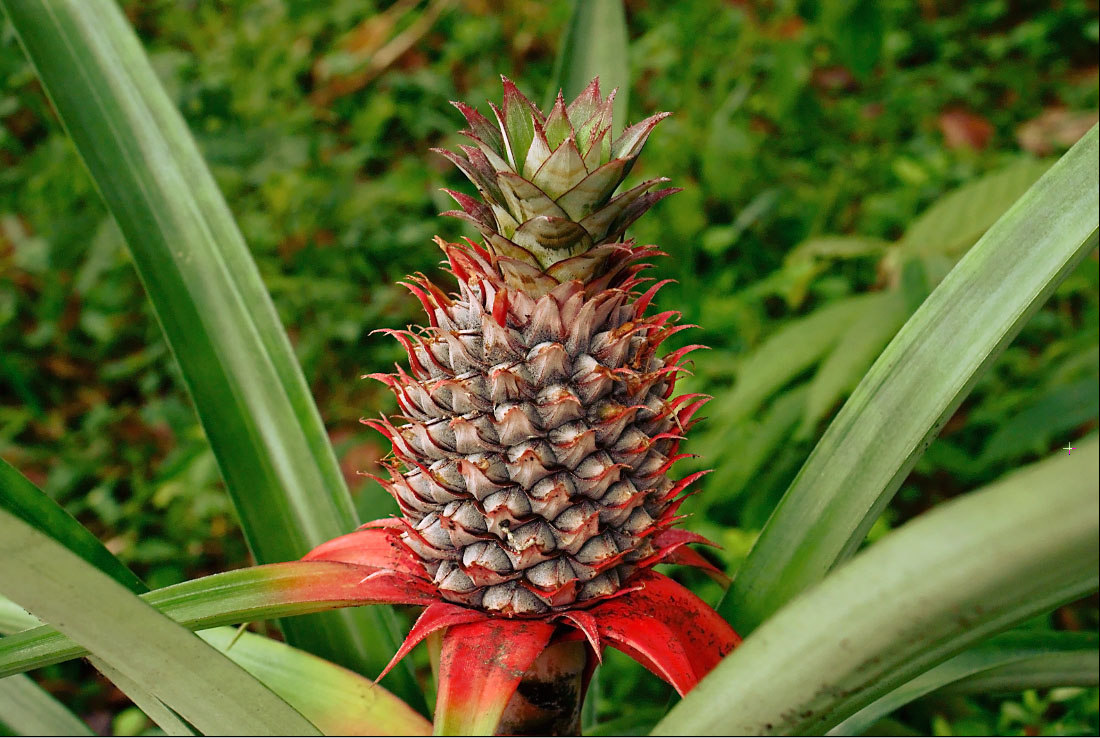
Pineapple (Ananas comosus) is a tropical terrestrial bromeliad native to the Paraná-Paraguay River basin between southern Brazil and Paraguay, recognised by its dense rosette of stiff, spiny leaves and central fruiting stem.
Indoor growers cultivate it as an architectural foliage plant or for the novelty of harvesting homegrown fruit. Success depends on providing at least six hours of direct sunlight and maintaining warm root temperatures year-round.
Key Facts
- Light: 6+ hours of full direct sun daily
- Water: soak soil thoroughly when the top 5 cm (2 in) dries
- Temperature: 20–30 °C (68–86 °F); strictly above 13 °C (55 °F)
- Soil: gritty, free-draining cactus or bromeliad mix
- Fruiting time: 24 to 36 months from rooted crown
- Toxicity: non-toxic to cats and dogs
Living with Pineapple: Space and Indoor Fit
A container pineapple requires at least 1 m (3.3 ft) of floor clearance in all directions because its stiff, serrated leaves spread outward horizontally.
The plant suits warm, draft-free living rooms, heated conservatories, and unshaded south-facing window bays. The leaf margins of standard types bear sharp spines that snag fabric and scrape skin, making wide walkways essential.
- Clear an area 100–120 cm (39–47 in) wide to prevent accidental contact with spiny leaf tips.
- Keep the pot out of reach of toddler crawl spaces and high-traffic pet corridors.
- Position the container away from winter radiators, exterior doors, and air-conditioning drafts.
What Pineapple Plants Look Like as They Grow
A mature pineapple forms a stemless rosette of 30 to 80 stiff, sword-shaped leaves measuring 80–120 cm (31–47 in) long and 4–6 cm (1.5–2.4 in) wide.
Despite the widespread search term ‘pineapple tree’, pineapples do not grow on trees; the central stem remains short and thick, buried in the ground level foliage. The foliage is grey-green, channeled along the upper surface to funnel rainwater directly into the root zone, and coated in microscopic silver water-absorbing trichome scales.
When the plant reaches two to three years of age, the central growing tip elongates into a terminal flower stalk bearing 100 to 200 individual flowers. Each purple-red flower produces a berry, and these berries fuse around the central fibrous core to form the aggregate multiple fruit topped by a leafy crown.
Sunlight Requirements for Indoor Pineapples
Indoor pineapple plants demand six to eight hours of direct sunlight every single day to stay compact and produce fruit.
Place your container directly on a south-facing windowsill where glass does not filter the sun. In northern latitudes or during dim winter months, ambient window light alone causes the leaves to stretch, fade to pale green, and flop outward.
- Install an LED grow light providing 400–600 µmol/m²/s of photosynthetically active radiation if natural light drops below 6 hours.
- Keep supplementary grow fixtures suspended 30 cm (12 in) directly above the foliage crown for 12 to 14 hours daily.
- Rotate the container 90 degrees every week so the leaf rosette develops symmetrical, upright growth.
How Often to Water a Pineapple Plant
Water a potted pineapple thoroughly only when the top 5 cm (2 in) of compost has dried out completely.
As a terrestrial bromeliad utilizing Crassulacean Acid Metabolism (CAM), the plant opens its stomata at night to absorb carbon dioxide and conserves internal moisture through daytime heat. Drench the root ball until water flows freely through the drainage holes, then discard all runoff accumulated in the drip saucer within 15 minutes.
- Water every 7 to 10 days during the peak active growing months of May through August.
- Reduce frequency to once every 18 to 25 days during cool, dim winter dormancy.
- Pour water exclusively onto the soil surface around the base, avoiding stagnant puddles inside the leaf cup where rot can set in.
Best Potting Soil and Drainage for Pineapple
Pot pineapples in an acidic, gritty medium with a target pH between 4.5 and 5.5 that drains water immediately.
Standard peat-heavy indoor potting compost retains excessive moisture around the shallow root structure, quickly suffocating feeder roots. Use unglazed terracotta containers fitted with wide bottom drainage holes to promote rapid soil oxygenation and moisture evaporation.
- Mix two parts commercial cactus compost with one part coarse perlite and one part horticultural sand.
- Alternatively, combine equal volumes of pine bark fines, coco coir, and pumice.
- Step pot sizes up gradually from a 15 cm (6 in) starter pot to a final 30 cm (12 in) container over two seasons.
Temperature and Humidity Levels
Pineapple plants thrive in warm temperatures between 20 °C and 30 °C (68–86 °F) and cannot tolerate frost.
Growth stops abruptly when ambient temperatures fall below 15 °C (59 °F), and sustained exposure to 5 °C (41 °F) causes physiological chilling injury that turns the internal foliage grey and watery. Maintain household relative humidity between 40% and 60%, which mirrors its subtropical origin while preventing foliar fungal spores.
- Move patio-grown plants indoors before nighttime garden temperatures drop below 13 °C (55 °F).
- Avoid unheated conservatories or porches where winter night temperatures slide into single digits.
- Set a digital room humidifier nearby during winter if indoor heating dries ambient air below 30% relative humidity.
Fertilizer Schedule for Container Pineapples
Feed an established potted pineapple every two to four weeks from April through September using a balanced liquid fertiliser diluted to half strength.
Pineapples are light feeders with modest nutrient reserves in their thick leaves, but container soils run out of trace minerals quickly. Apply a balanced 10-10-10 or high-potassium 15-5-30 formula to encourage robust leaf tissue and sugar development in forming fruit.
- Dilute balanced liquid houseplant fertiliser to 50% of the manufacturer’s suggested dose before applying.
- Spray the leaf surfaces occasionally with a mild 0.1% chelated iron and magnesium sulphate solution to prevent leaf chlorosis.
- Cease all fertilizer feeding entirely between October and March when growth slows down in response to short days.
How to Propagate Pineapple from Tops
You can propagate a new plant by rooting the leafy green crown twisted off a fresh, mature store-bought fruit.
Select a fruit with firm, undamaged central leaves and an unblemished apex. Remove the crown by gripping the leaf base firmly with one hand and twisting the fruit body with the other until the stalk snaps clean.
- Strip off the lowest 2–3 cm (1 in) of small bottom leaves to expose the pale stem stalk and tiny brown root primordia dots.
- Trim any remaining sweet yellow fruit flesh off the base with a clean knife to prevent bacterial rot during rooting.
- Let the stripped crown dry out on an airy kitchen counter for 48 to 72 hours until the wound calluses over.
- Insert the base 3 cm (1.2 in) deep into moist perlite or sandy cactus mix, firming the medium around the stem.
- Place in bright, indirect light at 22–26 °C (72–79 °F); new anchor roots will establish within 6 to 8 weeks.
Troubleshooting Indoor Pineapple Problems
The single most destructive issue affecting indoor pineapples is root rot triggered by overwatering in dense potting compost.
Soggy media deprives the sensitive terrestrial root system of oxygen, allowing waterborne pathogens such as Phytophthora cinnamomi to rot the base. Check the stem weekly; healthy rosettes remain firm and anchored, whereas decaying plants pull free from the soil with no resistance.
- Cut away mushy brown root tissue, treat the healthy stem with powdered sulphur, and repot into fresh dry pumice.
- Isolate mealybugs (Dysmicoccus brevipes) hiding within deep leaf axils and dab them with a 70% isopropyl cotton swab.
- Eradicate brown scale insects stuck along the leaf underside by spraying horticultural neem oil every 7 days for three weeks.
Are Pineapple Plants Toxic to Pets?
Pineapple foliage and ripe fruit flesh are non-toxic to cats and dogs according to the ASPCA.
You can keep potted specimens in households with companion animals without risking systemic poisoning. However, chewing on tough, fibrous leaves can induce mild stomach irritation, mechanical vomiting, or mouth scrapes from the serrated teeth.
Unripe fruit and the green peel contain high concentrations of bromelain, a proteolytic enzyme that breaks down proteins and irritates delicate tongue membranes. If a cat or dog gnaws on green fruit rinds, offer fresh water and monitor them for temporary drooling or mild digestive upset.
How to Trigger Flowering and Fruit Production
Induce flowering on a healthy two-year-old plant by exposing its central cup to ethylene gas released by ripening apples.
An indoor pineapple must have developed at least 30 mature leaves before it possesses sufficient carbohydrate reserves to support a flower head. Natural flowering occurs between December and April, but captive indoor specimens often remain strictly vegetative without deliberate ethylene stimulation.
- Place the potted plant inside a large clear plastic bag along with two ripe, bruised apples (Malus domestica).
- Seal the bag loosely and keep the plant in bright, indirect light out of hot direct sun for 72 hours.
- Remove the bag, return the plant to full sun, and look for a bright pink or red flower cone in the centre within 6 to 10 weeks.
- Allow the resulting fruit to mature on the central stalk for five to six months until the rind changes from deep green to golden-yellow.
Frequently Asked Questions
Do pineapples grow on trees?
No, pineapples do not grow on trees; they grow on a low, ground-level rosette of spiny bromeliad leaves. A single fruit emerges on a central stalk rising 30–50 cm (12–20 in) out of the middle of the plant.
What are the health benefits of pineapple fruit and juice?
Pineapple fruit and fresh pineapple juice provide high concentrations of vitamin C, manganese, and bromelain, an enzyme complex traditionally used to support protein digestion and ease inflammation.
How do you pineapple curly hair?
To 'pineapple' hair, gather dry curls loosely on top of your head right above your forehead using a soft satin scrunchie before sleeping. This beauty technique protects hair volume and curl definition overnight and takes its name from the upright leafy crown of the fruit.
What is a pineapple conure?
A pineapple conure is a colour morph of the green-cheeked parakeet (Pyrrhura molinae), not a plant variety. The bird is named for its bright yellow chest and red-orange facial feathers, which resemble the colours of a cut pineapple.
How long does an indoor pineapple take to produce fruit?
A pineapple grown from a rooted fruit crown takes between 24 and 36 months to produce a harvestable ripe fruit indoors. The plant requires at least 30 mature leaves and 6 to 8 hours of direct daily sunlight before it can sustain flowering and fruiting.
Why does raw pineapple make your tongue tingle or burn?
Raw pineapple flesh contains bromelain, an active protease enzyme that breaks down protein molecules on the surface of your tongue and lips. Cooking or grilling the fruit deactivates the enzyme and eliminates the stinging sensation.
Information about traditional or historical uses is provided for educational interest only and is not medical advice. Do not use any plant to treat a condition without speaking to a qualified professional.
Sources & Verification
Taxonomy and distribution are checked against the databases below. Care guidance is written for cultivated species only and reviewed by our editor. How We Build Plant Profiles →
- Kew Plants of the World OnlineTaxonomic status and native distribution of Ananas comosus
- University of Florida IFAS ExtensionCommercial and home garden cultivation guidelines for pineapple
- ASPCA Animal Poison ControlToxicity profile for companion animals
- Missouri Botanical GardenPlant characteristics and indoor culture
- GBIF — Global Biodiversity Information Facilitytaxonomy, synonyms, occurrence records
- Wikipediageneral reference