
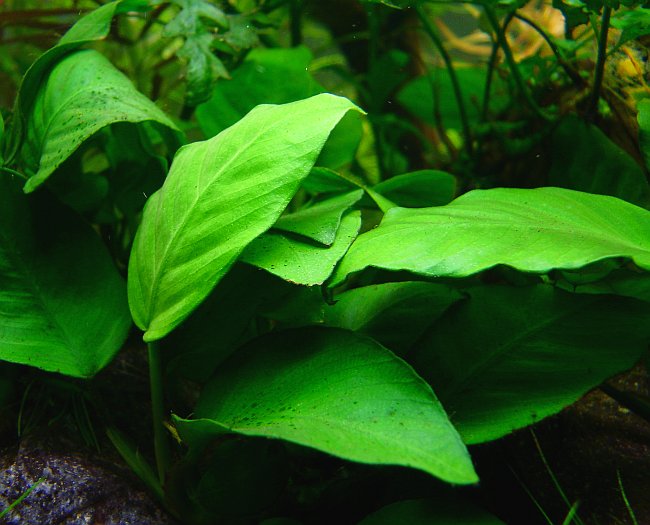
Anubias (Anubias barteri) is a perennial amphibious plant native to the rocky forest streams of south-eastern Nigeria, Cameroon, and Bioko, recognised by its thick, creeping green rhizome and tough, leathery leaves.
It thrives in aquariums submerged or in humid terrariums grown emersed, dying quickly if you bury its horizontal rhizome beneath gravel or sand.
Key Facts
- Light: Low to moderate, 0.25 to 0.5 watts per litre
- Temperature: Maintain water between 22 and 28 °C (72–82 °F)
- Water pH: Tolerates a stable range of 6.0 to 7.5
- Rhizome: Attach to wood or rock; never bury underground
- Growth rate: Slow, producing roughly 1 leaf per month
Living with Anubias in Home Aquariums
Anubias fits almost any freshwater aquarium or paludarium setup because herbivorous fish like cichlids rarely eat its tough, fibrous leaf blades.
Its slow metabolic pace means it does not demand pressurised carbon dioxide injection or high-intensity fixtures to remain healthy. You can anchor it in community tanks housing tetras, dwarf shrimp, or goldfish where soft-leaved stem plants would quickly get shredded.
- Fits nano tanks up to large display aquariums from 20 to 500 L (5 to 130 gal)
- Withstands persistent nibbling from herbivorous fish
- Demands minimal pruning due to slow foliage turnover
Anubias Appearance and Growth Habit
A typical Anubias barteri features a thick, cylindrical green rhizome measuring 5 to 15 mm (0.2–0.6 in) in diameter from which glossy, cordate to lanceolate leaves arise.
Leaf blades range from 7 to 20 cm (2.8–8 in) long and 4 to 10 cm (1.6–4 in) wide depending on the variety, held on stiff petioles that emerge alternately along the creeping stem. Below the rhizome, thick white and brown anchor roots extend downward to grip textured wood, porous volcanic lava rock, or large gravel pebbles.
Lighting Requirements for Anubias
Anubias requires low to moderate indirect lighting delivering 10 to 30 PAR at the plant level to avoid leaf-smothering algae.
Direct, intense aquarium lighting encourages stubborn spot algae (Coleochaete) to colonise the long-lived leaves, which can slowly choke out photosynthesis over months. Position the plant under the shade of taller species like Amazon sword (Echinodorus grisebachii) or beneath floating cover like water lettuce (Pistia stratiotes).
- Photoperiod: 6 to 8 hours of light per day
- Intensity: 0.25 to 0.5 watts per litre (approx. 1 to 2 watts per gallon)
- Placement: Shaded corners, midground wood, or under canopy branches
Water Parameters and Tank Conditions
Keep water temperatures between 22 and 28 °C (72–82 °F) with a neutral to slightly acidic pH between 6.0 and 7.5.
The plant handles water hardness ranging widely from 3 to 15 dGH, making it adaptable to both soft rain water and moderately hard municipal tap water. Steady, gentle water circulation prevents detritus from settling across the flat leaf surfaces while delivering dissolved mineral nutrients to the foliage.
Substrate and Mounting: Why Soil Will Kill the Rhizome
Never bury the thick horizontal rhizome in aquarium soil or sand, as anaerobic substrate bacteria cause rapid rhizome rot within 7 to 14 days.
Instead, secure the plant directly onto porous driftwood, bogwood, or aquarium-safe stones using cotton thread, fishing line, or cyanoacrylate-based gel glue. Fine white feeder roots may eventually enter aquarium gravel or aquasoil to pull nutrients, but keep the central green creeping stem completely elevated above the substrate line.
- Mounting materials: Cotton sewing thread, clear fishing line, or cyanoacrylate gel
- Surfaces: Lava rock, dragon stone, driftwood, or ceramic decorations
- Substrate contact: Roots can enter soil, but the rhizome must stay exposed
Humidity for Emersed and Paludarium Growth
When cultivated out of water in terrariums or ripariums, Anubias demands relative air humidity above 80% to prevent its foliage from drying out.
In West African riverbanks, the plant grows partially submerged on wet river stones where seasonal flash floods submerge it for months at a time. If growing emersed, keep its roots submerged in water or wet sphagnum moss while misting the foliage daily or running an automated terrarium fogger.
Fertiliser and Nutrient Needs
Dose a comprehensive liquid micro- and macro-nutrient fertiliser into the water column once every 1 to 2 weeks.
Because the rhizome and roots gather nutrients directly from water currents rather than dirt, root fertilizer tabs offer little benefit unless roots have fully penetrated a substrate. Nitrogen, potassium, and iron deficiencies appear as pinholes in older growth or pale yellowing between the dark green leaf veins.
- Liquid iron supplement: Prevents chlorosis on expanding leaves
- All-in-one liquid feed: 1 to 2 ml per 50 L weekly after water changes
- CO2 supplementation: Optional, though 5–15 ppm accelerates leaf output
How to Propagate Anubias
Propagate Anubias by slicing the horizontal rhizome with a clean scalpel, ensuring each new division has at least 3 to 4 healthy leaves.
Never chop the rhizome into pieces that are too short or leafless, as tiny segments often exhaust their stored starches before generating new auxiliary buds. Reattach each newly cut rhizome cutting to hardscape using gel glue or thread, and leave the parent rhizome in place to sprout a new growing tip from a dormant lateral node.
Anubias Pests, Rot, and Algae Troubles
The most frequent problem is green spot algae coating leaf surfaces due to excessive lighting or phosphate imbalances.
Another serious issue is bacterial rhizome rot, which turns firm green tissue into a foul-smelling, translucent brown mush over 48 hours. If rot begins, lift the plant from the aquarium immediately, slice away all discoloured mush until you reach clean green tissue, and treat the cut wound with 3% hydrogen peroxide before returning the plant to isolated water.
- Green spot algae: Reduce light hours down to 6 per day and raise water phosphate levels
- Black beard algae: Spot-treat affected leaf edges with liquid carbon using a syringe
- Yellowing leaves: Add potassium and chelated iron to water column
- Melting leaves: Occurs when moving plants between emersed and submerged states
Is Anubias Safe for Fish and Invertebrates?
Anubias is completely safe for fish, freshwater snails, and shrimp under all normal aquarium conditions.
Like many plants in the family Araceae, the tissues contain microscopic calcium oxalate raphide crystals that deter grazing fish by causing localized irritation to the mouth and throat if chewed. While older hobby rumours suggested that cutting Anubias inside a shrimp tank releases lethal amounts of oxalic acid, countless aquarium tests confirm that pruning the plant in an active tank poses zero risk to sensitive dwarf shrimp (Neocaridina davidi).
Underwater Flowering and Spathe Development
Anubias regularly blooms completely submerged, producing a distinctive cream-coloured spadix enclosed by a pale green spathe lasting 2 to 4 weeks.
The flower stalk rises directly from a node on the rhizome, pushing 5 to 10 cm (2–4 in) above the foliage crown before uncurling its modified white bract. Submerged blooms do not produce viable seeds because pollination requires dry-air insect pollinators, but the spathes can remain pristine underwater for nearly a month without decaying.
Year-Round Maintenance for Anubias
| Spring | Trim yellowing outer leaves close to the rhizome using sharp aquascaping scissors. Increase water column iron dosing slightly if fresh shoots appear pale. |
|---|---|
| Summer | Monitor aquarium water temperature so it does not exceed 30 °C (86 °F) during heatwaves. Inspect leaf tops for green spot algae caused by extended summer daylight. |
| Autumn | Divide overgrown rhizomes measuring longer than 15 cm (6 in) into smaller sections. Re-tie new offshoots to hardscape using cotton thread. |
| Winter | Check aquarium heater calibration to keep water steady above 22 °C (72 °F). Perform regular 25% bi-weekly water changes to prevent dissolved organic waste buildup. |
Diagnosing Common Anubias Leaf and Rhizome Problems
| What you see | Likely cause | What to do |
|---|---|---|
| Rhizome turns soft, brown, and foul-smelling | Anaerobic bacterial rhizome rot, usually triggered by burying the stem in substrate | Cut away all soft mush into healthy green tissue and re-mount the plant above substrate. |
| Green dots firmly encrusting upper leaf surfaces | High light intensity combined with low water phosphate levels | Dim aquarium light, shorten the daily photoperiod to 6 hours, and move the plant to shade. |
| Leaf tips develop dark, feathery tufts | Black beard algae caused by unstable dissolved carbon dioxide levels | Spot-dose 3% hydrogen peroxide or glutaraldehyde solution onto affected leaf margins with filters turned off. |
| New foliage emerges white, translucent, or yellow | Iron deficiency in the water column | Dose chelated iron liquid fertilizer into the water column once weekly. |
| Pinholes appearing in older, mature leaves | Potassium deficiency | Dose potassium sulfate or an all-in-one macro fertilizer after water changes. |
Popular Anubias Varieties and Cultivars Compared
- var. ‘Nana’ – compact 5–10 cm height, oval leaves
- var. ‘Nana Petite’ – miniature form reaching just 3–5 cm
- var. ‘Coffeefolia’ – ridged, corrugated leaves resembling coffee foliage
- ‘White Rose’ – pale variegated white and pale-green foliage
- var. ‘Caladiifolia’ – heart-shaped leaves held on upright petioles
- var. ‘Glabra’ – lanceolate, narrow leaves with wavy edges
Frequently Asked Questions
Can you plant Anubias in aquarium gravel or sand?
You can let the fine roots push into gravel, but you must keep the horizontal green rhizome completely uncovered. Burying the rhizome beneath gravel or sand cuts off water circulation and causes bacterial decay within two weeks.
How fast does Anubias grow?
Anubias grows very slowly, producing roughly 1 or 2 new leaves every month under standard aquarium conditions. High light and CO2 injection can slightly increase growth, but it remains one of the slowest-growing plants in the aquarium hobby.
Why is my Anubias melting?
Leaf melt happens when an Anubias grown out of water in a commercial nursery transitions to being submerged underwater. Trim away the decaying foliage; new submerged-adapted leaves will sprout from the rhizome within several weeks if the rhizome remains firm.
What is the difference between Anubias barteri and Anubias congensis?
Anubias barteri features broad, heart-shaped or ovate leaves, whereas plants sold as Anubias congensis (a form of Anubias heterophylla) produce slender, lance-shaped leaves that can reach 30 to 40 cm (12–16 in) in height.
Will plant-eating fish eat Anubias?
Most herbivorous fish, including goldfish and African cichlids, leave Anubias alone because its leaves are thick, tough, and filled with bitter calcium oxalate crystals. Only very destructive species like silver dollars or large crayfish will chew through the mature foliage.
Sources & Verification
Taxonomy and distribution are checked against the databases below. Care guidance is written for cultivated species only and reviewed by our editor. How We Build Plant Profiles →