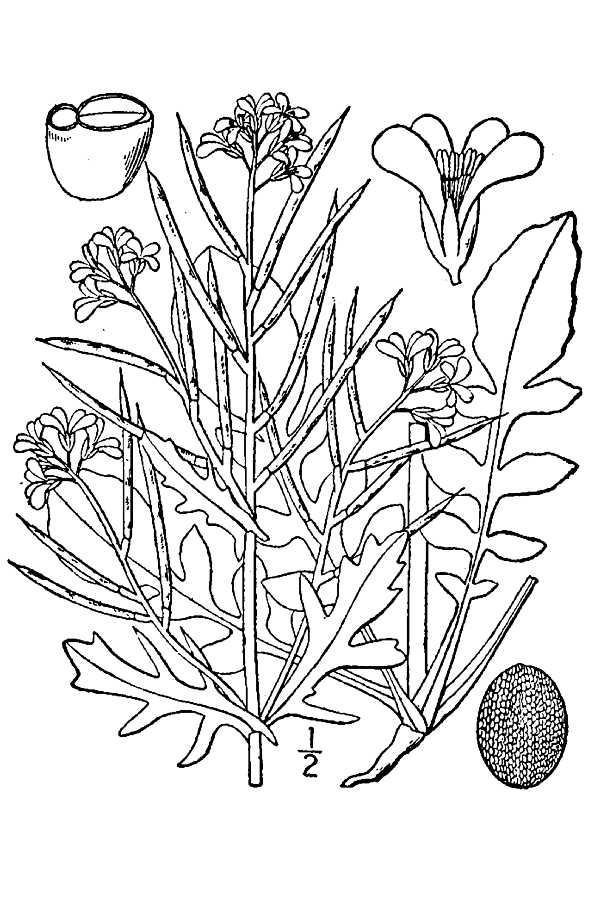
Wintercress (Barbarea vulgaris) is a biennial Eurasian herb in the mustard family that thrives in disturbed ground, displaying glossy basal rosettes through winter before shooting up yellow flower spikes.
While traditional foragers harvest the peppery overwintered foliage as wild greens, garden owners more often encounter it as an aggressive self-seeder in turf and agricultural beds.
Key Facts
- Plant cycle: biennial forming basal rosettes in year one
- Flowering period: April to July
- Height: 30–90 cm (12–35 in) tall when flowering
- Edibility: young leaves edible cooked or raw; pungent mustard flavour
- Dispersal: produces thousands of small seeds per mature plant
Living with Wintercress in the Garden
Wintercress operates as a cold-hardy biennial pioneer that establishes silently in autumn and bolts rapidly as temperatures rise above 10 °C (50 °F) in spring.
Foragers appreciate its green rosettes because they remain tender and green beneath snowbanks when cultivated greens have perished. In formal lawns and cultivated vegetable patches, its deep taproot makes hand-pulling stubborn once the flower stalk develops.
How to Identify Wintercress
Wintercress forms a basal rosette of dark green, glossy lyre-shaped leaves that reach 5–15 cm (2–6 in) in length during its first year.
Key diagnostic features visible on mature plants include:
- Basal leaves: large, rounded terminal lobe with 1–4 smaller paired lateral lobes along the stalk
- Stem leaves: alternately arranged, smaller, clasping the ridged stem with toothed or lobed margins
- Flowers: bright yellow, 4-petalled, 6–8 mm (0.25–0.3 in) across, clustered in dense terminal racemes
- Seed pods: slender, upright siliques measuring 15–30 mm (0.6–1.2 in) long held stiffly on thin stalks
Habitat and Distribution
Native to temperate Eurasia, wintercress naturalises readily in moist, disturbed soils across North America, Australia, and New Zealand.
It colonises roadsides, cultivated agricultural ground, riverbanks, ditch edges, and poorly maintained turf. The species shows a strong preference for damp loam or clay soils with moderate nitrogen levels, though it can survive in gravelly waste ground.
Ecological Role and Insect Interactions
Wintercress flowers provide early-season nectar and pollen for solitary bees, hoverflies, and small beetles starting in mid-spring.
The plant produces specific glucosinolates and triterpenoid saponins that act as a natural dead-end trap crop for the diamondback moth (Plutella xylostella). While female moths readily lay eggs on the foliage, the resulting larvae cannot digest the leaves and starve, reducing local pest pressure on related crops like cabbage.
Conservation and Invasiveness
Wintercress holds a conservation status of Least Concern and is considered an introduced agricultural weed throughout much of North America.
Single specimens produce between 5,000 and 10,000 seeds that remain viable in the soil seed bank for several years. While not usually choking out pristine native woodlands, it outcompetes pasture grasses and contaminates forage hay fields.
Foraging and Traditional Uses of Creasy Greens
Young first-year leaves are harvested for food before flower buds appear in spring when bitterness levels are lowest.
In the Appalachian region, gatherers steam or boil the rosettes as “creasy greens” with bacon fat to mellow their sharp, cress-like pungency. In European folk medicine, the herb was traditionally used as a fresh poultice for minor cuts and consumed as an antiscorbutic winter tonic rich in vitamin C.
How to Eliminate Bittercress in Lawns and Beds
The most effective physical removal method is to sever the taproot 5 cm (2 in) below the crown before flower pods turn brown.
To clear an infestation without chemicals, apply these targeted practices:
- Hand weed after rain: moist soil loosens the grip of the taproot so the rosette pulls free without snapping
- Mow regularly: cut turf at 7 cm (2.8 in) to shade out germinating biennial seeds in late summer
- Mulch garden beds: spread a 5–8 cm (2–3 in) layer of wood chips or straw to block light from the soil bank
- Targeted post-emergent treatment: apply a broadleaf lawn herbicide in late autumn when rosettes actively pull sugars down to their roots
Wintercress Look-Alikes and Similar Species
Wintercress is most frequently confused with other yellow-flowered wild brassicas and common lawn bittercresses.
Compare these distinct species when identifying your find:
- Hairy bittercress (Cardamine hirsuta): much smaller annual with tiny white flowers, explosive seed pods, and hairy leaf stalks
- Wild mustard (Sinapis arvensis): annual with bristly stems, lighter green leaves lacking glossy sheen, and angular seed pods
- Black mustard (Brassica nigra): taller summer plant reaching 1.8 m (6 ft) with coarsely lobed lower leaves and four-sided pods pressed flat to the stem
- Marsh yellowcress (Rorippa palustris): found in standing mud, bearing much smaller yellow petals that barely equal the sepals in length
Frequently Asked Questions
Is bittercress edible?
Yes, the foliage of wintercress is edible, offering a peppery mustard flavour. Harvest the basal leaves in late winter or early spring before the yellow flower stalks appear, as mature leaves become intensely bitter.
Is bittercress poisonous to dogs?
Wintercress is mildly toxic to dogs if consumed in large quantities because it contains glucosinolates that irritate the stomach lining. Small accidental nibbles rarely cause more than minor drooling or brief digestive upset.
What is the difference between wintercress and hairy bittercress?
Wintercress (Barbarea vulgaris) grows up to 90 cm (35 in) tall with glossy foliage and vivid yellow flowers, whereas hairy bittercress (Cardamine hirsuta) is a small weed under 30 cm (12 in) bearing tiny white flowers.
Why is wintercress called Herb Barbara?
It was historically dedicated to Saint Barbara because its cold-hardy rosettes provided fresh green edible leaves around her feast day on December 4th.
How do you stop wintercress from spreading in turf?
Mow high at 7–8 cm (3 in) to maintain dense turf that shades out germinating seeds, and dig out visible rosettes with a weeding fork before they bloom in April.
Information about traditional or historical uses is provided for educational interest only and is not medical advice. Do not use any plant to treat a condition without speaking to a qualified professional.
Sources & Verification
Taxonomy and distribution are checked against the databases below. Care guidance is written for cultivated species only and reviewed by our editor. How We Build Plant Profiles →
- Kew Plants of the World OnlineTaxonomy, native range, and synonymy
- NC State Extension Gardener Plant ToolboxMorphology, weed status, and ecological data
- Missouri Botanical Garden Plant FinderHabit and growth characteristics
- USDA PLANTS DatabaseDistribution and weed characterisation
- GBIF — Global Biodiversity Information Facilitytaxonomy, synonyms, occurrence records
- Wikipediageneral reference