
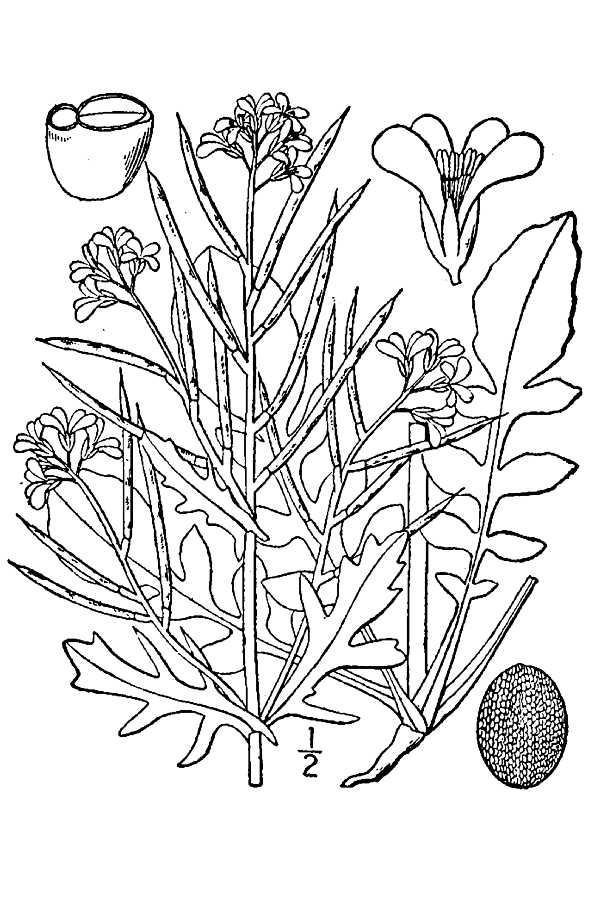
American cress (Barbarea verna) is a biennial salad green native to southern Europe and western Asia, recognised by its dark, pinnately lobed rosettes and sharp, peppery flavour. It produces edible leaves throughout autumn and winter without requiring the running water essential for true watercress.
The plant tolerates frosts down to -15 °C (5 °F) and produces harvests when summer salad crops fail. In warm spring weather, it bolts quickly into yellow flower spikes that turn the leaves bitter.
Key Facts
- Type: Hardy biennial brassica grown as a cool-season annual
- Sowing depth: 0.5 cm (0.2 in) in firm soil
- Position: Partial shade in summer; full sun in winter
- Soil moisture: Consistently moist but well-drained
- Harvest: Cut-and-come-again rosettes within 50 to 60 days
- Hardiness: USDA zones 5 through 9
Growing American Cress in the Garden
American cress is a cool-season green that thrives in damp, fertile garden beds where traditional salad greens struggle during cold months. It provides a sharp culinary substitute for watercress (Nasturtium officinale) without the need for ponds, aquatic troughs, or moving water systems.
Because it establishes rapidly from seed, growers often slot it into empty beds left behind by harvested summer potatoes or sweetcorn. The plant performs best during short, cool days and quickly declines once high summer heat triggers premature flowering.
American Cress Identification and Botanical Features
You can identify Barbarea verna by its low rosette of glossy, dark green basal leaves bearing 4 to 10 pairs of lateral lobes and a distinctly rounded terminal lobe. Stems remain compact at 15–25 cm (6–10 in) during the vegetative stage before elongating up to 60 cm (24 in) during the second year’s flowering phase.
In mid-spring, the rosette produces upright, branched racemes carrying small, four-petaled yellow flowers typical of the mustard family (Brassicaceae). The blooms are followed by slender, four-angled seed pods called siliques, which measure 4 to 7 cm (1.6 to 2.8 in) in length and stand erect on thick, short stalks.
- Basal leaves: Pinnatifid, 10–20 cm (4–8 in) long, with 4–10 pairs of lateral lobes
- Stem leaves: Smaller, clasping the stem with ear-shaped basal lobes
- Flowers: Pale yellow, 5–8 mm (0.2–0.3 in) across, arranged in terminal racemes
- Seed pods: Linear, upright siliques 4–7 cm (1.6–2.8 in) long containing small brown seeds
Soil and Sun Requirements
American cress grows best in partial shade during early autumn and late spring, shifting to full sun in midwinter. Direct, unshaded summer sun causes soil drought and triggers rapid, bitter bolting.
The root system requires moisture-retentive, humus-rich soil with a pH between 6.0 and 7.5. Heavy clay amended with compost retains the damp conditions this plant prefers, while sandy soils require mulching with leaf mould to prevent drying out.
Sowing American Cress Seeds
Sow seeds 0.5 cm (0.2 in) deep in finely raked drills spaced 30 cm (12 in) apart between late summer and early autumn for prime winter harvests. Spring sowings are also possible in March or April, though these crops bolt rapidly as days lengthen and temperatures rise.
Germination occurs within 7 to 14 days at soil temperatures between 10 and 20 °C (50–68 °F). Thin emerging seedlings in two stages to prevent crowding and mildew:
- First thinning: Space seedlings to 7 cm (3 in) apart once true leaves appear
- Final spacing: Leave plants 15–20 cm (6–8 in) apart to allow full rosette expansion
- Succession: Sow every 3 weeks from August through September for continuous pickings
Water and General Crop Care
Keep the soil consistently damp, applying 2.5 cm (1 in) of water per week in the absence of steady rainfall. Water stress instantly intensifies the pungent mustard oils in the foliage, rendering the leaves unpleasantly hot and tough.
A light mulch of compost or shredded leaves suppresses weed competition and insulates the soil surface against sudden hard freezes. No synthetic nitrogen fertilizer is required; excessive feeding produces soft, watery leaf growth that succumbs easily to winter rot and downy mildew.
How to Harvest American Cress
Begin harvesting 50 to 60 days after sowing by snipping individual outer leaves with sharp kitchen scissors. Always leave the central growing crown untouched so the rosette can generate fresh leaves throughout the season.
Pick leaves when they reach 8 to 12 cm (3 to 5 in) in length for the best balance of crunch and peppery bite. In areas with sustained sub-zero temperatures, protect plants with a fleece tunnel or cloche to keep the leaves tender and prevent windburn.
Culinary Uses and Flavour Profile
American cress leaves are fully edible raw or cooked, delivering a pungent, peppery flavour that closely matches wild watercress. The leaves contain high concentrations of glucosinolates, giving them a mustard-like heat that pairs well with rich dishes.
In the American South, where the crop is traditionally known as creasy greens, cooks simmer the mature leaves with bacon drippings, onion, and broth. Young leaves are shredded raw into mixed winter salads, blended into cold-season pestos, or layered into egg and mayonnaise sandwiches.
Pest and Disease Management
Flea beetles (Phyllotreta species) are the primary pest, chewing hundreds of tiny holes in young foliage during dry late-summer spells. Covering newly sown beds immediately with fine insect mesh (0.8 mm) excludes the beetles completely.
Slugs (Deroceras reticulatum) and snails attack the outer foliage during damp autumn nights, while downy mildew can appear in poorly ventilated winter cold frames. Spacing plants generously and clearing decaying lower foliage keeps fungal infections under control.
Storing and Preserving Fresh Cress
Store unwashed leaves in the refrigerator wrapped in a damp paper towel inside a ventilated container for up to 7 days. The leaves wilt quickly if exposed to dry circulating air in modern frost-free refrigerators.
For longer preservation, mature leaves can be blanched in boiling water for 60 seconds, plunged into ice water, drained thoroughly, and frozen in solid blocks for winter soups. Dried leaves lose their characteristic mustard oils and are not recommended for culinary use.
Year-Round Growing Calendar for American Cress
| Spring | Harvest the remaining overwintered leaves before yellow flower stems emerge. Pull bolted plants to clear beds for warm-season vegetables, or leave one plant to set seed for autumn. |
|---|---|
| Summer | Collect dry brown seed pods from flowering plants in July for later planting. Prepare shaded garden beds in late August by working in 5 cm (2 in) of aged organic matter. |
| Autumn | Sow seeds directly into moist soil through September. Thin seedlings to 15–20 cm (6–8 in) and water regularly during dry spells to establish strong rosettes. |
| Winter | Harvest outer leaves regularly throughout mild spells. Cover beds with horticultural fleece or cold frame sashes when temperatures drop below -5 °C (23 °F) to preserve leaf quality. |
Common American Cress Problems and Solutions
| What you see | Likely cause | What to do |
|---|---|---|
| Tiny shotgun holes scattered over young leaves | Flea beetle infestation during warm, dry weather | Erect fine horticultural insect mesh immediately over the crop and keep soil damp. |
| Plant forms a tall central stem with yellow flowers; leaves taste bitter | Premature bolting caused by long days, heat, or root dryness | Sow in late summer rather than spring, and ensure soil stays continuously moist. |
| Grey fuzzy fungal growth on the undersides of leaves | Downy mildew encouraged by overcrowded planting and cold, stagnant air | Thin plants to at least 15 cm (6 in) apart and ventilate cloches or frames daily. |
| Leaf margins turn yellow, limp, and papery | Prolonged soil drought combined with drying winds | Soak the bed thoroughly with 2.5 cm (1 in) of water and apply an organic mulch. |
Frequently Asked Questions
Is American cress edible?
Yes, both the leaves and young flowering shoots are fully edible. They provide a peppery, spicy flavour identical to watercress and are rich in vitamins A and C.
What is the difference between Barbarea verna and Barbarea vulgaris?
Barbarea verna has leaves with 4 to 10 pairs of lateral lobes, whereas bittercress (Barbarea vulgaris) has fewer lobes, typically only 1 to 4 pairs. Barbarea verna also has much longer, erect seed pods and a milder, more palatable flavour for culinary use.
Why is American cress called scurvy cress?
It was traditionally gathered and eaten by sailors and coastal communities to prevent scurvy due to its exceptionally high vitamin C content during winter months when fresh fruit was unavailable.
Does American cress come back every year?
No, it is a biennial plant that lives for two growing seasons. It produces leaves in its first autumn and winter, flowers and sets seed the following spring, and then dies.
Can you grow American cress in containers?
Yes, it grows well in pots at least 20 cm (8 in) deep filled with peat-free multi-purpose compost. Position the pot in partial shade and water frequently to prevent the compost from drying out.
Information about traditional or historical uses is provided for educational interest only and is not medical advice. Do not use any plant to treat a condition without speaking to a qualified professional.
Sources & Verification
Taxonomy and distribution are checked against the databases below. Care guidance is written for cultivated species only and reviewed by our editor. How We Build Plant Profiles →
- Royal Horticultural SocietyCultivation and harvesting guidance for land cress
- Plants of the World Online (Kew)Native distribution and taxonomy of Barbarea verna
- North Carolina State Extension Plant ToolboxBotanical description, identification traits, and ecology
- GBIF — Global Biodiversity Information Facilitytaxonomy, synonyms, occurrence records
- Wikipediageneral reference
