
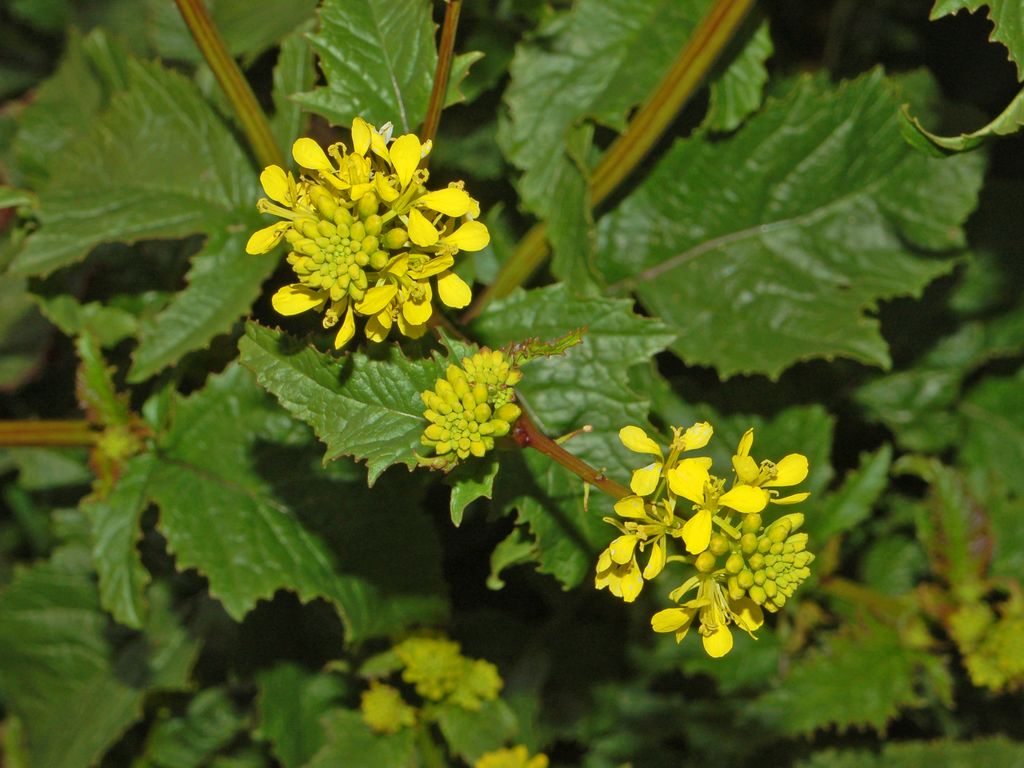
Charlock is a fast-growing annual wildflower native to Europe, North Africa, and Asia, belonging to the cabbage family Sinapis arvensis. It is most frequently recognized by its clusters of four-petaled yellow flowers and its ability to thrive in disturbed agricultural soils.
While often treated as a common weed in cereal crops, it serves as a vital nectar source for pollinators. Its seeds are remarkably long-lived, remaining viable in the ground for several decades until the soil is turned.
Key Facts
- Family: Brassicaceae (Mustard family)
- Life Cycle: Annual or winter annual
- Height: Typically 30-80 cm (12-31 in)
- Bloom Time: May to September
- Seeds: Up to 2,000 produced per plant
Why Charlock Appears in Your Field
Charlock is a rapid coloniser of disturbed ground, often appearing overnight in tilled fields or garden borders where the soil has been recently turned. You will likely encounter it as a volunteer rather than a deliberate planting, as its seeds can remain dormant in the soil for 50 years or more.
It suits those interested in foraging or supporting local butterfly populations, but it requires management to prevent it from outcompeting smaller native flora in a meadow setting. In agricultural settings, it is often viewed as a competitor to wheat and barley, as it is highly efficient at extracting nitrogen from the earth.
How to Identify Sinapis arvensis
Identification of Sinapis arvensis begins with the stems, which are typically 30-80 cm (12-31 in) tall and covered in stiff, downward-pointing bristles near the base. The flowers are bright yellow, measuring 15-20 mm (0.6-0.8 in) across, with four petals arranged in a cross shape characteristic of the Brassicaceae family.
The leaves and fruit provide further clues for a positive ID:
- Lower Leaves: Stalked and deeply lobed with a large terminal section.
- Upper Leaves: Smaller, lance-shaped, and lack stalks (sessile).
- Seedlings: Produce kidney-shaped cotyledons with a distinct notch at the tip.
- Fruit: A silique (pod) 2-4.5 cm (0.8-1.8 in) long with a prominent flattened beak.
- Sepals: Spread horizontally, unlike many other mustard species.
Where Wild Mustard Grows Best
This species thrives in open, sunny locations with nutrient-heavy, calcareous, or clay-based soils. You will frequently spot it in arable fields, waste ground, and along railway embankments across Europe and North America. It is a nitrogen-indicator, meaning its presence often suggests high levels of nitrates in the substrate.
While it prefers full sun, it can tolerate partial shade at the edges of hedgerows. It is rarely found in acidic or waterlogged peat soils, preferring the stability of heavy clay or chalky loams. Because it is an annual, it relies on annual soil disturbance to clear space for its seedlings to emerge.
The Role of Charlock in Local Ecosystems
Charlock is a vital food source for several specialist insects, particularly the larvae of the small white butterfly (Pieris rapae) and the green-veined white butterfly (Pieris napi). The flowers produce significant amounts of nectar and pollen, attracting hoverflies, honeybees, and solitary bees during its long blooming period from May to September.
Because it often flowers during gaps in the agricultural calendar, it provides a bridge for pollinators when other sources are scarce. Birds such as the linnet (Linaria cannabina) frequently consume the oily seeds during the winter months. However, in high densities, it can reduce the yields of nearby crops by harboring pests like the cabbage root fly.
Is Sinapis arvensis an Endangered Species?
Currently, charlock is classified as Least Concern (LC) and is not at risk of extinction. In many regions where it has been introduced, such as North America and Australia, it is managed as an agricultural weed because it competes with cereal crops for moisture and nutrients.
It is highly successful due to its prolific seed production, with a single plant capable of producing up to 2,000 seeds per season. While modern herbicides have reduced its prevalence in intensive farming, it remains a common sight in organic fields and roadside verges. Its survival is aided by the extreme longevity of its seed bank.
Traditional and Edible Uses of Wild Mustard
The young leaves of wild mustard were traditionally used as a potherb or salad green, offering a pungent, peppery flavour similar to arugula (Eruca vesicaria). The seeds can be crushed and mixed with vinegar to create a rustic mustard paste, though they are less potent than commercial black mustard (Brassica nigra).
In historical folk medicine, the plant was traditionally used as a topical poultice for joint pain and respiratory issues. The stems can be boiled and eaten like broccoli, provided they are harvested before the flowers open and the plant becomes too fibrous. Always ensure the foraging site is free from agricultural chemical runoff before consumption.
Distinguishing Charlock from Similar Yellow Weeds
Distinguishing charlock from its relatives requires looking at the sepals and seed pods. While many yellow-flowered crucifers look identical from a distance, Sinapis arvensis has unique botanical markers that separate it from look-alikes like wild radish.
- Wild Radish (Raphanus raphanistrum): Sepals press against the petals; charlock sepals spread horizontally.
- Black Mustard (Brassica nigra): Seed pods press tightly against the stem; charlock pods spread outwards.
- White Mustard (Sinapis alba): Pods have very hairy, flat beaks longer than the seed-bearing part.
- Oilseed Rape (Brassica napus): Upper leaves clasp the stem; charlock upper leaves do not clasp.
Frequently Asked Questions
Is Sinapis arvensis edible?
Yes, the young leaves can be eaten raw in salads or boiled as a vegetable, and the seeds can be used to make mustard. However, the plant becomes bitter and tough once it begins to flower.
Is wild mustard toxic to dogs or livestock?
The seeds contain glucosinolates which can be mildly toxic to livestock and pets if consumed in large quantities, potentially causing digestive irritation. Most animals avoid the plant due to its bitter taste.
How do I get rid of charlock in my garden?
The most effective method is hand-pulling the plants before they have a chance to set seed. Since seeds can live for 50 years in the soil, preventing new seed rain is essential for long-term control.
What is the difference between Sinapis arvensis and Brassica rapa?
Sinapis arvensis has sepals that spread out horizontally and leaves that do not clasp the stem, whereas Brassica rapa (Field Mustard) has sepals that stay more upright and upper leaves that partially clasp the stem.
Information about traditional or historical uses is provided for educational interest only and is not medical advice. Do not use any plant to treat a condition without speaking to a qualified professional.
Sources & Verification
Taxonomy and distribution are checked against the databases below. Care guidance is written for cultivated species only and reviewed by our editor. How We Build Plant Profiles →
