
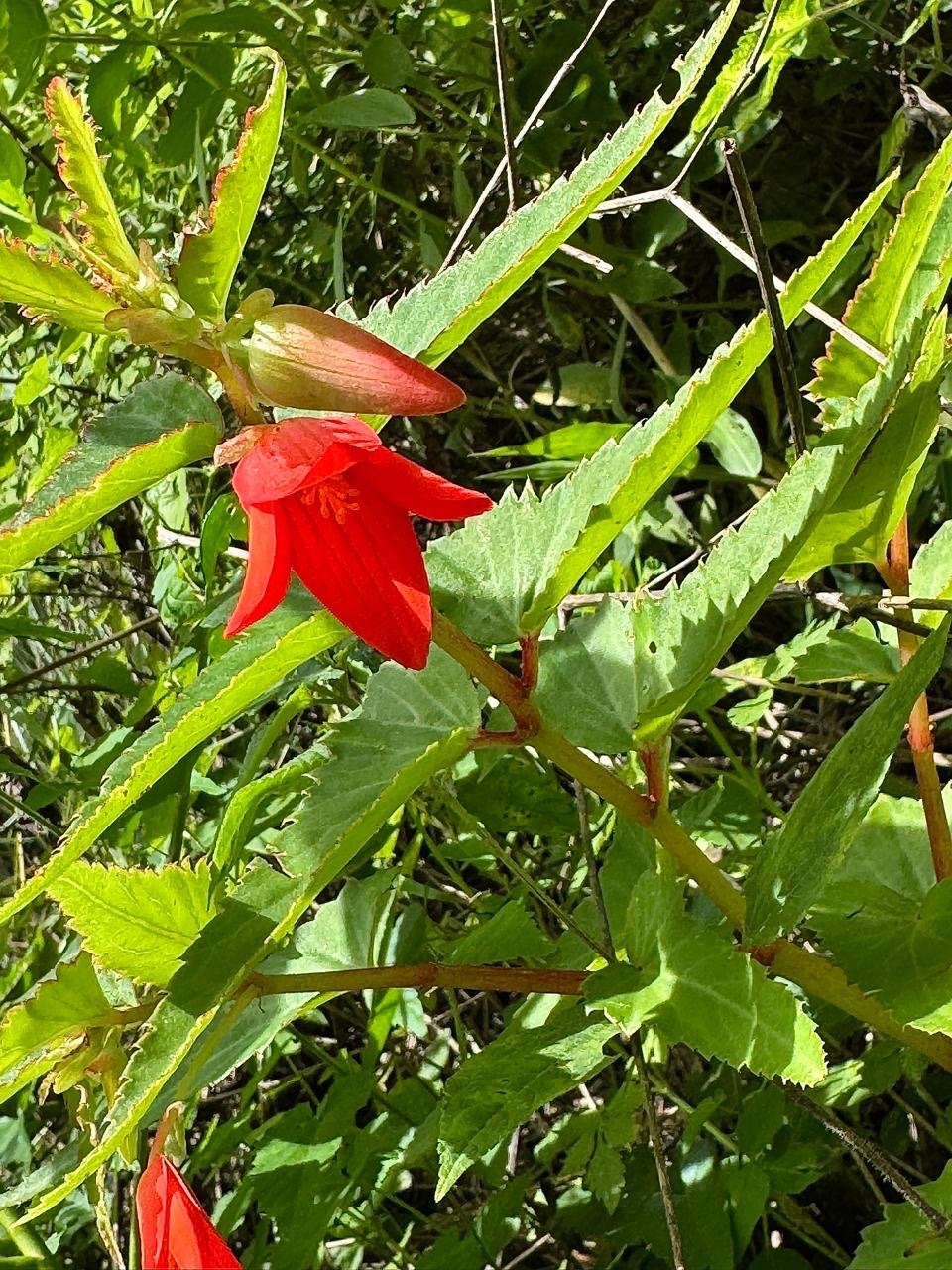
Bolivian begonia (Begonia boliviensis) is a tuberous perennial native to moist mountain rock crevices in Bolivia and Argentina. It produces trailing stems that reach 30-60 cm (12-24 in) in length, bearing pointed leaves and fiery, bell-shaped flowers from late spring until autumn frost.
In USDA zones 9 to 11, the plant survives winter outdoors, while growers in colder zones lift the tubers before temperatures drop below 5 °C (41 °F). It requires free-draining potting soil to prevent tuber rot during active growth.
Key Facts
- Hardiness: USDA zones 9–11; tender perennial
- Light: Morning sun with partial afternoon shade
- Water: Keep soil evenly moist, never soggy
- Height: 30–60 cm (12–24 in) trailing
- Toxicity: Toxic to pets if tubers are ingested
Growing Bolivian Begonia in Baskets and Containers
Bolivian begonia thrives in hanging baskets, window boxes, and elevated pots where arching stems cascade over container edges. Individual plants grow 30–60 cm (12–24 in) long and spread up to 60 cm (24 in) wide. High summer heat above 32 °C (90 °F) slows shoot growth, so container placement requires shelter from intense afternoon sunlight.
The arching habit suits elevated containers better than flat garden beds, as long stems can break under heavy rain or wind. A single 25 cm (10 in) hanging basket accommodates two to three tubers for a dense display.
- Container depth: Minimum 15 cm (6 in) for root space
- Drainage: Must have bottom drainage holes
- Placement: Sheltered porches, balconies, or patio edges
Bolivian Begonia Physical Characteristics
Bolivian begonia features lance-shaped, pointed leaves with serrated reddish edges arranged alternately along reddish stems. Stems grow from a thick subterranean tuber, branching freely to create a rounded, weeping canopy.
Flowers hang in clusters of two or three at stem tips. Individual blooms measure 4–5 cm (1.5–2 in) long, featuring four narrow, pointed tepals that form a drooping bell shape. Wild forms produce orange-red flowers, while modern cultivars include white, pink, yellow, and deep red varieties.
Sun or Shade Requirements for Bolivian Begonia
Bolivian begonia performs best in partial shade receiving 4 to 6 hours of morning sun. Deep shade reduces bloom count and causes stems to stretch, while midday summer sun scorches leaf tips.
In cool coastal locations, plants accept full sun if soil moisture remains consistent. In hot interior climates, shade between 11:00 and 15:00 prevents foliage damage and stem wilting.
Potting Mix and Planting Guidelines
Plant tubers in spring after frost risk ends, setting them concave-side up under 2.5 cm (1 in) of potting soil. Use a lightweight, peat-based or coir-based mix with a pH of 5.5 to 6.5.
Amending commercial potting soil with 20 percent perlite ensures fast water movement away from the tuber. Dense garden soil holds excess water around dormant tubers, triggering bacterial decay within 7 to 10 days.
- Tuber orientation: Depressed side facing upward
- Planting depth: Cover with 2.5 cm (1 in) of soil
- Initial watering: Keep soil barely moist until shoots appear
- Spacing: Space tubers 15–20 cm (6–8 in) apart
Watering and Fertilizer Schedule
Water whenever the top 2.5 cm (1 in) of soil feels dry to the touch. Apply water directly to the soil surface rather than splashing foliage or the center of the tuber crown.
Feed every 14 days from May through August using a liquid fertilizer balanced at 10-10-10 diluted to half strength. Taper off feeding in September as daylight hours shorten and growth rate decreases.
How to Prune Bolivian Begonia
Pinch stem tips back by 2.5 cm (1 in) when shoots reach 10–15 cm (4–6 in) in height to stimulate branching. Pruning early in the season results in a bushier plant with more flowering side shoots.
Remove dead leaves and yellowing stems weekly to maintain air circulation. Old flowers drop cleanly on their own, but trimming spent flower stalks prevents grey mould from colonising lower foliage.
How to Propagate Bolivian Begonia
Propagate Bolivian begonia by taking 7–10 cm (3–4 in) stem cuttings in late spring or sowing seeds indoors 12 weeks before the last frost. Cuttings root within 14 to 21 days in moist perlite held at 20–22 °C (68–72 °F).
Tuber division offers another propagation route for mature specimens in early spring. Slice large tubers with a clean knife, ensuring every section contains at least one active eye bud.
- Cuttings: Take non-flowering stem tips with two leaf nodes
- Seeds: Dust fine seeds over soil surface; do not cover
- Tubers: Allow cut surfaces to callus for 24 hours before planting
Overcoming Common Pests and Diseases
Powdery mildew and tuber rot represent the main health issues, occurring when air circulation is poor or soil remains waterlogged. White powdery patches on foliage indicate mildew infection during humid conditions.
Aphids occasionally gather on tender shoot tips, while vine weevil larvae target roots and tubers in containers. Spray aphid colonies with insecticidal soap and avoid overwatering to deter soil pests.
- Powdery mildew: Apply sulfur spray and space containers apart
- Tuber rot: Reduce watering frequency and improve soil drainage
- Aphids: Wash off with warm water or insecticidal soap
- Vine weevils: Apply beneficial nematodes to container soil
How to Overwinter Bolivian Begonia
Overwinter Bolivian begonia by lifting tubers before autumn frosts and storing them at 10–13 °C (50–55 °F). Allow foliage to yellow naturally in autumn when temperatures dip to 5 °C (41 °F), transferring energy into the tuber.
Dig up tubers, cut away dried stems, and let tubers air-dry for 7 days in a dry room. Pack dried tubers in boxes filled with dry peat moss or sawdust, inspecting them monthly for soft spots until repotting in March.
Managing Blooms and Flowering Cycles
Plants flower continuously from late May until the first freezing temperature in autumn when grown in temperatures between 18–26 °C (65–78 °F). Sudden bloom drop indicates dry soil or temperature spikes above 35 °C (95 °F).
Excessive nitrogen fertilizer promotes leafy growth while suppressing flower buds. Switch to a high-phosphorus liquid formula if flower output drops during peak summer months.
Bolivian Begonia Seasonal Care Calendar
| Spring | Pot up stored tubers in March in a warm room at 18–21 °C (65–70 °F). Pinch back young shoots when 10–15 cm (4–6 in) tall. Move containers outdoors after all frost danger passes. |
|---|---|
| Summer | Water when top 2.5 cm (1 in) of soil dries out. Apply half-strength balanced liquid fertilizer every 14 days. Provide afternoon shade when temperatures exceed 30 °C (86 °F). |
| Autumn | Stop fertilizer applications in September. Reduce watering as growth slows. Lift tubers before the first frost, dry for 7 days, and store in dry peat moss. |
| Winter | Keep dormant tubers in a dark location at 10–13 °C (50–55 °F). Check tubers monthly and discard any showing signs of mould or soft rot. |
Bolivian Begonia Problems and Fixes
| What you see | Likely cause | What to do |
|---|---|---|
| Yellowing leaves and mushy stem bases | Overwatering or waterlogged potting mix | Allow soil to dry out between waterings and verify container drainage holes are clear. |
| White powdery patches on leaf surfaces | Powdery mildew infection due to high humidity and poor airflow | Move plant to a location with better air circulation and apply a copper fungicide. |
| Flower buds falling off before opening | Underwatering or heat stress above 32 °C (90 °F) | Keep soil evenly damp and relocate container to cooler afternoon shade. |
| Pale, stretched stems with few flowers | Insufficient light exposure | Move container to a spot receiving 4 to 6 hours of bright morning sun. |
Popular Bolivian Begonia Cultivars
- ‘Bonfire’ – bright orange-red flowers, dark green leaves with red margins
- ‘Santa Cruz Sunset’ – reddish-orange bell flowers, heat-tolerant compact habit
- ‘Mistral White’ – clear white flowers with yellow center stamens
- ‘Bellfire’ – deep bronze foliage paired with rich pinkish-red flowers
- ‘Bossa Nova Red’ – free-branching habit with brilliant red cascading blooms
Best Companion Plants for Containers
Pair Bolivian begonia with shade-tolerant species such as fuchsia (Fuchsia magellanica) and trailing lobelia (Lobelia erinus). These species thrive under identical moisture levels and partial shade exposure.
Other suitable container companions include sweet potato vine (Ipomoea batatas), wax begonia (Begonia cucullata), and impatiens (Impatiens walleriana). Select companions that share a preference for free-draining potting soil and morning sun.
Frequently Asked Questions
Is Bolivian begonia an annual or perennial?
Bolivian begonia is a tender perennial in USDA zones 9 to 11. In colder regions, growers treat it as an annual or lift its tubers in autumn to store indoors over winter.
Can Bolivian begonia grow indoors as a houseplant?
Yes, Bolivian begonia can grow indoors if placed in a bright window receiving morning sun. Indoor plants require high humidity and an autumn dormant period where tubers dry out.
Does Bolivian begonia prefer sun or shade?
It prefers partial shade with morning sunlight and afternoon protection. Full sun burns leaf tips in warm climates, while deep shade reduces flower production.
Are white Bolivian begonias available?
Yes, cultivars like 'Mistral White' produce white flowers on trailing stems. They require identical growing conditions and overwintering care as orange and red varieties.
How do you propagate Bolivian begonia from cuttings?
Take 7–10 cm (3–4 in) stem tips in late spring, insert them into damp perlite, and cover with plastic to retain humidity. Roots develop within 14 to 21 days at 20 °C (68 °F).
Sources & Verification
Taxonomy and distribution are checked against the databases below. Care guidance is written for cultivated species only and reviewed by our editor. How We Build Plant Profiles →
More in Begonia

Tuberous Begonia
Begonia tuberhybrida
☀️ Partial Shade 💧 Moderate
Polka Dot Begonia
Begonia maculata
☀️ Bright Indirect 💧 Moderate
Rex Begonia
Begonia rex
☀️ Bright Indirect 💧 Moderate

Wax Begonia
Begonia cucullata
☀️ Bright Indirect 💧 Moderate

Hardy Begonia
Begonia grandis
☀️ Partial Shade 💧 Moderate