
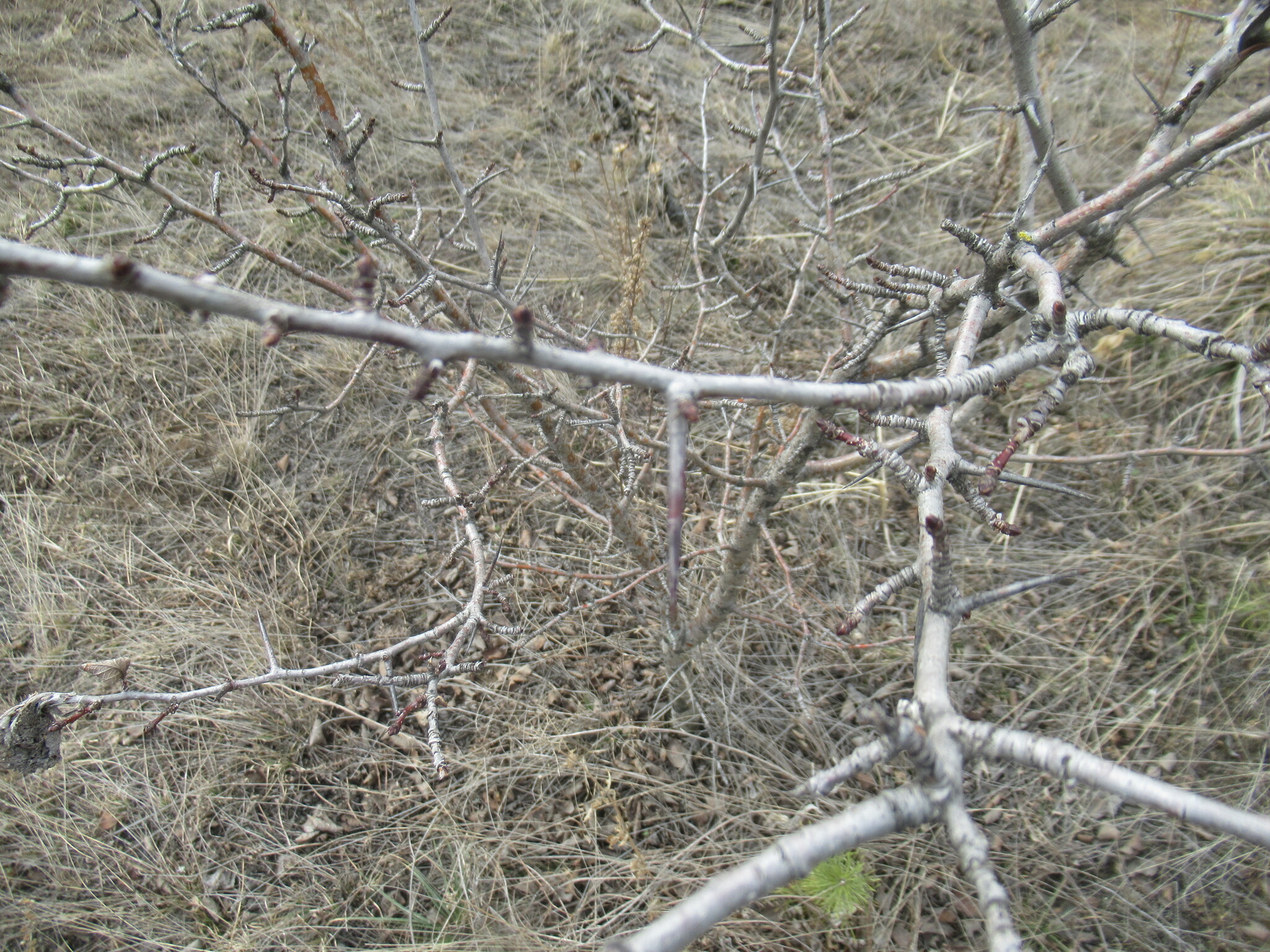
Red hawthorn (Crataegus sanguinea) is a deciduous small tree or large shrub native to southern Siberia, Mongolia, and northern China. It forms a rounded, thorny crown with glossy dark green leaves that turn orange and red in autumn.
This species withstands extreme winter cold down to -40 °C (-40 °F) and produces bright red edible pomes in early autumn. Its spring white flowers emit a distinct scent that attracts specialized dipteran pollinators.
Key Facts
- Hardiness: USDA Zones 2 to 6
- Light: Full sun to partial shade
- Height: 3–7 m (10–23 ft)
- Fruit: Edible red pomes in late summer
- Soil: Moist, well-draining loams or clays
Is Red Hawthorn Suitable for Your Landscape?
Red hawthorn suits cold-climate landscapes where winter temperatures drop below -30 °C (-22 °F) and soil remains moist. It provides cold hardiness unmatched by standard fruit trees while serving as a functional boundary plant or windbreak.
Its sharp thorns require careful placement away from high-traffic pedestrian paths or play spaces. A single mature tree occupies up to 5 m (16 ft) of lateral garden space.
- Zone range: USDA hardiness zones 2 to 6
- Space requirement: Clear clearance of 4 m (13 ft) from walls and driveways
- Maintenance level: Low maintenance after root establishment
How to Identify Crataegus sanguinea
Red hawthorn produces 8–12 mm (0.3–0.5 in) spherical glossy red pomes containing 3 to 5 hard pyrenes alongside purplish-brown thorny twigs. The bark turns grey-brown with shallow fissures as branches mature.
Leaves are broadly ovate, measuring 5–9 cm (2–3.5 in) long and 4–7 cm (1.5–2.7 in) wide, with 3 to 5 pairs of shallow, serrated lobes. In May and June, corymbs holding 10 to 20 small white flowers open at the branch tips.
- Bark: Dark grey with sharp 1–2.5 cm (0.4–1 in) straight thorns
- Foliage: Dark green above, paler with soft hairs along veins beneath
- Fruit: Bright red, soft pomes maturing in August and September
Mature Size and Growth Rate
Crataegus sanguinea reaches a mature height of 3 to 7 m (10 to 23 ft) with a crown spread of 3 to 5 m (10 to 16 ft). It forms a short central trunk with spreading lateral branches.
Young saplings grow at a moderate rate of 25 to 40 cm (10 to 16 in) per year under full sunlight. Vertical extension slows after 12 to 15 years as energy shifts to crown expansion and fruit production.
Where to Plant Siberian Hawthorn
Select a site receiving at least 6 hours of direct sun daily with fertile, moisture-retentive soil. Full sun produces maximum bloom density and heavy fruit sets.
Siberian hawthorn tolerates heavy clay and slightly alkaline soils, provided drainage prevents prolonged standing water. Maintain a soil pH between 6.0 and 7.5 for efficient nutrient uptake.
How to Plant Red Hawthorn
Dig a hole twice as wide as the root ball and set the root collar flush with surrounding ground level in spring. Backfilling with native soil mixed with aged compost speeds root development.
Water immediately after planting with 20 L (5 gal) to settle air pockets around feeder roots. Maintain a wide weed-free circle around the base for three seasons.
- Soaking: Soak bare-root stock for 4 hours prior to planting
- Hole size: Excavate 60 cm (24 in) wide by 40 cm (16 in) deep
- Mulching: Spread a 7 cm (3 in) bark layer, keeping 10 cm (4 in) clear of bark
Watering and Soil Care
Provide 25 mm (1 in) of water weekly during the first two growing seasons whenever natural rainfall falls short. Established trees rely on deep root systems and require supplemental watering only during extended droughts.
Apply 100 g of balanced 10-10-10 granular fertilizer around the dripline in early April before spring buds break. Excess nitrogen reduces flower density and encourages soft stem growth susceptible to sap-feeding insects.
How to Prune Crataegus sanguinea
Prune Siberian hawthorn during late winter dormancy between January and March before sap begins flowing. Removing dead wood and crossed limbs maintains an open canopy structure.
Trim suckers arising from the root collar promptly to prevent dense thicket formation. Disinfect pruning shears in 70% isopropyl alcohol between cuts to prevent pathogen transmission.
- Timing: Late winter dormant period
- Sucker removal: Cut flush at the root collar base
- Canopy thinning: Remove up to 15% of interior wood to improve air movement
Common Pests and Plant Diseases
Hawthorn rust (Gymnosporangium species) causes yellow-orange leaf spots and early defoliation during rainy spring weather. This fungal disease requires nearby alternate hosts such as eastern red cedar (Juniperus virginiana) to complete its lifecycle.
Aphids occasionally colonize shoot tips in early summer. Wash colonies off with high-pressure water spray before leaves curl around feeding sites.
Winter Care for Red Hawthorn
Install a 60 cm (24 in) wire mesh cylinder around young trunks before winter snow to prevent rabbit and vole damage. Mature trees require no frost protection across USDA zones 2 to 6.
Apply a deep autumn soaking before ground freezing occurs in November. Moisture-rich soil around roots guards against winter desiccation caused by cold winds.
Traditional Uses, Edible Berries, and Raw Material
The ripe red fruits and dried spring flowers of Crataegus sanguinea served historically in Siberian and East Asian medicine as herbal raw material (“сырье”). The pomes contain flavonoids, crataegic acids, and natural sugars.
Fresh pomes have a sweet, mealy flesh surrounding hard seeds. They are gathered in September for jelly, fruit syrups, and berry pastes, or dried for herbal infusions.
- Edible pomes: Harvested in late summer for jams, preserves, and wine
- Herbal raw material: Dried blossoms and fruits processed for traditional remedies (“сырье”)
- Wildlife food: Winter fruits sustain fieldfares, waxwings, and small mammals
Year-Round Care for Red Hawthorn
| Spring | Apply 100 g balanced granular fertilizer around the dripline in April. Plant bare-root saplings before leaf buds open. |
|---|---|
| Summer | Deliver 25 L of supplemental water during prolonged heat over 30 °C (86 °F). Monitor terminal shoots for aphid colonies. |
| Autumn | Harvest red fruits in September for cooking or drying. Spread a 7 cm (3 in) layer of wood chip mulch over the root zone. |
| Winter | Prune interior crossing branches while dormant in February. Check trunk guards to ensure rodents cannot chew bark. |
Diagnosing Red Hawthorn Problems
| What you see | Likely cause | What to do |
|---|---|---|
| Yellow-orange spots on upper leaf surfaces | Hawthorn rust infection (Gymnosporangium species) | Rake and destroy fallen leaves in autumn and avoid planting near host junipers. |
| Curled foliage with sticky honeydew drops | Aphid infestation on tender shoot tips | Spray leaves with insecticidal soap or a firm blast of clean water. |
| Premature fruit dropping before ripening | Extended summer drought stress | Provide 30 L of water weekly during prolonged dry spells. |
| Sharp odor near open flower clusters | Natural trimethylamine compounds in blooms | No action required as the smell naturally attracts pollinating flies and beetles. |
Cultivars and Forms of Crataegus sanguinea
- ‘Sanguinea’ – standard species selection valued for dense clusters of crimson pomes
- ‘Sieboldii’ – regional form noted for slightly larger leaf lobes and heavy fruit yield
Frequently Asked Questions
What is the common name for Crataegus sanguinea?
The main common name for Crataegus sanguinea is red hawthorn, though it is also widely known as Siberian hawthorn.
What does Crataegus sanguinea Pall stand for?
The designation "Pall" refers to Peter Simon Pallas, the 18th-century German botanist who first scientifically described Crataegus sanguinea during expeditions across Siberia.
What is Crataegus sanguinea raw material ("сырье") used for?
In Russian and North Asian herbal traditions, the dried flowers and ripe fruits of red hawthorn are harvested as botanical raw material ("сырье") to prepare traditional extracts, teas, and tinctures.
Is Crataegus good for the heart?
Hawthorn species, including Crataegus sanguinea, common hawthorn (Crataegus monogyna), and midland hawthorn (Crataegus laevigata), were traditionally used in regional herbalism for cardiovascular support, though modern medicinal use requires professional health guidance.
What are Crataegus Q uses in homeopathy?
Crataegus Q refers to a homeopathic mother tincture prepared from hawthorn berries or leaves, traditionally used in alternative practices for circulatory and heart complaints.
Are the berries of red hawthorn edible?
Yes, the red pomes of red hawthorn are edible raw or cooked, though they are most commonly boiled into jams, jellies, and fruit syrups after straining out the hard inner seeds.
Information about traditional or historical uses is provided for educational interest only and is not medical advice. Do not use any plant to treat a condition without speaking to a qualified professional.
Sources & Verification
Taxonomy and distribution are checked against the databases below. Care guidance is written for cultivated species only and reviewed by our editor. How We Build Plant Profiles →
More in Crataegus
Cockspur Hawthorn
Crataegus crus-galli
☀️ Full Sun 💧 Low

Fleshy Hawthorn
Crataegus succulenta
☀️ Full Sun 💧 Moderate

Mexican Hawthorn
Crataegus mexicana
☀️ Full Sun 💧 Moderate
Chinese Hawthorn
Crataegus pinnatifida
☀️ Full Sun 💧 Moderate

Yellowleaf Hawthorn
Crataegus flava
☀️ Full Sun 💧 Low

Broad-Leaved Cockspur-Thorn
Crataegus persimilis
☀️ Full Sun 💧 Moderate