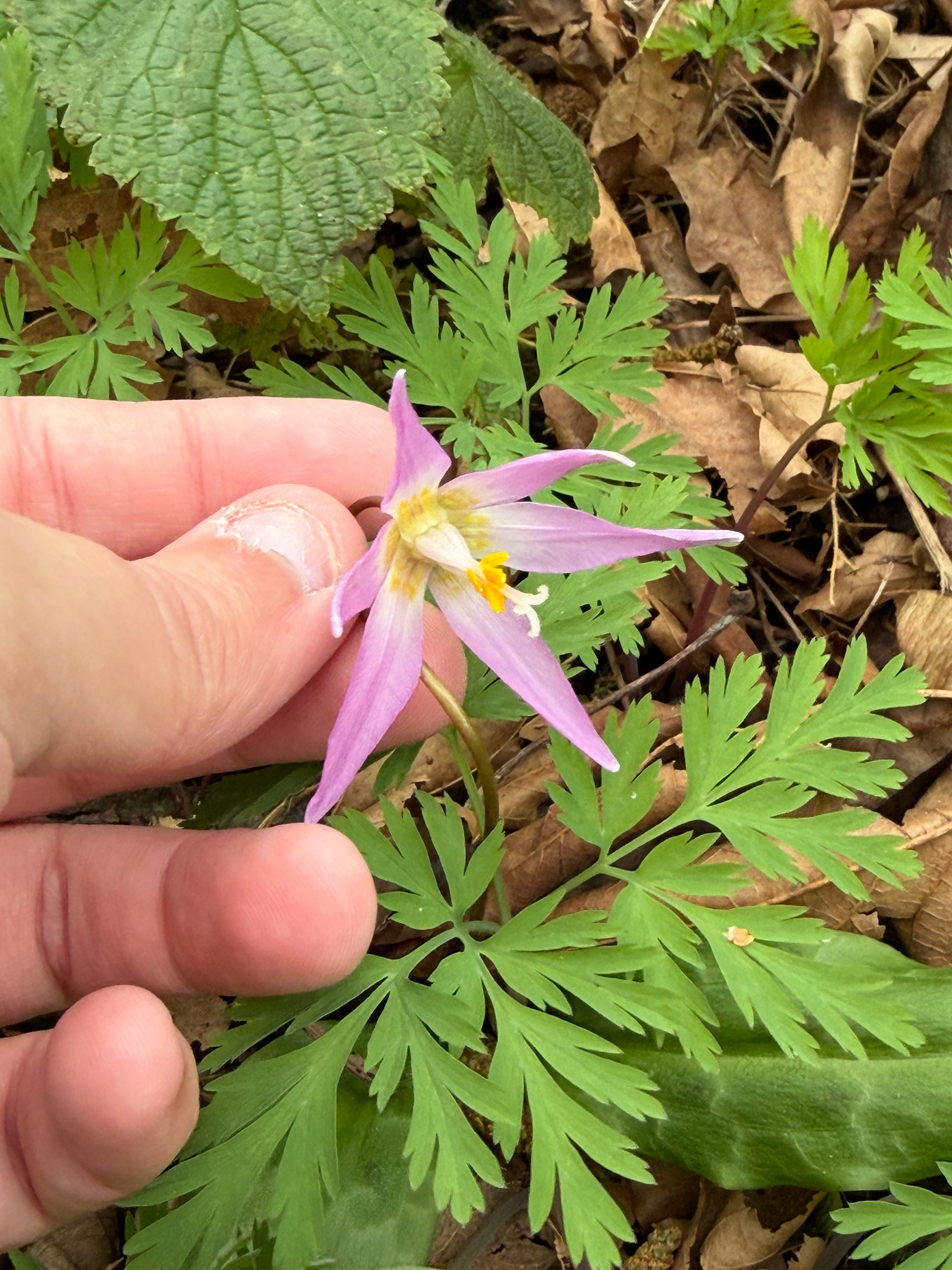
Trout lily (Erythronium americanum) is a perennial, colony-forming spring ephemeral native to moist woodlands across eastern North America. You will recognize it by its distinctive gray-green leaves mottled with brown spots and nodding yellow flowers that appear before the tree canopy leafs out.
As a true woodland ephemeral, this species completes its entire above-ground growth cycle in just a few spring weeks. Once summer arrives, the foliage dies back completely, leaving the bulb dormant underground until the next freeze triggers new growth.
Key Facts
- Plant Type: Herbaceous perennial wildflower
- Native Range: Eastern North America
- Bloom Time: March to May
- Flower Color: Yellow
- Habitat: Deciduous woodlands and floodplains
Where Does Trout Lily Grow
Trout lily thrives in deciduous forests, floodplains, and shaded ravines where organic matter accumulates in the soil. You will find it carpeting the forest floor across eastern Canada and the eastern United States.
- Prefers undisturbed soil under a canopy of sugar maple (Acer saccharum) or American beech (Frugus grandifolia).
- Requires moist, humus-rich earth that stays damp through the spring thaw.
- Relies on filtered sunlight that reaches the forest floor before trees develop full leaves.
Colonies spread slowly via underground stolons and offsets. It takes several years for a single seed to produce a flowering bulb, which explains why large colonies represent decades of undisturbed growth.
How to Identify Trout Lily
Trout lily is easily identified by its mottled gray-green leaves and solitary, drooping yellow bell-shaped flowers. The leaves feature brownish-purple blotches that allegedly resemble the skin of a brook trout.
- Leaves grow in pairs from the base, measuring 7-15 cm (3-6 in) long with an elliptical shape.
- Flowers feature six yellow tepals that reflex backward, with brownish-red tones on the outer surface.
- Flowering stems stand 10-25 cm (4-10 in) tall, each bearing a single nodding blossom with prominent reddish stamens.
- Non-flowering plants produce only a single leaf and fail to form a bloom stalk.
Pay close attention to leaf count when scouting woodlands. Only mature bulbs with two leaves possess enough stored energy to produce a flower.
Trout Lily Habitat and Ecology
Trout lily plays a vital ecological role by providing early-season nectar for native pollinators emerging from winter dormancy. Queen bumblebees and specialized mining bees rely on these yellow blooms when few other food sources exist.
- Ants disperse the seeds through a process called myrmecochory, attracted by a fleshy appendage called an elaiosome.
- White-tailed deer occasionally graze the tender spring foliage.
- Mycorrhizal fungi associate closely with the underground bulb to help absorb nutrients from decaying leaf litter.
Because the foliage disappears by early summer, this plant avoids direct competition with taller summer perennials for light and moisture.
Conservation Status of Trout Lily
Trout lily is classified as a species of Least Concern globally, though local populations face pressure from habitat destruction and invasive woodland plants. Urban expansion and clear-cutting destroy the slow-forming underground colonies.
- Encroaching garlic mustard (Alliaria petiolata) aggressively outcompetes native spring ephemerals for root space and light.
- Overgrazing by high deer populations reduces seed set and depletes colony vigor.
- Unregulated wild digging for garden transplanting depletes natural woodland stands.
Protecting existing forest floors remains the best conservation strategy. Never harvest wild bulbs from state parks or protected natural areas.
Traditional Uses of Trout Lily
Native American groups traditionally used trout lily parts for medicinal purposes to treat various physical ailments. Indigenous peoples applied poultices made from the leaves to heal wounds, swellings, and ulcers.
- The Iroquois and other tribes utilized root infusions as a remedy for fevers.
- Raw bulbs possess strong emetic properties and were used historically to induce vomiting.
- Leaves were occasionally cooked as pot herbs, though the strong purgative effect discouraged heavy consumption.
Modern herbalism rarely employs this plant due to its potency and the ecological importance of preserving wild woodland populations.
Plants Similar to Trout Lily
Trout lily shares its woodland habitat with several other spring ephemerals that feature contrasting flower or leaf structures. Knowing these look-alikes prevents misidentification in the field.
- White trout lily (Erythronium albidum) features identical mottled foliage but produces white or pale violet flowers.
- Large-flowered bellwort (Uvularia grandiflora) has yellow drooping flowers but taller, unspotted stems clasping the foliage.
- Spring beauty (Claytonia virginica) shares the ephemeral niche but displays pale pink striped petals instead of yellow bells.
- Bloodroot (Sanguinaria canadensis) emerges at the same time with white blossoms and a single lobed leaf wrapping the stem.
Examining the mottled leaves alongside the color of the tepals will immediately separate yellow trout lily from its woodland peers.
Frequently Asked Questions
How to grow trout lily?
Trout lily is a wild woodland plant that rarely succeeds in traditional gardens unless given simulated forest conditions with rich, moist leaf mold and deep shade. Most attempts to grow it involve purchasing ethically propagated bulbs from specialized native plant nurseries rather than digging them from the wild.
How to identify trout lily?
You can identify trout lily by its pair of gray-green basal leaves mottled with brown spots and its single, nodding yellow bell-shaped flower. Non-flowering specimens produce only one spotted leaf instead of two.
How to transplant trout lily?
Transplanting trout lily requires digging deeply below the fragile bulbs during their summer dormancy to avoid severing the underground stems. Replant them immediately in rich, moist woodland soil at a depth of 5-8 cm (2-3 in).
How to propagate trout lily from seed?
Propagating trout lily from seed requires sowing fresh seeds immediately in shaded flats containing woodland soil, as they lose viability if allowed to dry out. Germination is slow, and seedlings typically take 4 to 7 years to produce a single flower.
How to eat trout lily?
Eating trout lily is generally discouraged because raw bulbs act as a strong emetic and cause severe vomiting. While the leaves were occasionally consumed historically by indigenous groups, modern foragers leave them alone due to their mild toxicity and conservation value.
Information about traditional or historical uses is provided for educational interest only and is not medical advice. Do not use any plant to treat a condition without speaking to a qualified professional.
Sources & Verification
Taxonomy and distribution are checked against the databases below. Care guidance is written for cultivated species only and reviewed by our editor. How We Build Plant Profiles →