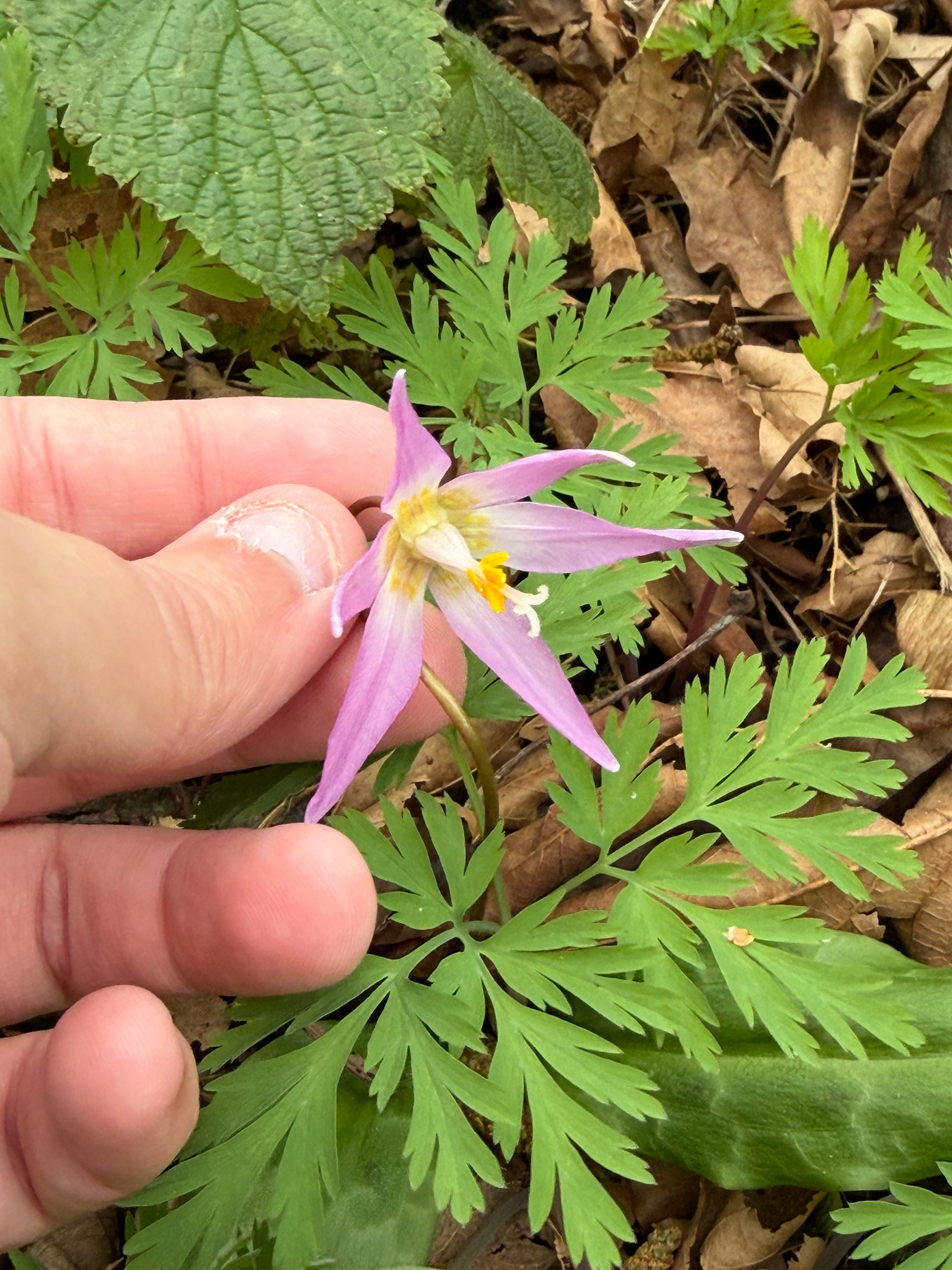
Dog’s-tooth violet (Erythronium dens-canis) is a small spring-flowering bulb native to central and southern Europe, spanning from Portugal to Ukraine. It bears solitary, reflexed pink to mauve blossoms above pairs of elliptical leaves heavily spotted with brown.
The white, elongated corms resemble a dog’s canine tooth and shrivel rapidly if exposed to dry air. Successful establishment relies on planting tubers into moist, shaded leaf mold immediately after purchase in autumn.
Key Facts
- Light: Partial shade to dappled woodland light
- Soil: Humus-rich, moist, well-drained loams
- Hardiness: USDA zones 3 to 8
- Height: 10 to 15 cm (4 to 6 in)
- Planting Depth: 8 to 10 cm (3 to 4 in)
Gardening with Dog’s-Tooth Violet
Dog’s-tooth violet thrives best in sheltered woodland borders and rock gardens that replicate European forest floors. It prefers temperate climates where spring soils stay moist and deciduous canopies shade tubers from heat later in the year.
Clumps naturalize slowly over 3 to 5 years, forming low colonies beneath early-leafing trees. Ensure soil remains damp through early summer before the bulbs enter complete seasonal dormancy.
How to Identify Dog’s-Tooth Violet
Dog’s-tooth violet produces single, nodding flowers with 6 sharply reflexed tepals on stalks reaching 10 to 15 cm (4 to 6 in) high. Each plant bears two basal leaves measuring 6 to 10 cm (2.5 to 4 in) long, mottled with brownish-purple blotches.
Below ground, the naked corm measures 3 to 5 cm (1.2 to 2 in) long, ending in a curved tip that resembles a dog’s canine tooth.
- Leaves: Paired, broad, blotched with reddish-brown marks
- Flowers: Solitary, reflexed blooms 3 to 5 cm (1.2 to 2 in) across
- Corm: Elongated white tuber shaped like a dog’s tooth
- Height: Compact spring foliage 10 to 15 cm (4 to 6 in) tall
Best Planting Site for Dog’s-Tooth Violet
Plant dog’s-tooth violet in partial shade with humus-rich soil that holds moisture without staying waterlogged. Sunlight should filter through bare branches in early spring, followed by canopy shade from May onward.
Direct summer sun scorches foliage early and overheats dormant tubers. Soil pH should sit between 6.0 and 7.0, amended heavily with leaf mold or composted bark to prevent rapid drying during hot periods.
Planting Erythronium dens-canis Bulbs
Plant dog’s-tooth violet bulbs immediately upon receipt in autumn at a depth of 8 to 10 cm (3 to 4 in). Because the tubers lack a protective dry tunic, ambient air dries them out within days.
Space individual bulbs 10 to 15 cm (4 to 6 in) apart to give multiplying offsets room to spread over subsequent years.
- Timing: Plant in September or October as soon as tubers arrive
- Depth: Position point-side up at 8 to 10 cm (3 to 4 in) deep
- Spacing: Set tubers 10 to 15 cm (4 to 6 in) apart
- Soil Mix: Incorporate equal parts leaf mold into the top 20 cm (8 in)
Water and Fertilizer Needs
Keep soil consistently damp from initial shoot emergence in March until foliage dies back, providing 2.5 cm (1 in) of water weekly during dry periods. Water late in the morning so excess moisture evaporates from leaf surfaces before dusk.
Top-dress beds each autumn with 3 cm (1.2 in) of well-rotted leaf mold or balanced organic compost. Avoid high-nitrogen fertilizers, which soft-rot delicate tubers and suppress spring blooms.
Pruning and Post-Bloom Care
Allow yellowing foliage to wither naturally for 6 to 8 weeks after flowering before clearing spent leaves. Green foliage feeds energy back into the corm for next season’s flower buds.
Snip off fading seed heads at the stalk base if you want to direct energy into bulb expansion rather than seed production. Cut brown foliage to ground level only once leaves dry out completely in mid-summer.
Propagating and Dividing Bulbs
Propagate dog’s-tooth violet by separating dormant offset bulbs in mid-summer every 4 to 5 years. Lift crowded clumps carefully with a garden fork in July once leaves wither.
Detach small side corms from the parent bulb and replant all tubers immediately at the standard 8 to 10 cm (3 to 4 in) depth. Seed propagation requires cold stratification below 4 °C (40 °F) and takes 4 to 5 years to bloom.
Common Dog’s-Tooth Violet Problems
Protect emerging spring shoots from slugs, snails, and soil waterlogging during cold, wet springs. Slugs chew holes in young leaves as shoots emerge through leaf litter in early March.
Poorly drained clay causes fungal corm rot, causing foliage to wilt and turn yellow prematurely. Apply grit to heavy soils and set copper tape or slug bait around delicate clumps.
Winter Care and Frost Hardiness
Dog’s-tooth violet withstands extreme winter temperatures down to -30 °C (-22 °F) without requiring lifted bulbs. Cold winter chilling is necessary to break corm dormancy for uniform spring blooming.
Spread a 5 cm (2 in) mulch of shredded leaf mold over planting beds in late autumn to cushion soil against severe freeze-thaw cycles. Rake excess leaf clutter away in February before early shoots break ground.
Year-Round Care for Dog’s-Tooth Violet
| Spring | Keep soil moist as shoots emerge in March. Apply slug control around emerging leaves, and snip spent seed heads after blooms finish in April. |
|---|---|
| Summer | Allow foliage to turn brown naturally over 6 to 8 weeks. Keep soil slightly damp during hot spells so dormant corms do not dry out. |
| Autumn | Plant newly acquired corms 8 to 10 cm (3 to 4 in) deep immediately. Spread a 5 cm (2 in) top-dressing of leaf mold across established beds. |
| Winter | Ensure mulch remains intact during prolonged freezing weather. Avoid walking over dormant beds to prevent crushing fragile spring shoots underground. |
Dog’s-Tooth Violet Troubleshooting Guide
| What you see | Likely cause | What to do |
|---|---|---|
| Holes chewed in young leaves | Slugs and snails feeding on emerging spring foliage | Apply iron phosphate slug pellets or lay copper tape barriers around clumps. |
| Yellow leaves in mid-spring | Soil dried out completely during bloom period | Water weekly to provide 2.5 cm (1 in) of moisture until leaves wither naturally. |
| Soft, rotting corms below ground | Fungal corm rot from waterlogged, poorly drained soil | Lift surviving corms and replant in well-drained soil mixed with coarse sand and leaf mold. |
| Foliage emerges without flowers | Bulbs planted too shallowly or crowded by old offsets | Lift dormant clumps in July, divide offsets, and replant at 8 to 10 cm (3 to 4 in) depth. |
Popular Dog’s-Tooth Violet Cultivars
- ‘Snowflake’ – pure white reflexed petals with yellow centers
- ‘Purple King’ – deep magenta-purple blooms with heavily spotted foliage
- ‘Rose Queen’ – clear pink flowers with dark mottled leaves
- ‘Lilac Wonder’ – pale violet-pink flowers with prominent central rings
- ‘Frans Hals’ – broad pinkish-red petals and heavy leaf spotting
- ‘Old Aberdeen’ – dark violet-pink flowers with striking foliage
Best Companion Plants for Dog’s-Tooth Violet
Pair dog’s-tooth violet with slow-expanding woodland perennials that share damp, shaded growing conditions. Companion species should leaf out later in spring to fill gaps as foliage dies back.
Suitable spring companions include wood anemone (Anemone nemorosa), snowdrop (Galanthus nivalis), and snake’s head fritillary (Fritillaria meleagris). For summer cover, groundcover ferns or Siberian squill (Scilla siberica) maintain root cover over dormant bulbs.
Frequently Asked Questions
Is dog's-tooth violet a true violet?
No, dog's-tooth violet is a member of the lily family (Liliaceae) and is not related to true violets in the genus Viola. The common name refers to its flower shape and color, while 'dog's tooth' describes its white, pointed corm.
Why is my dog's-tooth violet not flowering?
Dog's-tooth violet fails to bloom when planted too shallowly, overcrowded by old roots, or exposed to dry summer soil. Newly planted corms also often spend their first spring establishing root systems before producing flowers.
When should I plant dog's-tooth violet bulbs?
Plant dog's-tooth violet corms in early autumn, between September and October, immediately upon purchasing them. Unplanted corms lack a protective tunic and desiccate rapidly if left exposed to air.
Are dog's-tooth violet bulbs toxic to pets?
Yes, dog's-tooth violet bulbs contain toxins that cause gastrointestinal upset, vomiting, and drooling if ingested by dogs or cats. Keep freshly planted beds covered if pets tend to dig up garden tubers.
Can I grow dog's-tooth violet in containers?
Yes, dog's-tooth violet grows well in pots provided the potting mix stays consistently damp and well-drained. Place containers in cool shade after blooming to prevent dormant bulbs from baking in summer heat.
Sources & Verification
Taxonomy and distribution are checked against the databases below. Care guidance is written for cultivated species only and reviewed by our editor. How We Build Plant Profiles →