
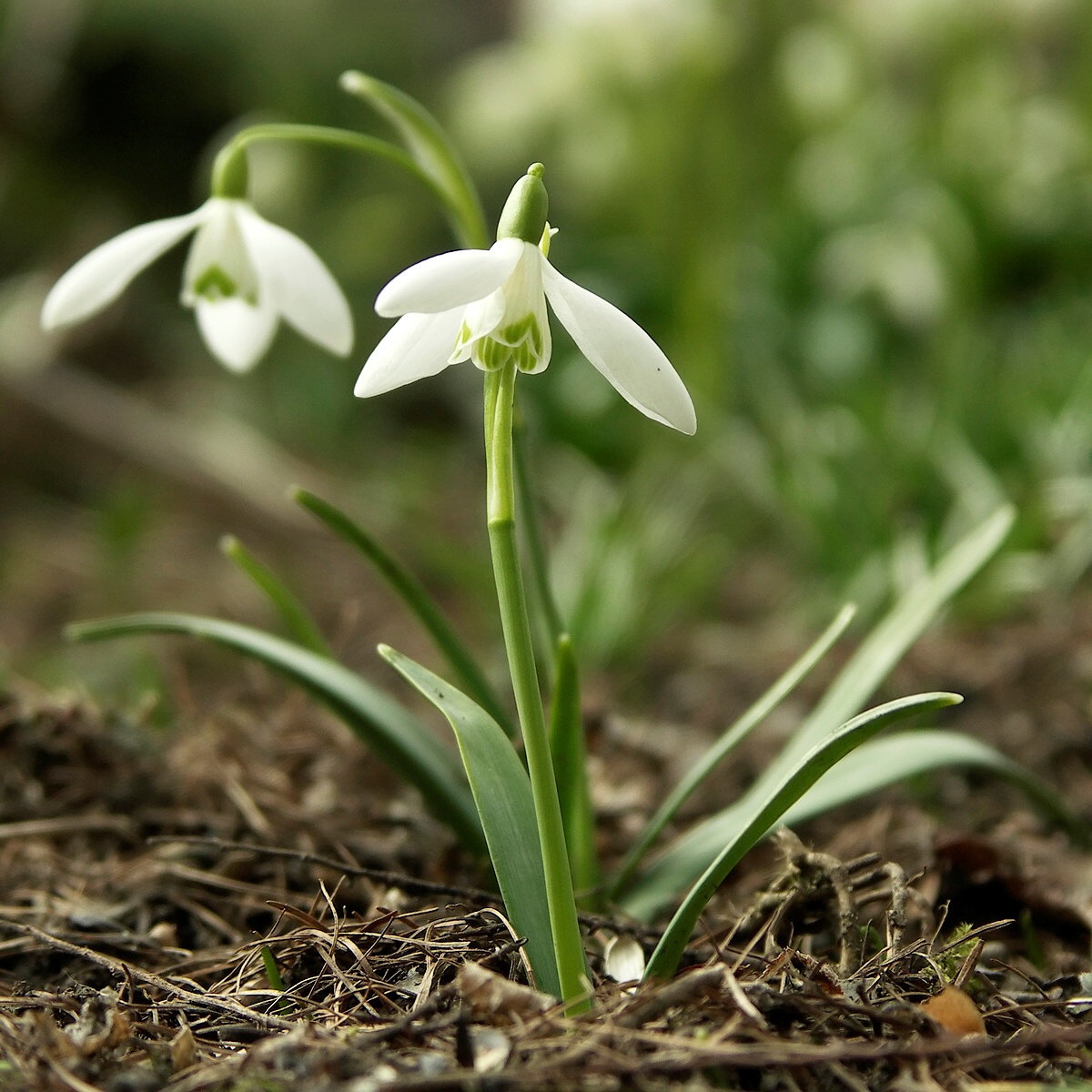
Common snowdrop (Galanthus nivalis) is a perennial bulb native to central and southern Europe, recognised by its solitary, nodding white blooms that open in late winter. The species naturalises across damp meadows and woodland floors, multiplying beneath deciduous trees before the spring canopy closes.
Unlike many summer-blooming bulbs, dry snowdrop bulbs perish quickly on retail shelves; establishing them in active growth “in the green” during late winter yields far higher success than autumn planting.
Key Facts
- Planting depth: 8 to 10 cm (3 to 4 in) deep
- Flowering period: January to March in mild spells
- Moisture: moist soil in spring, drier during summer dormancy
- Sunlight: dappled shade beneath deciduous canopies
- Cold hardiness: fully hardy down to -35 °C (-31 °F)
Growing Snowdrop Plants in the Garden
Snowdrops suit cool-temperate borders, rockeries, and woodland margins where soil stays undisturbed throughout summer. They thrive under deciduous fruit trees, beech, and hazel, taking advantage of open winter light before branches cast full shade. Gardeners with dry, baking Mediterranean climates or heavy, waterlogged clay will struggle to keep the small bulbs alive.
Because the foliage disappears by late May, place clumps among late-emerging perennials that will hide the empty ground. A established patch requires minimal intervention for decades once settled into leaf-rich topsoil.
How to Identify Galanthus nivalis
Common snowdrops reach a height of 10 to 15 cm (4 to 6 in) with two linear, glaucous grey-green basal leaves that measure 5 to 15 cm (2 to 6 in) long and 4 to 8 mm wide. A single leafless scape rises from each bulb, bearing one nodding, bell-shaped flower.
The bloom possesses six tepals arranged in two distinct whorls:
- Three outer tepals: pure white, spreading, 15 to 25 mm long, oblong to ovate.
- Three inner tepals: half the length of the outer, notched at the apex, marked with an inverted green V or U shape on the outer face.
- Fruit: an ovoid, pale green, three-valved capsule that ripens on the ground.
- Seeds: light brown, each fitted with a pale, fleshy appendage (elaiosome) that attracts foraging ants.
Light and Soil Requirements for Snowdrops
Plant snowdrops in cool, humus-rich soil in partial shade. The ideal site mimics a forest floor: loose leaf mould that holds moisture through early spring yet drains cleanly so dormant bulbs do not rot during warm summer storms.
Aim for a soil pH between 6.0 and 7.5. In early spring, the plants tolerate full winter sun because trees are bare. Once temperatures rise above 18 °C (65 °F) in May, tree leaves protect the bulbs from direct solar heat, keeping the root zone temperate.
Planting Depth and Spacing for Snowdrop Bulbs
Plant bulbs at a depth of 8 to 10 cm (3 to 4 in), which is roughly three times the height of the bulb, spacing them 5 to 8 cm (2 to 3 in) apart. Planting too shallowly causes bulbs to split into non-flowering offsets prematurely.
Choose between two planting methods:
- In the green (late winter): Buy actively growing clumps right after flowering while the leaves are green; plant immediately at their original soil depth.
- Dry dormant bulbs (autumn): Plant from September to October. Soak desiccated bulbs in lukewarm water for two hours prior to burying.
- Group size: Plant in tight drifts of 10 to 25 bulbs for a naturalised appearance rather than single spaced lines.
Water and Fertilizer Routine
Keep soil consistently moist while foliage and flowers are active from January through April. In most cool climates, winter rain and melting snow provide ample water, but dry spells in early spring will shorten flowering times.
Snowdrops need little supplementary feeding. An annual top-dressing of shredded leaf mould or composted bark in November provides all required nutrients. Avoid high-nitrogen chemical fertilisers, which produce weak, floppy foliage susceptible to fungus.
Pruning and Foliage Removal Guidelines
Never cut back snowdrop foliage until it has turned completely yellow and dried out, which takes about six to eight weeks after flowering. The green leaves manufacture starches to fuel next year’s embryonic bud inside the subterranean bulb.
Follow these management rules for tidy beds:
- Do not knot, tie, or braid the foliage, as this crushes internal vascular tissue.
- Leave seed pods in place if you want self-sowing colonies, or snap them off at the stem base to direct energy back into bulb enlargement.
- Delay lawn mowing in naturalised turf until mid-May when snowdrop leaves pull away freely from the soil surface with a gentle tug.
Dividing Snowdrops in the Green
Propagate snowdrops by dividing congested clumps immediately after flowering, while foliage remains fresh and green in February or March. This method avoids the high mortality rate common to dry autumn bulbs.
The division process involves four clear steps:
- Lift an overcrowded clump with a hand fork, digging well beneath the 10 cm (4 in) root layer.
- Gently tease the root mass apart by hand into smaller bundles of three to five bulbs.
- Discard soft, damaged, or discoloured bulbs to prevent spread of soil-borne pathogens.
- Replant immediately into prepared soil at the original depth mark visible on the white stem base, watering thoroughly.
Pest and Disease Troubleshooting
Grey mould fungus and the narcissus bulb fly pose the two most severe threats to snowdrop colonies. Heavy, wet soils during summer dormancy exacerbate root rot organisms.
Inspect collections for these specific signs:
- Snowdrop grey mould (Botrytis galanthina): Causes fuzzy grey mycelium around the neck and fuzzy rotting foliage as shoots emerge; dig up and burn infected plants immediately.
- Large narcissus bulb fly (Merodon equestris): Larvae bore into bulb centres, leaving hollow, mushy cavities; remove soft bulbs in late spring.
- Slugs and snails: Rasp holes through emergent blooms in mild, wet February spells; use physical grit barriers around prized beds.
Winter Hardiness and Cold Dormancy
Common snowdrops are fully cold-hardy down to -35 °C (-31 °F), surviving without protection across USDA Zones 3 through 8. The stems and petals produce specialized antifreeze proteins and sugars that allow tissues to freeze solid during sharp frost snaps without bursting cell walls.
When temperatures drop below freezing, stems flop flat onto the snow. As soon as sunlight strikes the petals and air temperatures rise above 0 °C (32 °F), the blooms stand upright without structural damage.
Snowdrop Flowering Times and Chilling Needs
Bulbs require at least 10 to 14 weeks below 7 °C (45 °F) to break winter dormancy and trigger floral elongation. Flowers open as early as January in southern England and as late as March or April in continental North America.
Individual blooms remain open for two to three weeks when temperatures hover between 2 and 8 °C (36 and 46 °F). On warm days above 10 °C (50 °F), outer petals flare horizontal to reveal nectar glands, closing again each evening or during heavy rain.
Best Companion Plants for Galanthus nivalis
Interplant snowdrops with low-growing woodland perennials and early-flowering bulbs that share identical soil preferences and bloom windows. Combining textures creates dense ground cover while leaves slowly die down.
Reliable garden companions include:
- Winter aconite (Eranthis hyemalis): buttercup-yellow flowers that contrast directly with white snowdrop petals.
- Cyclamen (Cyclamen coum): pink or magenta flowers with silver-marbled, rounded foliage.
- Early crocus (Crocus tommasinianus): slender lavender-purple flowers that open simultaneously in late winter.
- Lenten rose (Helleborus orientalis): architectural evergreen foliage that shelters emergent snowdrop scapes.
Frequently Asked Questions
What is the difference between snowdrops and snowflakes?
Snowdrops belong to the genus Galanthus and have three long outer petals and three short inner petals. Snowflakes belong to the genus Leucojum (such as spring snowflake, Leucojum vernum) and have six equal-sized petals, each tipped with a green or yellow dot.
Why did my snowdrop bulbs fail to come up?
Dry bulbs bought in autumn often desiccate completely on garden centre shelves before they are planted. Planting bulbs "in the green" during late winter or immediately after flowering eliminates this failure rate.
Are snowdrops poisonous to dogs and cats?
Yes, all parts of Galanthus nivalis are toxic to dogs, cats, and humans because they contain lycorine and other toxic alkaloids. Ingestion causes vomiting, diarrhea, drooling, and abdominal cramping.
Can you mow over snowdrops in a lawn?
Only mow after the foliage has turned yellow and withered completely, usually around mid-May. Mowing green leaves starves the bulb and stops it from producing flowers next year.
Do snowdrops spread on their own?
Yes, established clumps expand slowly underground by producing offset bulbs each season. They also spread by seed, which are carried across borders by ants attracted to their oily elaiosomes.
Information about traditional or historical uses is provided for educational interest only and is not medical advice. Do not use any plant to treat a condition without speaking to a qualified professional.
Sources & Verification
Taxonomy and distribution are checked against the databases below. Care guidance is written for cultivated species only and reviewed by our editor. How We Build Plant Profiles →
- Royal Horticultural SocietyRHS plant profile for Galanthus nivalis
- Kew Plants of the World OnlineNative distribution and taxonomy
- IUCN Red ListConservation status of wild populations
- North Carolina State ExtensionPlant characteristics and toxicity notes
- GBIF — Global Biodiversity Information Facilitytaxonomy, synonyms, occurrence records
- Wikipediageneral reference