
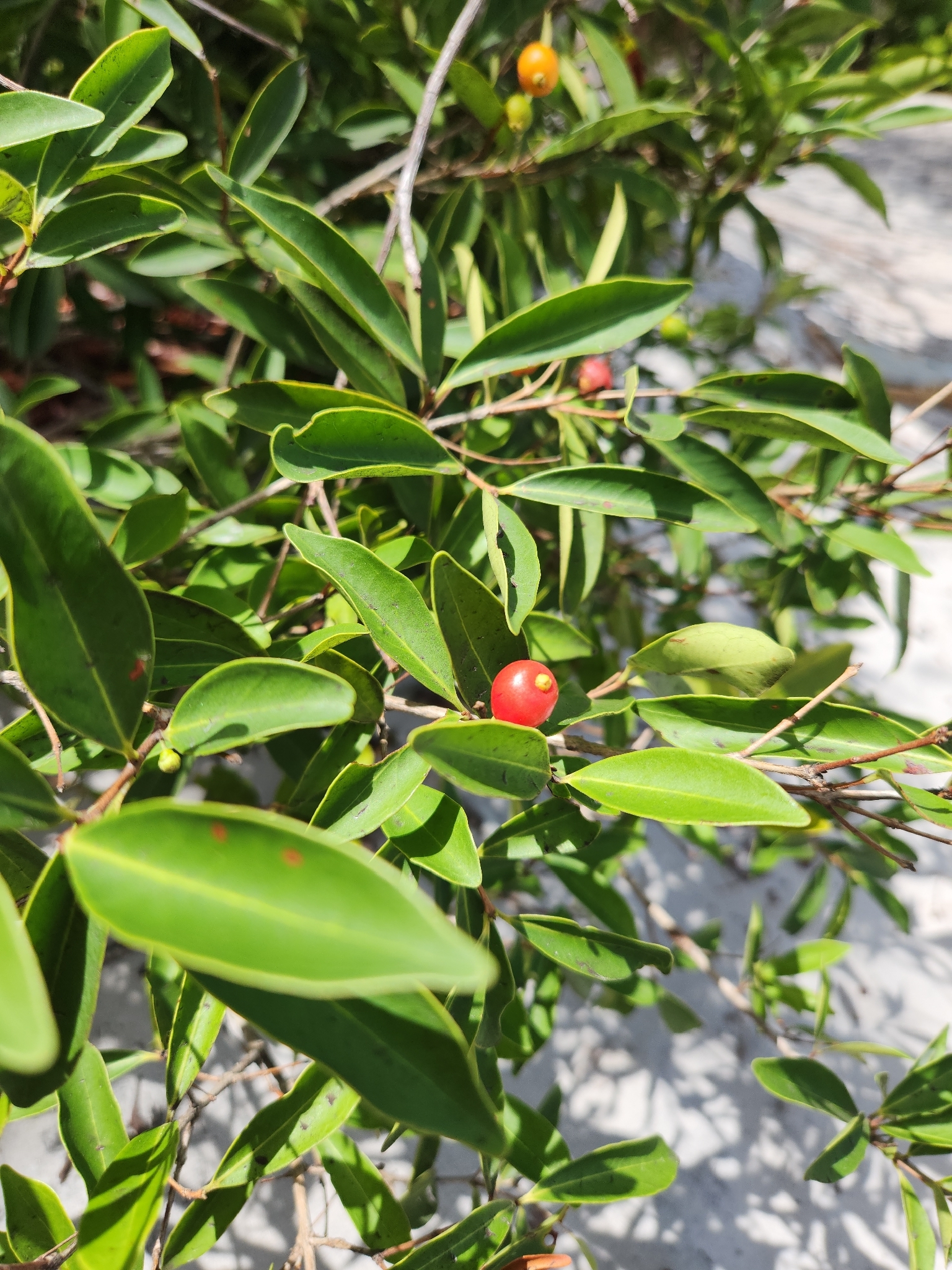
Cerecita (Eugenia punicifolia) is an evergreen tropical shrub native to South America and the Caribbean. Belonging to the Myrtaceae family, it produces bright red, spherical berries and small white flowers.
Across savannas in Brazil, Venezuela, and Colombia, this plant grows in dry, sandy soils. Its edible fruits feed wild birds and offer a sweet-tart flavour.
Key Facts
- Plant Type: Wild evergreen shrub or small tree
- Native Range: South America and Caribbean Islands
- Fruit: Red edible berry 8-12 mm (0.3-0.5 in)
- Soil: Sandy, acidic, well-draining ground
- Family: Myrtaceae (Myrtle family)
Encountering Cerecita in the Wild
Cerecita is a wild woody perennial that grows up to 4 m (13 ft) tall in sun-exposed tropical ecosystems. It forms dense branching along savanna borders, coastal dunes, and open scrublands.
In native habitats spanning from Cuba to Argentina, it copes with nutrient-poor ground and periodic dry periods. It remains primarily a wild foraging plant rather than a widespread commercial crop.
Identifying Eugenia punicifolia
You can identify Eugenia punicifolia by its glossy, opposite leaves measuring 3-7 cm (1.2-2.8 in) long and its small white blossoms. The leaves yield a aromatic scent when bruised.
Flowers feature four small petals with dense central clusters of white stamens. As the flowers fade, round berries develop, turning from green to bright red or purple-black when ripe.
- Elliptic, leathery leaves with visible oil glands
- White four-petaled flowers measuring 8-10 mm (0.3-0.4 in) wide
- Globose berries 8-12 mm (0.3-0.5 in) across
- Smooth, light brown to greyish bark
Native Range and Habitat of Cerecita
Cerecita grows naturally across tropical South America and parts of the Caribbean, from sea level up to 1,200 m (3,937 ft) elevation. Countries with established wild populations include Brazil, Venezuela, Colombia, Peru, and Ecuador.
It inhabits low-nutrient environments, including Brazilian Cerrado savannas, Amazonian white-sand scrub, and coastal Restinga habitats. These regions feature high sun exposure and well-draining ground.
- Mean annual temperatures of 22-28 °C (72-82 °F)
- High sun exposure in open savannas
- Acidic, sandy, or stony soils
Ecological Value and Wildlife
The blossoms of this species provide nectar for wild bees, while the ripe berries feed native birds and small mammals. Flowering often coincides with early seasonal rains.
Birds digest the berry pulp and disperse seeds across open terrain. The shrub also exhibits underground root storage that allows it to resprout after seasonal savanna fires.
Wild Status and Distribution
Cerecita maintains stable wild populations throughout its range, with thousands of documented distribution records across tropical America. It is not currently listed as globally threatened.
Localised populations in coastal Restinga zones experience habitat loss from urban development and agriculture. However, its tolerance for dry, poor soil allows it to persist across protected savanna regions.
Edible Berries and Traditional Uses
The wild fruits of Eugenia punicifolia are edible fresh, offering a sweet to mildly tart cherry flavour. Local populations harvest ripe berries directly from wild shrubs.
The fruits are eaten raw or processed into wild fruit juices, jellies, and syrups. In South American folk medicine, leaf teas were traditionally prepared to address mild digestive discomfort and fevers.
- Fresh consumption of ripe red berries
- Local preparation of wild jams and beverages
- Historical use of leaves in traditional herbal teas
Similar Wild Eugenia Species
Cerecita closely resembles several other berry-bearing members of the Myrtaceae family found in tropical America. Key distinctions rely on fruit shape, leaf texture, and plant size.
Comparing flower attachment and foliage density helps separate these wild species in the field.
- Surinam cherry (Eugenia uniflora) – features deeply ribbed, pumpkin-shaped red fruits rather than smooth round berries
- Pitomba (Eugenia luschnathiana) – produces larger, bright yellow-orange fruits with soft foliage
- Guavaberry (Myrciaria floribunda) – yields smaller orange to dark red berries on very fine branches
- Red strawberry guava (Psidium cattleyanum) – has thicker leaves and prominent calyx lobes on the fruit tip
Frequently Asked Questions
Is Eugenia punicifolia fruit edible?
Yes, the fruits of Eugenia punicifolia are edible. The ripe red berries have a sweet-tart flavour and are eaten fresh or made into juices.
What is the taste of Cerecita fruit?
Cerecita fruit tastes sweet and slightly acidic, similar to a wild cherry or pitanga berry. The soft pulp surrounds one or two seeds.
What family does Eugenia punicifolia belong to?
Eugenia punicifolia belongs to the Myrtaceae (myrtle) family. This family includes other berry-bearing tropical plants like guava and allspice.
What does the common name Cerecita mean?
Cerecita is Spanish for 'little cherry', referring to the small size, bright red colour, and round shape of the ripe fruit.
Where is Cerecita native to?
Cerecita is native to tropical South America and the Caribbean. It grows naturally in countries including Brazil, Venezuela, Colombia, Peru, and Cuba.
Information about traditional or historical uses is provided for educational interest only and is not medical advice. Do not use any plant to treat a condition without speaking to a qualified professional.
Sources & Verification
Taxonomy and distribution are checked against the databases below. Care guidance is written for cultivated species only and reviewed by our editor. How We Build Plant Profiles →

