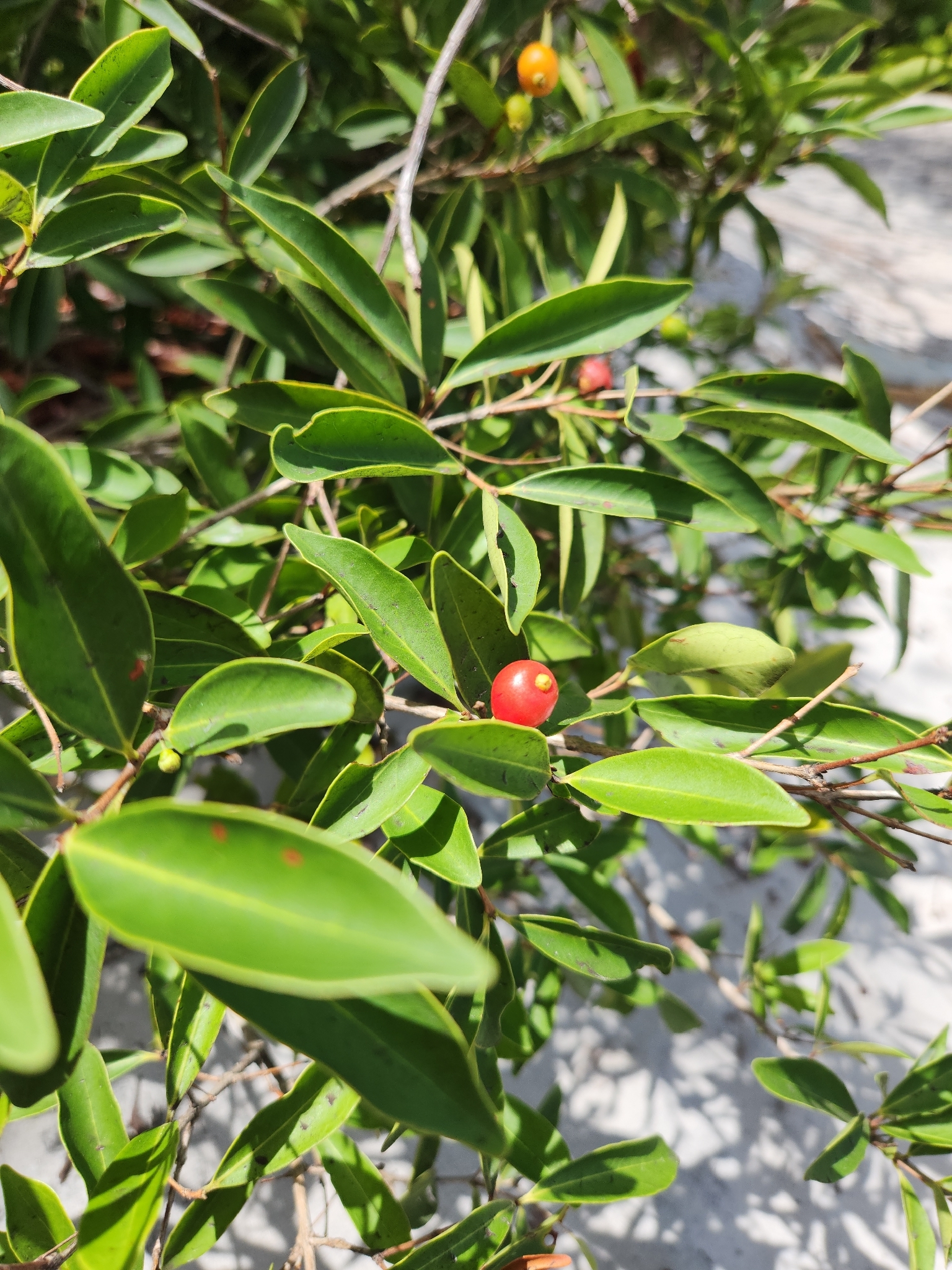
Surinam cherry (Eugenia uniflora) is a subtropical evergreen shrub or small tree native to South America, characterised by pumpkin-shaped, deeply ribbed berries that ripen from green to bright scarlet and dark maroon.
Established plants survive brief cold snaps down to -2 °C (28 °F), but regular hedge shearing removes the outer flower-bearing wood and significantly reduces fruit production.
Key Facts
- Light: Full sun to light afternoon shade
- Water: Moderate; weekly deep soakings during fruiting
- Hardiness: USDA Zones 9b through 11
- Fruiting age: 2 to 3 years from seed
- Soil pH: 5.5 to 6.5 (acidic to neutral)
- Mature height: 2 to 7 m (6.5 to 23 ft)
Growing Surinam Cherry in Home Landscapes
Surinam cherry suits gardeners in warm, frost-free climates who want a dense evergreen barrier or productive fruiting bush with minimal pest problems. It tolerates poor soils, high salt levels near coastal zones, and moderate urban pollution.
Before planting in regions like Hawaii, Florida, or Bermuda, check local municipal invasive species lists. The plant self-seeds readily through bird dispersal, displacing understory species in moist subtropical forests. In dry regions like southern California and Arizona, it behaves predictably and stays within designated garden beds.
Surinam Cherry Identification and Botanical Traits
Surinam cherry is identified by its eight-ribbed, fluted fruit measuring 2 to 4 cm (0.8 to 1.6 in) across, which turns from green to orange and finally deep crimson or near-black when fully ripe.
The opposite leaves are ovate to lanceolate, 2.5 to 6 cm (1 to 2.4 in) long, and emerge with a coppery bronze tint before turning dark glossy green. Crushed foliage releases a sharp, resinous aroma due to essential oils containing cineole and curzerene. Four-petaled white flowers appear in clusters at the leaf axils, measuring 1.5 cm (0.6 in) across with prominent clusters of delicate white stamens.
- Foliage: Glossy, ovate, coppery red when young, deep green when mature
- Flowers: Small, solitary or clustered, pure white with 50 to 60 stamens
- Fruit: 8-lobed, oblate berry holding 1 to 3 large, round seeds
- Bark: Thin, mottled greyish-brown that flakes lightly on older trunks
Mature Size and Growth Rate
An unpruned Surinam cherry grows to a mature height of 4 to 7 m (13 to 23 ft) with an equal spread over 15 to 20 years. In typical suburban gardens, standard shrubs reach 2 to 3 m (6.5 to 10 ft) tall within five years.
Seedlings grow slowly during their initial 12 months, usually reaching 20 to 30 cm (8 to 12 in). Growth accelerates significantly in year two and three once root networks establish in deep soil. Regular seasonal tip pruning keeps the plant within a 1.5 to 2 m (5 to 6.5 ft) boundary for easy hand harvesting.
Surinam Cherry Growing Zone and Soil Needs
Surinam cherry requires an outdoor climate within USDA Hardiness Zones 9b to 11, paired with fertile, well-draining soil that stays slightly acidic. It performs best in a pH range between 5.5 and 6.5.
Plants develop chlorosis—yellowing leaves with green veins—when planted in high-pH limestone or chalky soils above 7.5. Improve heavy clay soils by working in 30% organic compost or coarse grit before planting to ensure free drainage, as waterlogged roots invite fungal rot.
- Ideal light exposure: 6 to 8 hours of direct sunlight daily for heavy fruit set
- Shade tolerance: Foliage remains dense in light shade, but flowering drops by half
- Soil texture: Sandy loams and river silt provide the fastest root development
- Salt tolerance: Moderate tolerance to ocean spray and saline groundwater
How to Plant a Surinam Cherry Shrub
Dig a planting hole twice as wide as the root ball and precisely level with its existing soil surface. Planting too deep leads to collar rot and stem decay at the soil line.
Water the root ball thoroughly one hour before sliding it from the container. Position the plant in the centre, backfill with unamended native soil, and tamp down gently to eliminate underground air pockets. Create a 7 cm (3 in) raised soil ring around the drip line to direct irrigation water directly into the root zone.
- Single shrub spacing: Leave 3 to 4 m (10 to 13 ft) between standalone fruit trees
- Hedge spacing: Space root balls 60 to 90 cm (24 to 36 in) apart for a continuous screen
- Initial irrigation: Water with 10 to 15 L (2.5 to 4 gal) immediately after backfilling
- Mulching: Spread a 5 to 7 cm (2 to 3 in) layer of shredded bark, keeping it 10 cm (4 in) away from the trunk
Surinam Cherry Care: Watering and Nutrients
Provide 25 mm (1 in) of water per week during the flowering and fruiting period from March through August. Drought stress causes flowers and immature green cherries to drop prematurely.
Feed established shrubs three times per year in early spring, early summer, and late summer using a balanced 8-8-8 or 10-10-10 granular citrus-and-fruit fertiliser. Supplement with chelated iron foliar sprays if new leaves turn pale yellow in alkaline soils. Taper off feeding by mid-autumn to prevent late flushes of soft green shoots that are vulnerable to cool weather.
Pruning Surinam Cherry for Fruit, Hedges, and Bonsai
Prune Surinam cherry immediately after the final crop harvest in mid-summer to preserve the next cycle of bloom wood. Because flowers develop on mature second-year branchlets, aggressive mechanical shearing will eliminate fruit crops.
For hedges, shear sides three to four times per year between spring and late summer to force lateral bud breaks, accepting that berry yields will be minimal. For bonsai cultivation, wire young lignified branches during the summer growth flush; the species takes well to clip-and-grow pruning due to short internodes and flexible wood. Remove dead, crossed, or inward-growing branches annually with clean bypass pruners.
Surinam Cherry Problems and Pest Control
The Caribbean fruit fly (Anastrepha suspensa) is the primary threat to edible fruit harvests, as females deposit eggs directly under the thin fruit skin. Infested cherries soften quickly and rot from internal larvae feeding.
Protect crops by hanging yeast-baited traps nearby or bagging individual fruiting branches with fine mesh exclusion netting as soon as petals drop. Scale insects and whiteflies occasionally collect on the underside of young leaves; spray affected foliage with horticultural mineral oil or insecticidal soap diluted to 1 to 2% in water.
Winter Care and Frost Protection
Mature Surinam cherry plants survive temperatures dropping to -2 °C (28 °F) for short periods, but prolonged freezes cause severe foliage death. Young saplings under two years old perish if exposed to temperatures below 0 °C (32 °F).
When freezing temperatures are forecast in marginal zones, cover small trees with breathable burlap or thermal frost blankets anchored to the ground. Soak the surrounding soil 24 hours before the frost arrives, as wet soil radiates warmth into the canopy more effectively than dry dirt. Container specimens and bonsai should be moved into an unheated garage or greenhouse until freezing night temperatures pass.
Harvesting and Uses in the Kitchen
Harvest fruit only when it has turned dark red or purplish-black and drops freely into your hand with the gentlest pull. Underripe, bright orange-red cherries carry an intense pine-like resinous flavor that many find unpalatable.
Fully ripe pitangas deliver a sweet-tart taste resembling spiced cranberry with notes of mango and black pepper. Fresh fruit bruises easily and ferments within 24 hours of harvest, so process it immediately. Traditional preparations include simmered jams, jellies, cooling cordials, and fruit vinegars. The high natural pectin and acidity make it ideal for preserves without requiring synthetic gelling agents.
Seasonal Care for Surinam Cherry
| Spring | Apply a balanced 8-8-8 slow-release fruit fertiliser at 200 g per mature plant. Increase irrigation to 25 mm (1 in) weekly as flower buds break, and hang insect traps to monitor for fruit fly activity. |
|---|---|
| Summer | Harvest ripe, deep-crimson berries daily before birds take them. Prune back non-fruiting shoots and thin internal branches directly after the harvest window ends. |
| Autumn | Apply a light compost top-dressing around the root perimeter. Gradually taper off supplemental watering as daytime temperatures decline and growth slows. |
| Winter | Hold all fertilising until the following spring. Wrap young trunks or erect frost cloth frames over exposed shrubs if overnight temperatures drop below 0 °C (32 °F). |
Surinam Cherry Growing Problems and Fixes
| What you see | Likely cause | What to do |
|---|---|---|
| Yellow leaves with bright green veins | Iron deficiency caused by high-pH alkaline soil | Drench root zone with chelated iron (EDDHA formulation) and top-dress with elemental sulfur. |
| Premature fruit drop while berries are green | Soil drought during the post-flowering swelling stage | Apply 5 to 7 cm (2 to 3 in) of organic mulch and provide 25 mm (1 in) of water each week. |
| Soft, brown, rotting spots on ripe fruit with internal larvae | Caribbean fruit fly (Anastrepha suspensa) infestation | Install fine mesh netting over fruiting branches immediately after petal fall. |
| Shrub does not flower or produce fruit | Frequent hedge shearing or insufficient sunlight | Relocate to a site with 6+ hours of sun and pause mechanical trimming to allow second-year wood to mature. |
Surinam Cherry Cultivars and Selections
- ‘Zill Dark’ – near-black fruit, lower resin flavor, highly productive
- ‘Black Star’ – deep purplish fruit, exceptionally sweet when fully ripe
- ‘Vermillion’ – brilliant red berries with classic tart cranberry-like profile
- ‘Lolita’ – compact growth habit suitable for container cultivation
Frequently Asked Questions
What does a Surinam cherry taste like?
A fully ripe, deep maroon Surinam cherry tastes like a sweet-tart blend of cranberry and spiced mango. Eating underripe orange-red fruit produces a sharp, medicinal resin flavor.
What is the difference between Surinam cherry and Barbados cherry?
Surinam cherry (Eugenia uniflora) produces eight-ribbed, pumpkin-shaped fruit on an aromatic Myrtaceae shrub. Barbados cherry (Malpighia emarginata) belongs to the Malpighiaceae family and produces round, smooth, 3-lobed bright red berries known for astronomical vitamin C content.
Is Surinam cherry invasive in Hawaii?
Yes, Surinam cherry is classified as an invasive species in Hawaii and parts of central and south Florida. Frugivorous birds spread the viable seeds into native moist forests where thickets outcompete indigenous plants.
How do you grow Surinam cherry from seed?
Clean the pulp from fresh seeds immediately, as they lose viability within a month of drying out. Plant 1 cm (0.4 in) deep in moist seed-starting mix at 24 to 28 °C (75 to 82 °F); germination takes 3 to 4 weeks.
Can you grow Surinam cherry as a bonsai?
Yes, Surinam cherry is a classic subtropical bonsai subject because it naturally produces small leaves, tolerates heavy root reductions, and blooms even in shallow ceramic containers.
What are the health benefits of Surinam cherry?
The fruit contains high levels of vitamin C, provitamin A carotenoids, and anthocyanins. In traditional South American herbal medicine, an infusion of the aromatic leaves was used as an astringent and febrifuge.
Information about traditional or historical uses is provided for educational interest only and is not medical advice. Do not use any plant to treat a condition without speaking to a qualified professional.
Sources & Verification
Taxonomy and distribution are checked against the databases below. Care guidance is written for cultivated species only and reviewed by our editor. How We Build Plant Profiles →