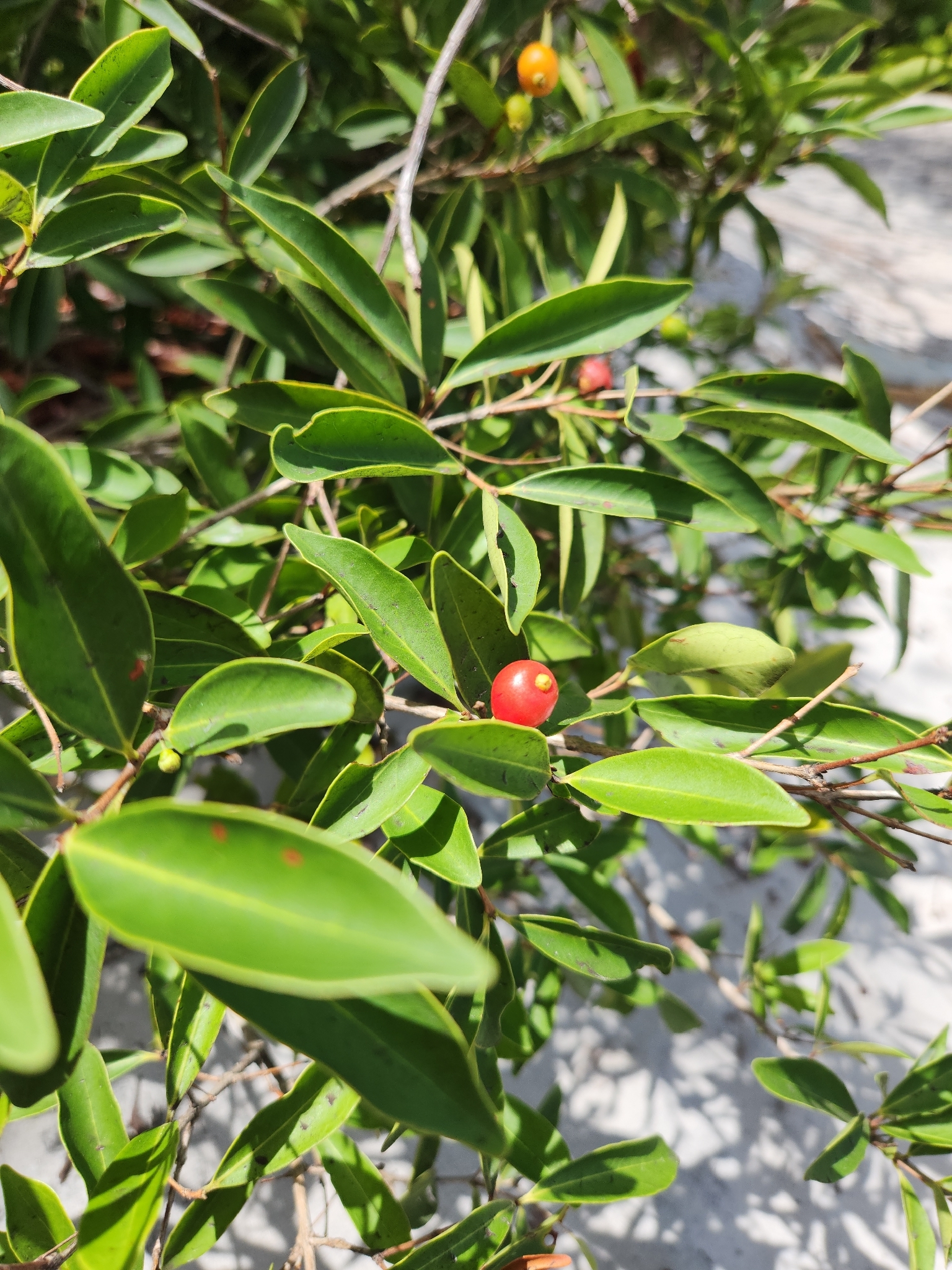
Cedar Bay cherry (Eugenia reinwardtiana) is an evergreen tropical shrub or small tree native to rainforest edges in Queensland, Indonesia, and the Pacific Islands. It produces glossy leaves, small white flowers, and bright red edible fruits with a sweet cherry flavour.
Plant trees in frost-free locations with well-drained soil to harvest fresh berries within three years. Seedlings grow slowly initially but form tight hedges when tip-pruned after fruiting.
Key Facts
- Light: Full sun to partial shade
- Height: 2 to 6 m (6.5 to 20 ft)
- Water: Regular moisture while establishing, drought-tolerant once mature
- Hardiness: USDA zones 10 to 11
- Fruit: Edible bright red berries 1.5-2.5 cm (0.6-1 in) wide
- Propagation: Fresh seeds germinate in 20-40 days
Growing Cedar Bay Cherry in the Garden
Cedar Bay cherry suits warm coastal gardens where winter temperatures remain above 0 °C (32 °F). It functions well as a compact specimen tree, container plant, or dense privacy hedge.
This species tolerates salty coastal breezes and poor sandy soils better than many other fruiting trees. However, wet roots caused by poor drainage will stunt growth and lead to leaf drop.
Identifying Cedar Bay Cherry Leaves and Flowers
Cedar Bay cherry features opposite, elliptical glossy green leaves measuring 4 to 9 cm (1.6 to 3.5 in) long with pale undersides. The foliage releases a light aromatic scent when crushed.
Small white four-petaled flowers appear singly or in pairs in leaf axils from spring through summer. Each flower spans 1.5-2 cm (0.6-0.8 in) across and displays a central cluster of prominent white stamens. Spherical red berries measuring 1.5-2.5 cm (0.6-1 in) across follow pollination, ripening from yellow to deep crimson in autumn.
Cedar Bay Cherry Tree Size and Growth Rate
Cedar Bay cherry matures to a height of 2 to 6 m (6.5 to 20 ft) with a canopy spread of 1.5 to 4 m (5 to 13 ft). Growth rate is slow, averaging 15 to 30 cm (6 to 12 in) per year under typical garden conditions.
Container-grown specimens remain smaller, capping out around 1.5 to 2 m (5 to 6.5 ft) tall. Trees grown from seed take three to four years to produce their first crop of fruit.
Ideal Site Conditions and Light Requirements
Cedar Bay cherry produces the most abundant fruit when positioned in full sun receiving at least 6 hours of direct light daily. Trees also grow in partial shade, though fruit yield decreases.
Select a sheltered spot away from strong freezing winds, as temperatures below -1 °C (30 °F) cause foliage dieback. Soil should drain freely, with a pH between 6.0 and 7.5.
How to Plant Cedar Bay Cherry
Space planted specimens 3 to 4 m (10 to 13 ft) apart for specimen growth, or 1.5 m (5 ft) apart for hedges. Dig a hole twice as wide as the root ball and equal in depth.
Follow these steps when planting out seedling or potted stock:
- Soak the root ball in water for 10 minutes prior to planting.
- Mix one part aged compost into two parts excavated native soil.
- Set the plant so the stem base sits level with the surrounding soil surface.
- Backfill and press soil gently around the roots to eliminate air pockets.
- Apply a 5-7 cm (2-3 in) layer of organic mulch, keeping it 10 cm (4 in) clear of the trunk.
Watering and Soil Care
Water young trees deeply whenever the top 5 cm (2 in) of soil feels dry. Mature trees withstand short dry spells but need supplemental water during prolonged heat above 32 °C (90 °F).
Apply a balanced organic fruit fertilizer twice annually, once in early spring and again in mid-summer. Avoid heavy nitrogen fertilizers, which spur excess foliage growth at the expense of flower and fruit production.
Pruning and Shaping Cedar Bay Cherry
Prune plants in late autumn after the main fruiting cycle finishes, removing no more than 20 percent of the outer canopy. Tip-pruning young stems encourages branching and denser growth.
Clear out dead or crossing branches inside the canopy to improve air circulation. Unlike coniferous cedars such as Atlas cedar (Cedrus atlantica), this broadleaf Myrtaceae species regrows readily from light structural cuts.
Pests and Diseases
Myrtle rust caused by Austropuccinia psidii poses the main disease threat to Cedar Bay cherry in humid regions, showing as bright yellow spore masses on new shoots. Pests include scale insects and fruit flies.
Watch for these common issues during the growing season:
- Myrtle rust: Yellow powder on shoots; prune affected tips and apply copper fungicide.
- Fruit fly larvae: Maggots in ripe fruit; cover developing berries with fine exclusion netting.
- Scale insects: Brown bumps on stems; spray with horticultural oil in late winter.
- Root rot: Yellow leaves and wilting; improve drainage and reduce watering frequency.
Protecting Trees in Cold Winters
Cedar Bay cherry requires protection whenever temperatures threaten to dip below 0 °C (32 °F). The plant is hardy in USDA zones 10 through 11 and cannot survive sustained frosts.
In marginal zone 9b climates, protect young plants by wrapping trunks with frost cloth and mulching roots heavily before winter. Move container specimens indoors to a bright room maintained at 15-20 °C (59-68 °F).
Harvesting and Culinary Uses of Beach Cherry
Harvest fruit when berries turn dark red and yield to gentle thumb pressure, usually 30 to 40 days after flowering. The fruit features a sweet, slightly aromatic flavor reminiscent of sweet cherry with resinous tropical notes.
Eat berries fresh out of hand or process them into preserves. The fruit contains high concentrations of vitamin C and antioxidants, traditionally used as bush tucker across Northern Australia.
Frequently Asked Questions
What does Cedar Bay cherry taste like?
Cedar Bay cherry has a sweet berry taste with a pleasant, slightly resinous tropical overtone. The texture is soft and juicy when fully ripe.
What is the difference between Cedar Bay cherry and Barbados cherry?
Cedar Bay cherry belongs to the Myrtaceae family and bears smooth red fruit with aromatic pulp, while Barbados cherry (Malpighia emarginata) belongs to the Malpighiaceae family and produces deeply lobed fruit with higher vitamin C acidity. Cedar Bay cherry leaves are glossy and leathery, whereas Barbados cherry foliage is thinner.
Is Cedar Bay cherry fruit edible?
Yes, Cedar Bay cherry fruit is non-toxic and fully edible when ripe. It can be eaten fresh or cooked into jams, jellies, and desserts.
How fast does a Cedar Bay cherry tree grow?
Cedar Bay cherry grows slowly, adding roughly 15 to 30 cm (6 to 12 in) of height per year. Trees grown from seed usually fruit within three to four years.
Can you prune Cedar Bay cherry trees?
Yes, Cedar Bay cherry tolerates light pruning well after the fruiting season ends. Unlike true conifers like Atlas cedar (Cedrus atlantica), this broadleaf shrub responds well to hedge trimming and shaping.
Information about traditional or historical uses is provided for educational interest only and is not medical advice. Do not use any plant to treat a condition without speaking to a qualified professional.
Sources & Verification
Taxonomy and distribution are checked against the databases below. Care guidance is written for cultivated species only and reviewed by our editor. How We Build Plant Profiles →