
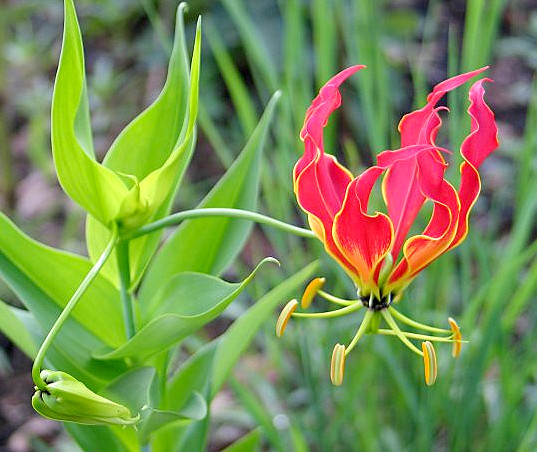
Flame lily (Gloriosa superba) is a climbing deciduous perennial native to tropical Africa and southern Asia, recognised by its bright red and yellow recurved flowers and leaf-tip tendrils. It grows from an underground V-shaped tuber and can scramble up supports indoors or in conservatories.
Indoor growers cultivate it for rapid summer flowering, but you must respect its strict winter dormancy and handle every part of the plant with gloves due to high toxicity.
Key Facts
- Light: 6 to 8 hours of bright, filtered light daily
- Water: Keep moist during growth, bone dry when dormant
- Toxicity: Severely toxic to humans and pets if ingested
- Dormancy: Dies back completely to tubers in late autumn
- Support: Needs a trellis or netting to climb
Is Flame Lily Right for Your Home?
Flame lily suits experienced indoor growers who want a fast-growing, seasonal climber with architectural blooms rather than evergreen foliage. Because stems emerge rapidly from dormancy in spring and die to the soil line in autumn, it requires active seasonal management rather than static year-round display.
You must provide a structural support such as a 1.5 m (5 ft) cane tripod or wire trellis as soon as shoots appear. Keep this plant away from curious children and pets, as all botanical tissues contain dangerous alkaloids.
Flame Lily Growth Habit and Leaf Tendrils
A mature flame lily produces slender, scandent stems that reach 1.5 to 2.5 m (5 to 8 ft) in a single growing season. The bright green, lance-shaped leaves grow 8 to 15 cm (3 to 6 in) long and taper into spiralled, coiling tendrils at the apex, which anchor the plant to supports.
The flowers measure 5 to 7 cm (2 to 3 in) across, featuring six wavy-edged, reflexed tepals that point backwards while long stamens radiate outwards. Blooms open green-yellow, turn scarlet with yellow margins, and deepen to crimson before fading.
Light Requirements for Indoor Growth
Place flame lily where it receives at least 6 hours of bright indirect sunlight daily, such as near an east- or south-facing window with sheer curtains. Insufficient light leads to weak, elongated stems, failed flower buds, and weak tendrils that fail to clasp trellises.
Protect the foliage from harsh, unshielded midday sun behind glass, which can scorch the thin leaf margins. If your indoor space lacks natural light, suspend a full-spectrum LED grow light 30 cm (12 in) above the vine tip for 12 to 14 hours each day.
How Often to Water Flame Lily
Water thoroughly whenever the top 2.5 cm (1 in) of potting mix feels dry during active spring and summer growth. Allow excess water to drain completely out of the drainage holes, and never let the pot rest in standing water in a saucer.
Follow this watering routine through the plant’s cycle:
- Early spring: Water sparingly until the green sprout emerges through the soil.
- Summer bloom: Water 1 to 2 times per week to keep the medium evenly damp.
- Early autumn: Taper water frequency as foliage turns yellow.
- Winter dormancy: Cease watering entirely to keep tubers completely dry.
Best Potting Soil for Flame Lily Bulbs
Pot flame lily tubers into an airy, porous medium with a pH between 6.0 and 7.0 to prevent underground rotting. Heavy potting soils retain excess moisture around dormant tubers and cause rapid bacterial rot.
Prepare an effective indoor potting blend with these components:
- 2 parts peat-free potting compost: provides baseline moisture retention and nutrients
- 1 part coarse horticultural sand: facilitates rapid drainage
- 1 part perlite or pumice: keeps air pockets around root zones
Temperature and Humidity Needs
Keep room temperatures consistently between 18 and 27 °C (65 and 80 °F) during active growth. Temperatures below 13 °C (55 °F) can shock the vine, stall floral initiation, and trigger premature dormancy.
Maintain relative indoor humidity at 50% or higher during leaf production and flowering. If dry indoor radiator air causes leaf tips to turn brown, run an ultrasonic humidifier nearby or group the plant near tropical foliage companions like zebra plant (Aphelandra squarrosa) or peace lily (Spathiphyllum wallisii).
Fertilizer Schedule for Maximum Flowers
Apply a high-potassium liquid fertilizer diluted to half strength every 14 days from the moment climbing stems reach 15 cm (6 in) until buds fully open. A tomato feed formulated at 1:1:2 or 2:1:3 promotes vigorous bud formation rather than excessive vine growth.
Never fertilize a dormant tuber or dry root ball, as unabsorbed mineral salts will burn delicate feeder roots. Stop all feeding at the end of summer when flowering stops and leaves begin their natural senescence.
How to Propagate Flame Lily Bulbs and Seeds
Flame lily propagates most reliably by dividing dormant V-shaped tubers in early spring before planting. You can also raise plants from seed, though seedlings take 2 to 3 years to reach blooming size.
Follow these steps to divide tubers or sow seeds:
- Divide tubers: Snap or slice two-pronged tubers at the junction, ensuring each section possesses an intact growing eye; dust cuts with sulfur.
- Plant tubers: Lay tubers horizontally 5 to 8 cm (2 to 3 in) deep in pots at least 20 cm (8 in) wide.
- Soak seeds: Place fresh seeds in warm water for 24 hours to soften the hard outer coat.
- Sow seeds: Press seeds into moist seed compost at 22 to 25 °C (72 to 77 °F) under bright light; germination takes 30 to 90 days.
Troubleshooting Common Flame Lily Problems
Most indoor culture problems trace back to excess moisture or insufficient light while shoots develop. Monitor new growth weekly for early signs of pests or fungal infections.
Watch for these common issues:
- Stems rotting at base: Caused by waterlogged soil in spring; reduce watering and increase grit.
- Bud drop before opening: Triggered by sudden cold drafts below 15 °C (59 °F) or dry root balls.
- Webbing under foliage: Red spider mites thrive in dry conditions; wash stems with insecticidal soap.
- Tendrils failing to grip: Supports are too thick; supply fine string or plastic mesh under 5 mm (0.2 in) diameter.
Is Flame Lily Poisonous to Cats, Dogs, and Humans?
Every part of flame lily is extremely toxic and potentially fatal to humans, cats, dogs, and livestock if ingested. The plant contains high concentrations of colchicine and related toxic alkaloids, with the highest concentration found in the underground tubers and seeds.
Ingestion causes acute gastrointestinal pain, severe vomiting, numbness, organ failure, and systemic collapse within hours. Always wear protective gloves when handling tubers or pruning vines, wash hands thoroughly after contact, and keep the plant strictly out of reach of household pets.
Managing Blooms and Winter Dormancy
Individual flame lily blooms remain open for 8 to 14 days, with each healthy vine producing a succession of buds over 6 to 8 weeks in summer. Once petals drop, prune off green seed pods to redirect metabolic energy back into the tuber unless you intend to harvest seed.
When vines turn yellow in autumn, let the foliage dry down naturally so nutrients retreat into the tuber. Cut dried stems to soil level, remove the pot to a cool, dark storage space at 10 to 15 °C (50 to 59 °F), and keep the soil bone dry until spring repotting.
Year-Round Flame Lily Care Calendar
| Spring | Inspect stored tubers for firmness in March or April. Pot tubers horizontally 5 cm (2 in) deep, set up a 1.5 m (5 ft) trellis, place in bright indirect light, and water lightly until green shoots emerge. |
|---|---|
| Summer | Water thoroughly whenever the top 2.5 cm (1 in) of soil dries out. Feed every two weeks with diluted high-potassium liquid fertilizer and guide leaf tendrils onto trellis wires. |
| Autumn | Deadhead spent flowers to prevent seed formation. Reduce watering as foliage naturally yellows in September or October, and cease feeding entirely. |
| Winter | Cut dead brown stems back to the soil level once completely dried. Store pots or excavated tubers completely dry at 10 to 15 °C (50 to 59 °F) throughout winter. |
Diagnosing Flame Lily Growing Problems
| What you see | Likely cause | What to do |
|---|---|---|
| Soft, brown base of emerging shoot | Tuber rot from cold, wet soil in early spring | Unpot tuber, cut away rot to clean tissue, dust with sulfur, and replant in warm, grittier compost. |
| Yellowing foliage during midsummer growth | Overwatering or waterlogged drainage holes | Allow top 5 cm (2 in) of soil to dry before watering again and empty drainage saucers immediately. |
| Flower buds shrivel and drop before opening | Low humidity, dry root ball, or cold air drafts | Move plant away from air conditioners, raise relative humidity above 50%, and maintain even soil moisture. |
| Fine stippling and webbing on leaf undersides | Two-spotted spider mites in hot, dry air | Rinse leaves with tepid water, apply insecticidal soap spray, and increase surrounding humidity. |
Flame Lily Cultivars and Color Forms
- ‘Rothschildiana’ – deep crimson petals with golden margins
- ‘Lutea’ – bright lemon-yellow petals throughout
- ‘Simplex’ – smaller orange and yellow blooms on slender stems
- ‘Grandiflora’ – larger red flowers with strongly waved margins
Frequently Asked Questions
What is the symbolic meaning of the flame lily flower?
Flame lily traditionally represents glory, courage, and transformation due to its fiery, upward-swept petals. It serves as the national flower of Zimbabwe and the state flower of Tamil Nadu in India.
How deep do you plant flame lily bulbs?
Plant flame lily tubers horizontally 5 to 8 cm (2 to 3 in) deep in well-drained potting compost. Ensure the growing eye at the tip is pointing sideways or slightly upward without snapping it.
Is flame lily poisonous to touch?
Handling undamaged foliage rarely causes serious issues, but broken stems and sap can cause skin irritation in sensitive people. Because all parts contain dangerous colchicine, wear gloves when dividing or planting tubers.
Can you grow flame lily from seeds indoors?
Yes, flame lily grows from seeds if soaked in warm water for 24 hours and sown at 22 to 25 °C (72 to 77 °F). Seeds take 30 to 90 days to germinate and 2 to 3 years to produce their first blooms.
Why is my flame lily dying down in autumn?
Autumn dieback is the natural dormancy phase of the flame lily life cycle. The vine withdraws water and nutrients into the underground tuber to survive winter before sprouting again the following spring.
Information about traditional or historical uses is provided for educational interest only and is not medical advice. Do not use any plant to treat a condition without speaking to a qualified professional.
Sources & Verification
Taxonomy and distribution are checked against the databases below. Care guidance is written for cultivated species only and reviewed by our editor. How We Build Plant Profiles →
- Kew Plants of the World OnlineTaxonomy, distribution, and native status.
- Royal Horticultural SocietyCultivation profile and winter storage advice.
- NC State ExtensionPlant identification, morphology, and toxicity details.
- IUCN Red ListGlobal conservation assessment.
- GBIF — Global Biodiversity Information Facilitytaxonomy, synonyms, occurrence records
- Wikipediageneral reference