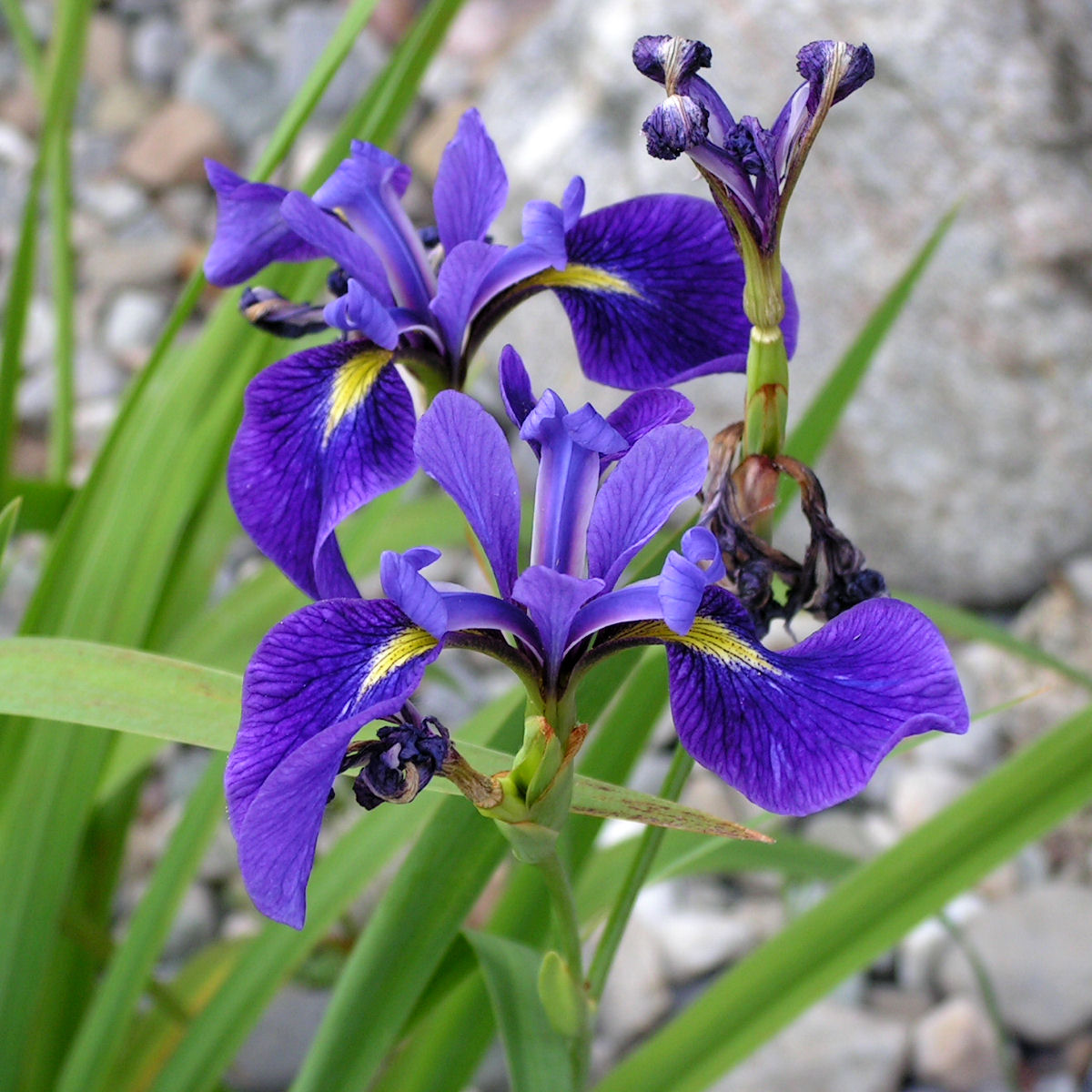
Crimean iris (Iris lutescens) is a dwarf rhizomatous perennial native to rocky hillsides and open woodlands across Southern France, Italy, and northeastern Spain. Despite its common name, this species does not originate from the Crimean Peninsula.
It reaches a height of 10–30 cm (4–12 in) and thrives in dry, sunny locations where excess water drains away rapidly. Spring blooms appear in yellow, violet, or white shades above fans of blue-green leaves.
Key Facts
- Height: 10–30 cm (4–12 in)
- Bloom Time: March to May
- Sunlight: Full sun (6+ hours daily)
- Hardiness: USDA zones 6 to 9
- Soil pH: 6.5–8.0 (neutral to alkaline)
- Toxicity: Mildly toxic to humans and pets
Is Crimean Iris Right for Your Garden?
Crimean iris suits rock gardens, gravel beds, and sunny slopes that mimic its Mediterranean native habitat. You need a site that receives at least 6 hours of sunlight daily and has coarse, free-draining soil.
This low-growing perennial requires minimal supplemental irrigation once established. Gardens with heavy clay soil or standing winter water will cause the rhizomes to rot within one season.
How to Identify Iris lutescens
Crimean iris forms clumps of sword-shaped, blue-green leaves measuring 10–25 cm (4–10 in) long and 1–2 cm (0.4–0.8 in) wide. Flowers emerge in early spring on short unbranched stems holding one or two blooms.
Each flower spans 5–7 cm (2–2.8 in) across, featuring bearded falls and upright standards. The seed fruit develops as a three-valved capsule containing brown, wrinkled seeds.
- Height: 10–30 cm (4–12 in) tall at maturity
- Flower Colours: Pale yellow, deep violet, purple, or pure white
- Leaves: Slightly curved, fan-shaped arrangements
- Fruit: Oblong seed capsule 3–4 cm (1.2–1.6 in) long
Choosing the Best Site for Crimean Iris
Select an unshaded position that provides full sunlight all day. Full sun encourages dense flowering and keeps rhizomes dry after rainfall.
Slopes, raised garden beds, and gravel borders prevent waterlogging around the rhizome crowns. In partial shade, foliage becomes floppy and flower production drops significantly.
How to Plant Crimean Iris Rhizomes
Plant rhizomes in late summer with the top upper surface exposed to direct sunlight. Burying the rhizome completely under soil encourages fungal rot.
Space individual plants 20–30 cm (8–12 in) apart to allow air circulation between fans. Dig a shallow hole, spread the roots outward over a ridge of soil, and firm the ground gently around the base.
- Planting Depth: Upper half of rhizome flush with soil surface
- Spacing: 20–30 cm (8–12 in) apart
- Soil Prep: Mix in coarse grit or crushed limestone to improve drainage
Watering and Fertiliser Needs
Water newly set plants deeply once every 7 to 10 days until roots establish in late autumn. Established plants survive on natural rainfall alone throughout most spring and summer months.
Apply a low-nitrogen, high-phosphorus fertiliser in early spring as new shoots emerge. Avoid high-nitrogen fertilizers, which trigger soft foliage growth vulnerable to leaf spot and fungal infection.
Trimming and Grooming Crimean Iris
Cut flower stems down to 2 cm (0.8 in) above the rhizome immediately after flowering finishes. Removing spent flower stalks prevents energy loss to seed production.
Trim dead or yellowing leaf tips in late autumn into a 15 cm (6 in) fan shape. Do not cut healthy green leaves during summer, as they replenish energy storage in the rhizome for next year’s bloom.
How to Divide Iris lutescens
Divide established clumps every 3 to 4 years in July or August after flowering completes. Division rejuvenates crowded plants and prevents central dieback in older rhizome clumps.
Lift the entire root mass with a garden fork. Cut away old, woody, or soft central rhizomes with a sharp knife, keeping young outer rhizomes that possess healthy leaf fans and firm roots.
- Step 1: Lift clump 4–6 weeks after spring flowers fade
- Step 2: Cut rhizomes into sections with 1 leaf fan each
- Step 3: Trim foliage back by half to reduce transpiration stress
- Step 4: Replant immediately in fresh, gritted soil
Preparing Crimean Iris for Winter
Crimean iris withstands winter frost down to -15 °C (5 °F) without artificial heat or heavy coverings. Remove fallen tree leaves from around the foliage fans to prevent trapped moisture.
In regions with persistent winter rain, cover the planting area with a gravel mulch 2–3 cm (0.8–1.2 in) deep. Do not apply organic bark mulches, which hold dampness against the exposed rhizomes.
Flowers and Seed Capsules of Crimean Iris
Flowers open between March and May, lasting 10–14 days per individual stalk. Yellow forms usually display a yellow beard, while violet forms feature a whitish or blue-bearded center.
If flowers are left unpruned, broad three-chambered fruit capsules form by midsummer. These capsules dry from green to tan, splitting open to shed brown seeds into surrounding gravel.
Best Companion Plants for Crimean Iris
Pair Crimean iris with shallow-rooted rockery species that demand dry soil and full sun. Alpines that bloom at slightly different times extend seasonal interest without shading the iris foliage.
Good companions include rock rose (Helianthemum nummularium), wall bellflower (Campanula portenschlagiana), purple aubrieta (Aubrieta deltoidea), and wild thyme (Thymus serpyllum). Avoid tall perennials like European goldenrod (Solidago virgaurea) that block sunlight from reaching the rhizomes.
Frequently Asked Questions
What is the common name of Iris lutescens?
Iris lutescens is commonly known as the Crimean iris or dwarf iris. In scientific literature, it is often referenced under the historical synonym Iris lutescens Lam. (described by Jean-Baptiste Lamarck).
Is the Crimean iris named after the Crimean War?
No, the plant's name is a geographical misnomer from early botanical catalogues. The species is native to Southern France, Italy, and Spain, and has no botanical connection to the Crimean Peninsula, Crimean War regiments, or Eastern Europe.
What does the fruit of Iris lutescens look like?
The fruit is an oblong, three-valved capsule measuring 3–4 cm (1.2–1.6 in) long. As it matures in mid-to-late summer, it turns brown and splits open to release wrinkled brown seeds.
Where can you buy Crimean iris plants?
Specialist alpine nurseries and online bulb suppliers list Crimean iris (often under 'Iris lutescens kaufen' in German-speaking regions or 'Iris lutescens chamaeiris'). They are typically sold as potted plants in spring or potted rhizomes in late summer.
Is Iris lutescens toxic to pets?
Yes, all parts of Crimean iris—especially the underground rhizomes—are mildly toxic to dogs, cats, and humans. Ingestion causes drooling, vomiting, diarrhea, and lethargy due to resinous irisin compounds.
Sources & Verification
Taxonomy and distribution are checked against the databases below. Care guidance is written for cultivated species only and reviewed by our editor. How We Build Plant Profiles →