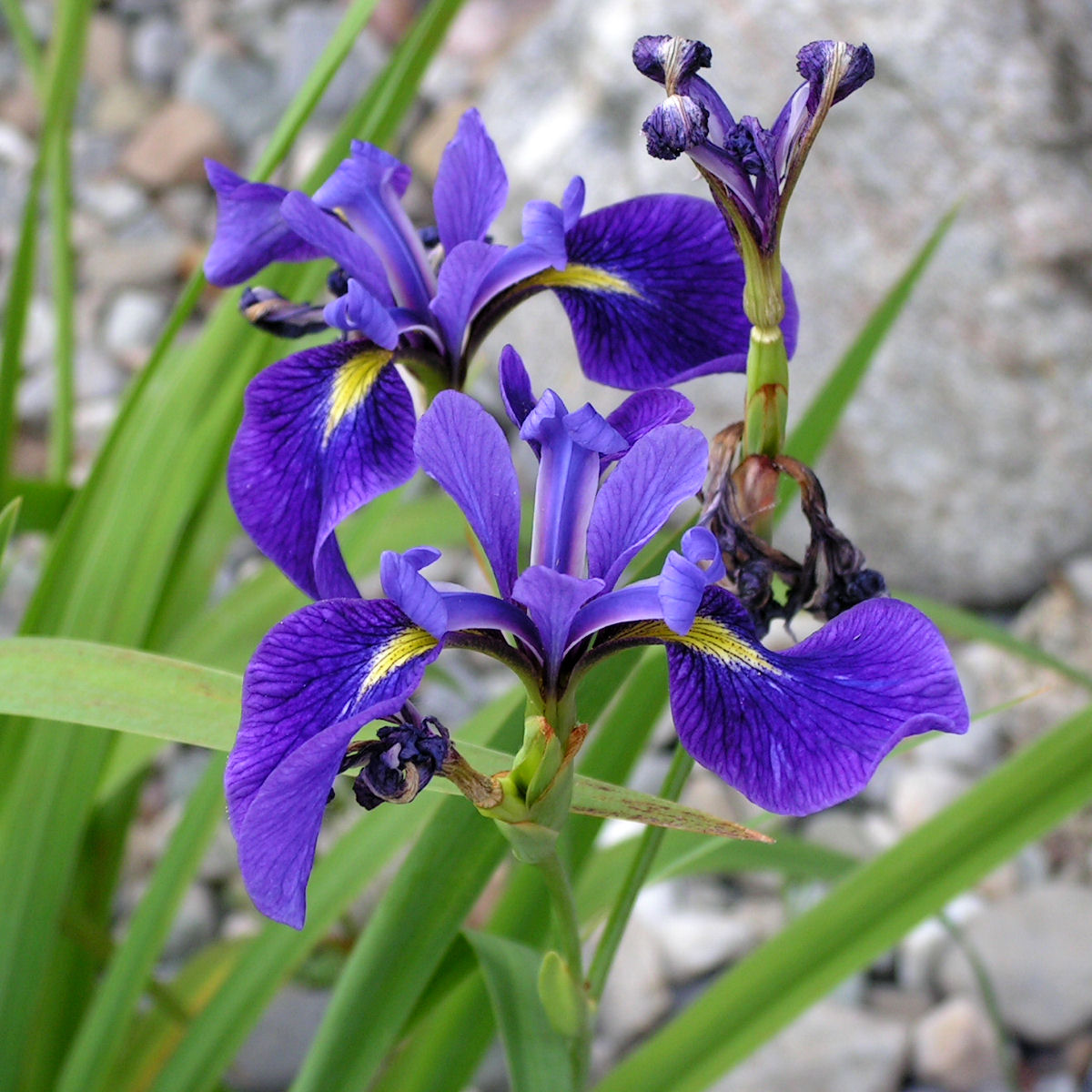
Iris virginica is a moisture-loving perennial that produces striking violet-blue flowers in late spring. It is a signature plant of the swampy edges and shallow marshes found throughout the eastern half of North America.
You will find this species in areas where the soil remains consistently saturated throughout the growing season. It often forms large, dense colonies that provide essential cover for wetland wildlife.
Key Facts
- Type: Perennial wetland rhizomatous herb
- Flower: Violet-blue with yellow signal patches
- Height: 60–90 cm (24–36 in)
- Habitat: Marshes, swamps, and pond edges
- Native Range: Central and Eastern North America
Why Choose Virginia Blue Flag for Your Wetland
Virginia blue flag is the ideal choice for naturalizing areas with standing water or consistently boggy soil. It thrives where other garden plants fail due to root rot, making it a reliable performer for rain gardens and pond margins.
This species is highly effective at stabilizing soil along stream banks and pond edges. Its spreading rhizomes create a dense mat that prevents erosion while providing a nectar source for native bumblebees and hummingbirds.
How to Identify Virginia Blue Flag
You can identify Iris virginica by its distinctive violet-blue petals and the yellow, ridge-like signal patch at the base of the falls. The leaves are sword-shaped, reaching up to 90 cm (36 in) in length, and are typically arranged in a fan-like pattern at the base of the stem.
- Flowers feature three upright petals and three drooping sepals.
- The stems are usually unbranched and smooth.
- Seed pods are elongated, green capsules that turn brown when mature.
- Rhizomes are thick, fleshy, and often partially exposed above the mud.
Where Does Virginia Blue Flag Grow
The natural habitat of this species is wetland environments, including swamps, marshes, floodplains, and the edges of slow-moving streams. It is native to the central and eastern United States, ranging from the Atlantic coast to the Great Plains.
It prefers full sun to partial shade and requires soil that stays wet for most of the year. You will rarely find this plant in dry or well-drained upland sites, as it lacks the drought tolerance of other iris species.
Ecology and Pollinators
Virginia blue flag serves as a critical food source for various native pollinators, particularly long-tongued bees. The yellow signal on the falls acts as a nectar guide, directing insects toward the reproductive structures of the flower.
Beyond its role as a pollinator plant, it provides essential habitat for amphibians and small aquatic insects. The dense foliage offers shade to the water surface, which helps regulate temperature and reduces algae growth in small ponds.
Conservation Status and Protection
Virginia blue flag is currently classified as Least Concern across much of its native range, though local populations are sometimes threatened by wetland drainage. Habitat loss remains the primary factor affecting its distribution in urbanized areas.
Because it is a wetland specialist, the protection of marshes and riparian corridors is vital for its long-term survival. You should avoid harvesting wild specimens, as they are essential to the health of the local aquatic ecosystem.
Traditional Uses of Virginia Blue Flag
This plant was traditionally used by Indigenous peoples for various medicinal purposes, primarily involving the preparation of poultices from the rhizomes. These were applied to the skin to address minor irritations or swelling.
It is important to note that all parts of this plant are considered toxic if ingested. Modern botanical practice discourages the use of this plant for internal consumption due to the presence of potent glycosides.
Similar Species to Virginia Blue Flag
You might easily confuse Iris virginica with other blue-flowering irises, most notably the northern blue flag (Iris versicolor). While they appear similar, you can distinguish them by checking the specific location and the shape of the flower parts.
- Iris versicolor: Generally has more compact flowers and is found further north.
- Iris prismatica: Features much narrower, grass-like foliage.
- Iris hexagona: Displays larger, more complex flower structures and is restricted to the southern US.
- Iris setosa: Has significantly smaller, nearly absent upright petals.
Frequently Asked Questions
What is the difference between Iris virginica and Iris versicolor?
The primary difference is the range and floral structure; Iris virginica is typically found in the southern and central US, while Iris versicolor is more common in the north. Additionally, Iris virginica often has a more distinct yellow signal patch at the base of the falls.
Is Virginia blue flag toxic to pets?
Yes, all parts of the plant are considered toxic to dogs and cats if ingested. It contains compounds that can cause vomiting, diarrhea, and skin irritation upon contact.
Does Virginia blue flag need to be planted in water?
It does not need to be submerged, but it requires soil that is constantly saturated or very boggy. It will not thrive in standard garden soil that dries out between waterings.
How do I propagate Virginia blue flag?
In the wild, it spreads primarily through the expansion of its thick, creeping rhizomes. You can also grow it from seeds, which require a period of cold stratification to germinate successfully.
Information about traditional or historical uses is provided for educational interest only and is not medical advice. Do not use any plant to treat a condition without speaking to a qualified professional.
Sources & Verification
Taxonomy and distribution are checked against the databases below. Care guidance is written for cultivated species only and reviewed by our editor. How We Build Plant Profiles →