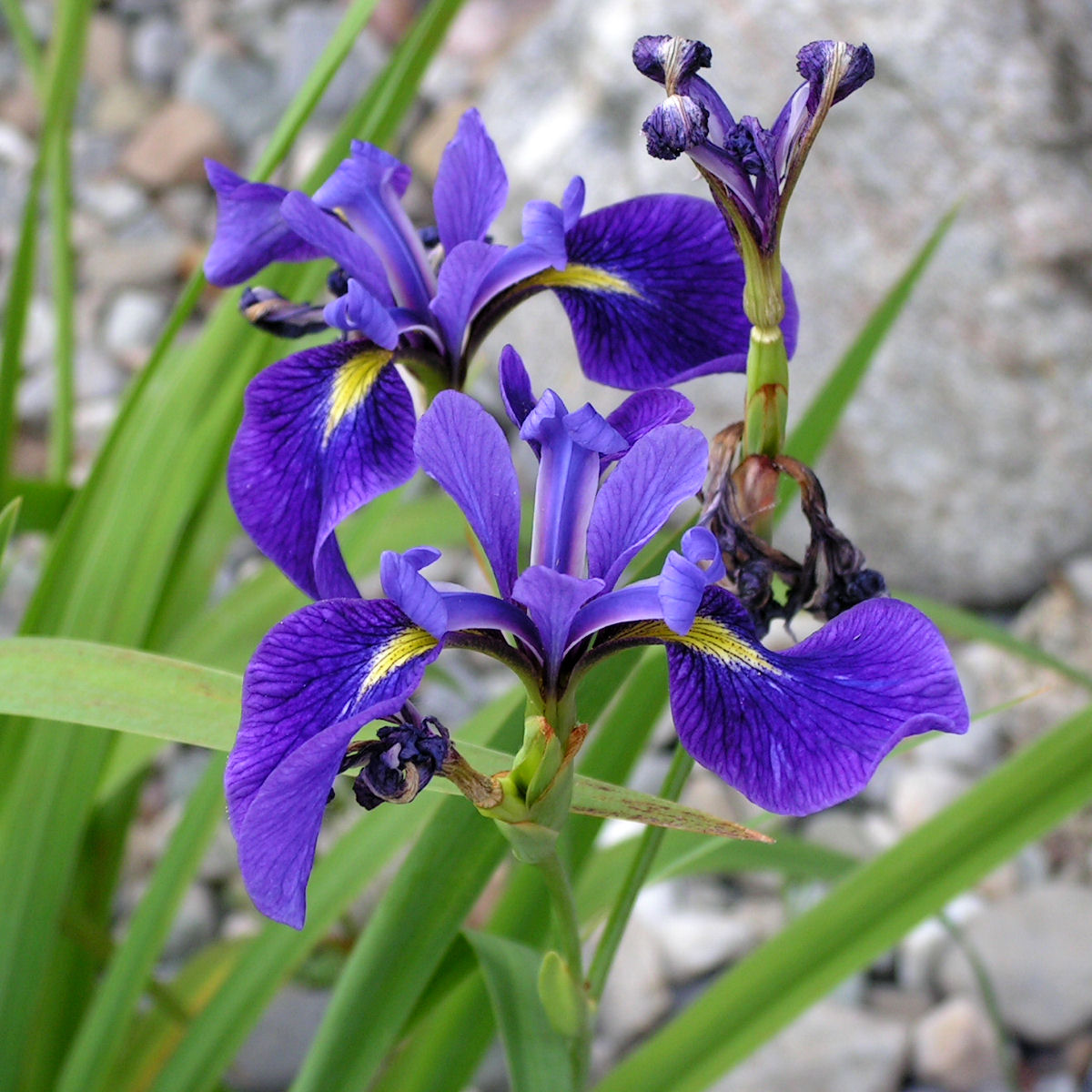
Douglas iris (Iris douglasiana) is a rhizomatous evergreen perennial native to coastal meadows and open woodlands from southern Oregon to Central California. Broad clumps of dark green, strap-like leaves produce showy floral displays in lavender, violet, or cream across mid-spring.
Unlike thirstier traditional border irises, this species requires a dry summer rest period and fails quickly if drowned with warm, standing irrigation. Established clumps form drought-tolerant ground cover that stabilizes slopes and resists deer browsing.
Key Facts
- Plant type: evergreen perennial rhizome
- Height: 30–60 cm (12–24 in) tall
- Light: partial shade inland; full sun along coastal fog belts
- Water: moderate in winter and spring; dry in summer
- Bloom time: March to May
- Hardiness: USDA zones 7–10
Growing Douglas Iris in the Garden
Douglas iris settles into garden beds as a long-lived, evergreen groundcover that thrives with minimal summer water once established. It suits dry shade gardens under native oaks, rockeries, and mixed coastal borders.
You will succeed with this plant if you mimic its native maritime rhythm: cool, damp winters followed by dry, warm summers. Heavy summer garden irrigation combined with hot soils will kill the root system through fungal crown rot within a single season.
- Prefers temperate coastal conditions with seasonal winter rainfall.
- Forms clumps that expand by 10–15 cm (4–6 in) annually through spreading rhizomes.
- Resists browsing by deer and rabbits due to bitter compounds in the foliage.
Botanical Description and Identifying Traits
Douglas iris is recognized by its broad, dark green leaves with reddish-purple staining at the base. Foliage reaches 30–60 cm (12–24 in) in length and 1.5–2 cm (0.6–0.8 in) in width, remaining evergreen throughout the year.
Flowering stems emerge unbranched or once-branched, carrying two to three blossoms per stem in spring. Each flower spans 7–10 cm (2.8–4 in) across, featuring three downward-curving falls with prominent yellow central signals and purple veining, along with three upright standards. Floral colours vary from deep violet-purple and blue to pale lavender, cream, or white.
Fertilized blooms form oblong, three-sided seed capsules measuring 4–5 cm (1.6–2 in) long. These turn brown and split open in late summer, releasing numerous hard, round, dark brown seeds.
Light and Soil Requirements
Plant Douglas iris in dappled shade to partial sun, or in full sun where coastal fog moderates daytime heat. Inland locations require protection from hot afternoon sun to prevent the foliage from scorching.
Soil must drain freely to protect the rhizomes from persistent saturation during warm weather. The species tolerates heavy clay if planted on a slope or mound, but thrives in acidic to neutral loam enriched with leaf mould.
- Inland gardens: 3–5 hours of morning sun or filtered tree canopy light.
- Coastal gardens: 6 or more hours of direct sun.
- Soil pH: 5.5 to 7.0; avoid alkaline soils or heavy lime applications.
- Drainage: high porosity required; avoid low, waterlogged depressions.
How to Plant Douglas Iris
Plant container-grown specimens in autumn to early winter to allow root establishment before the spring flowering season. Autumn planting allows the root system to take advantage of natural winter rains.
Dig a hole twice as wide as the root ball and equal in depth. Set the plant so the top of the rhizome sits level with or just below the soil surface, burying it no deeper than 2.5 cm (1 in). Backfill with native soil, firm gently, and water thoroughly to settle air pockets.
- Space individual plants 45–60 cm (18–24 in) apart for continuous groundcover.
- Topdress with a 5 cm (2 in) layer of coarse organic mulch, keeping it 2 cm clear of the rhizome crown.
- Water once a week for the first 8 weeks if winter rain is absent.
Douglas Iris Care: Water and Fertilizer
Established plants require little to no summer water once root systems mature after the first year. Winter and spring rain provides all the moisture needed for lush growth and flower production.
If growing in inland regions with high heat, supply deep water once every 3–4 weeks during summer, directing water around the root zone rather than onto the crown. Never irrigate with warm water during the peak heat of the day.
Fertilizer is rarely necessary in garden soil. An annual autumn application of composted pine bark or oak leaf mould around the base delivers adequate nutrients while maintaining a slightly acidic soil surface.
Pruning and Maintenance
Prune Douglas iris in late summer or early autumn by removing dead, tattered foliage and spent flower stalks at the base. Routine shearing is not recommended, as the foliage is evergreen and supports root reserves.
Cut spent flowering stalks down to the soil line once blooming finishes in May to redirect energy into rhizome growth. Comb out dry brown leaves with gloved hands or snip them off with sharp shears. If an old clump becomes congested and tatty after 5–7 years, cut the entire fan down to 10 cm (4 in) in late autumn just as fresh green growth appears.
How to Propagate Douglas Iris
The most reliable method of propagation is division in autumn or early winter as active root growth begins. Unlike bearded iris varieties, Pacific Coast irises resent summer division and usually perish if split while dormant.
Lift mature clumps carefully with a garden fork after the first soaking autumn rains. Look at the base of the fans for fresh white root tips emerging from the rhizomes. Slice rhizomes with a clean, sharp knife into sections that contain at least one healthy fan and several active white roots.
- Replant divisions immediately into moist soil; never allow exposed roots to dry out.
- Sow fresh seeds in autumn in seed trays filled with gritty, acidic seed compost.
- Expose seeds to cold winter temperatures outdoors; germination follows in 60–90 days.
- Seedlings reach flowering size within two to three growing seasons.
Pests and Disease Prevention
The primary threat to this plant is fungal root rot caused by Phytophthora species in warm, over-watered soils. Symptoms include yellowing leaves that turn brown and collapse at the crown, accompanied by mushy, foul-smelling rhizomes.
Snails and slugs chew irregular holes in young flower buds and leaves during damp spring weather. Set out beer traps or hand-pick pests after dark to protect emerging buds. Iris borer occasionally enters the foliage; clip out affected leaves at the first sign of tunneling.
- Crown rot: improve drainage, eliminate summer irrigation, and plant on slopes.
- Slugs and snails: hand-pick or apply iron phosphate pellets around borders.
- Thrips and aphids: spray off foliage with a strong jet of cold water.
Douglas Iris Bloom Season
Douglas iris blooms from March through May, producing waves of flowers over a four to six-week period. Cool coastal conditions extend the display into early June.
Each bloom lasts 3–5 days, with multiple buds opening in succession along the flower spike. Flower colours vary widely from seedling to seedling, ranging from deep royal purple to pale blue-gray, mauve, and cream with prominent yellow throat markings.
Deadheading spent flowers prevents unwanted self-seeding while keeping clumps neat. However, leaving seed capsules to mature provides seed for autumn propagation and feeds native birds.
Douglas Iris Care Through the Seasons
| Spring | Enjoy the flower display from March to May. Cut spent flower stems to the base after petals drop, and monitor foliage for slug or snail damage. |
|---|---|
| Summer | Withhold routine irrigation for established plants. Allow seed pods to dry if collecting seed, and clean out dry, dead leaves from inside the clumps in late summer. |
| Autumn | Divide and transplant overcrowded clumps after the first rains trigger new white root growth. Sow fresh seed into trays and topdress beds with 2–5 cm (1–2 in) of organic mulch. |
| Winter | Weed around expanding evergreen crowns as winter rains spur root and leaf growth. Protect young potted seedlings from prolonged freezing temperatures below -7 °C (20 °F). |
Troubleshooting Common Douglas Iris Problems
| What you see | Likely cause | What to do |
|---|---|---|
| Soft, rotting rhizomes and collapsing fans | Phytophthora crown or root rot from overwatering in warm weather | Cease summer watering immediately and replant healthy divisions into raised, sharply draining soil. |
| Chewed holes in flower petals and emerging leaves | Snails or slugs feeding during damp spring nights | Hand-collect pests after dark or distribute iron phosphate bait around the clump perimeter. |
| Yellowing foliage tips during mid-summer | Sun scorch or natural summer semi-dormancy | Provide light midday shade in hot inland zones and let the plant rest without force-watering. |
| Failure to bloom in spring | Excessive deep shade or clump overcrowding | Move to a location receiving 4–6 hours of sunlight or divide old clumps in late autumn. |
Douglas Iris Cultivars and Forms
- ‘Canyon Snow’ – white flowers with bright yellow throat signals; reliable bloomer
- ‘Point Reyes’ – compact habit with rich violet-blue petals
- ‘San Simeon’ – pale blue falls with dark purple veining
- ‘Albissima’ – pure white wild-collected form with faint cream wash
Companion Plants for Douglas Iris
Douglas iris combines naturally with drought-tolerant, shade-tolerant woodland natives that share its winter-wet, summer-dry cycle. It provides an evergreen structural base underneath larger shrubs and deciduous trees.
In dappled light, plant it alongside western sword fern (Polystichum munitum), coral bells (Heuchera micrantha), and redwood sorrel (Oxalis oregana). In sunny coastal spots, it pairs effectively with blue-eyed grass (Sisyrinchium bellum), seaside daisy (Erigeron glaucus), and California poppy (Eschscholzia californica).
- Polystichum munitum provides bold architectural texture in moist shade.
- Heuchera micrantha adds airy pink and white floral sprays in late spring.
- Sisyrinchium bellum offers complementary blue tones with upright, fine foliage.
- Erigeron glaucus blooms alongside iris in coastal sunshine with lavender daisy flowers.
Frequently Asked Questions
Is Douglas iris native to California?
Yes, Douglas iris is native to coastal California from Santa Barbara County north to southern Oregon. It naturally occurs in coastal meadows, bluffs, and open coniferous forests below 1,000 m (3,300 ft) elevation.
Is Douglas iris evergreen?
Yes, Douglas iris is an evergreen perennial that maintains dense, dark green leaves throughout the year. Clumps stay green without dying back to the ground unless hit by severe hard frosts below -10 °C (14 °F).
Can you grow Douglas iris from seed?
Yes, you can easily grow Douglas iris from seed sown in autumn. Seeds require 6 to 12 weeks of cool, moist winter conditions to break dormancy, followed by germination in early spring.
How do you divide Douglas iris successfully?
Divide Douglas iris only in late autumn or early winter when active root tips begin growing after the first seasonal rains. Dig the clump, slice the rhizomes into sections with leaves and active white roots, and plant them immediately.
Is Douglas iris toxic to dogs and cats?
Yes, all parts of Douglas iris are toxic to dogs, cats, and humans, with the highest concentration of toxins in the rhizomes. Ingestion causes drooling, vomiting, abdominal pain, and lethargy due to the compound irisin.
Information about traditional or historical uses is provided for educational interest only and is not medical advice. Do not use any plant to treat a condition without speaking to a qualified professional.
Sources & Verification
Taxonomy and distribution are checked against the databases below. Care guidance is written for cultivated species only and reviewed by our editor. How We Build Plant Profiles →
- Kew Plants of the World OnlineTaxonomic confirmation and native range
- Jepson eFlora (University of California, Berkeley)Morphological description and California ecological distribution
- ASPCA Animal Poison ControlToxicity and clinical signs in domestic pets
- GBIF — Global Biodiversity Information Facilitytaxonomy, synonyms, occurrence records
- Wikipediageneral reference