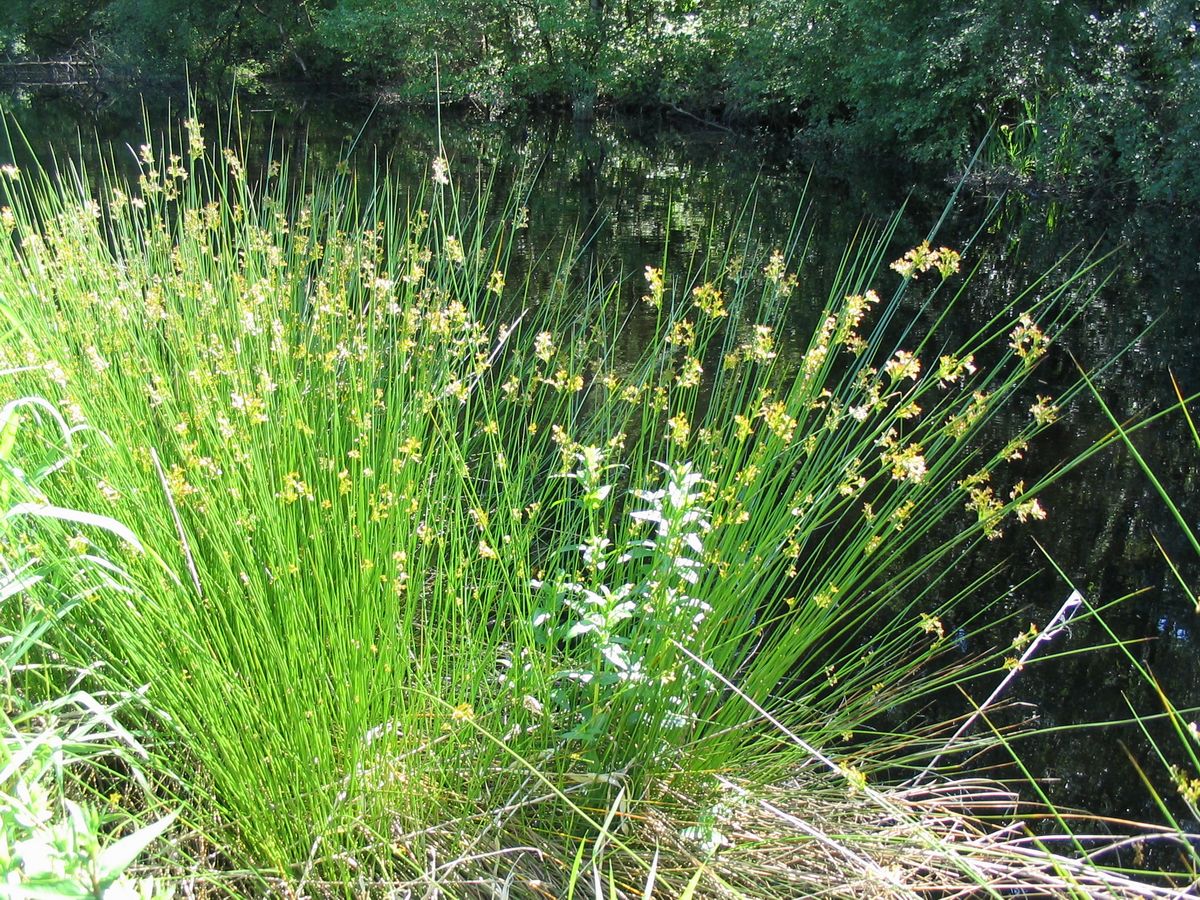
Compact rush is a perennial herbaceous plant in the rush family, found throughout Europe, North Africa, and parts of North America. You can recognize Juncus conglomeratus by its tall, leafless green stems that terminate in a tight, spherical cluster of brownish flowers.
While it is often confused with the soft rush (Juncus effusus), this species is distinguished by its deeply ridged stems and more compact flowering habit. It thrives in damp, acidic soils where it frequently forms dense, unpalatable clumps in grazing pastures.
Key Facts
- Height: 30–100 cm (12–39 in)
- Habitat: Marshes, damp pastures, and ditches
- Flowering: Dense brown clusters from May to August
- Identification: 12–30 prominent ridges on the upper stem
- Soil: Prefers acidic, poorly drained ground
Where You Will Encounter Compact Rush
You will find compact rush growing in permanently damp or seasonally waterlogged soils across temperate regions. It is a common sight in poorly drained agricultural fields, moorlands, and the margins of ponds or ditches. This plant acts as a biological indicator of heavy, compacted soil that lacks proper aeration.
Because it is highly tolerant of acidic conditions, it often dominates upland grazing areas where other grasses fail to thrive. In the United Kingdom and Northern Europe, it is a frequent component of wet meadow ecosystems. Its ability to withstand trampling by livestock allows it to persist in high-traffic farm gateways and path edges.
How to Identify Juncus conglomeratus
Identify the compact rush by checking for prominent ridges on the stem just below the flower head. Use your fingernail to feel the texture; you should count between 12 and 30 distinct ribs running vertically. The stems are cylindrical, grey-green, and filled with a continuous white pith that is easily seen if you snap a stem in half.
The flower head is a key diagnostic feature, appearing as a dense, ball-like cluster roughly 1-2 cm (0.4-0.8 in) in diameter. Unlike many other rushes that have spreading, loose branches, these flowers are tightly packed together. Although the cluster appears to grow from the side of the stem, it is actually terminal, with the “stem” above it being a modified leaf-like bract.
Wetland Habitat and Soil Preferences
Compact rush requires consistently high moisture levels and performs best in soils with a pH between 4.5 and 6.5. It is specifically adapted to anaerobic conditions where oxygen is limited due to water saturation. You will rarely find it in chalky or limestone-rich soils, as it struggles in alkaline environments.
The root system consists of short, creeping rhizomes that allow the plant to form stable, tufted clumps. These clumps can survive short periods of drought, but the plant will not flower or produce seeds without significant moisture. In garden settings, it is only suitable for bog gardens or the shallow margins of wildlife ponds.
Ecological Value for Birds and Insects
The dense structure of the common rush provides essential nesting cover for ground-nesting birds such as the lapwing (Vanellus vanellus) and the common snipe (Gallinago gallinago). These birds use the thick tufts to hide their eggs from aerial predators. In winter, the standing dead stems provide shelter for a variety of overwintering invertebrates.
While the flowers are wind-pollinated and do not produce nectar, the plant supports several specialist insects. The larvae of various case-bearer moths (Coleophora species) feed on the developing seeds. Additionally, the root mats help stabilize pond banks and prevent soil erosion during heavy rainfall events.
Is Common Rush Invasive or a Weed?
In agricultural contexts, compact rush is considered a significant weed because it displaces nutritious forage for cattle and sheep. Livestock generally avoid eating the tough, fibrous stems, allowing the plant to spread unchecked in neglected pastures. One single plant can produce thousands of tiny seeds that are easily dispersed by wind and water.
In North America, it is classified as an introduced species and can become invasive in sensitive wetland habitats. It outcompetes native sedges and rushes by forming dense monocultures. If you are managing a pasture, the presence of this plant usually signals that the land requires better drainage or a lime application to raise the soil pH.
Historical and Traditional Uses
Traditionally, the pith of the common rush was harvested to make rushlights, which served as a primary light source for the poor. The outer green skin was peeled away, leaving the inner white pith to be dried and dipped in rendered animal fat. These primitive candles provided a dim but steady flame for households that could not afford beeswax.
The tough stems were also used for weaving domestic items. You would find them woven into mats, baskets, and the seats of wooden chairs. While the plant is not toxic, it is not considered edible for humans due to the high cellulose content and lack of nutritional value; however, the tender base of the stem was occasionally chewed in survival situations.
Compact Rush vs Soft Rush
The main difference between the two is that the compact rush has deeply furrowed stems, while the soft rush (Juncus effusus) has stems that are smooth to the touch. When you look at the flower heads, the compact rush has a tight, rounded ball, whereas the soft rush has a loose, spreading arrangement of branches. These two species often grow side-by-side in the same marshy field.
Another similar relative is the hard rush (Juncus inflexus). You can tell the hard rush apart by its distinctly blue-green or glaucous stems and its interrupted pith, which looks like a series of small chambers when the stem is split lengthwise. Hard rush also prefers slightly more alkaline or neutral soils compared to the acid-loving compact rush.
How to Manage and Remove Common Rush
To successfully get rid of common rush, you must improve the soil drainage to eliminate the waterlogged conditions it loves. Mowing the plants twice a year—once in early summer and again in autumn—will eventually exhaust the energy stored in the rhizomes. However, mowing alone rarely kills the plant if the soil remains wet and acidic.
- Apply agricultural lime to raise the soil pH above 6.0.
- Use a chain harrow to pull up dead thatch and aerate the surface.
- Avoid overgrazing, which creates bare patches of mud where rush seeds can germinate.
- Spot-treat large clumps with a weed wiper using glyphosate if mechanical control fails.
Frequently Asked Questions
Is common rush edible?
No, common rush is not considered edible for humans. The stems are extremely fibrous and tough, making them indigestible, though they were historically used for weaving and making light wicks.
How do you prune common rush?
Prune common rush by cutting the entire clump down to 5 cm (2 in) above the ground in late winter. This removes the brown, dead stems and makes room for fresh green growth in the spring.
How do you propagate common rush?
Propagate by dividing the root clumps in early spring or by sowing seeds onto the surface of wet, acidic compost. The seeds require light and constant moisture to germinate successfully.
How do I get rid of common rush in my field?
The best way to get rid of it is to improve soil drainage and apply lime to reduce acidity. You can also weaken the plant by mowing it twice a year before it has a chance to set seed.
What is common club rush in Dreamlight Valley?
In the game, it is a forageable item, but in reality, 'club rush' usually refers to Schoenoplectus species, which are larger wetland plants with thick, spongy stems used for water purification.
Sources & Verification
Taxonomy and distribution are checked against the databases below. Care guidance is written for cultivated species only and reviewed by our editor. How We Build Plant Profiles →