
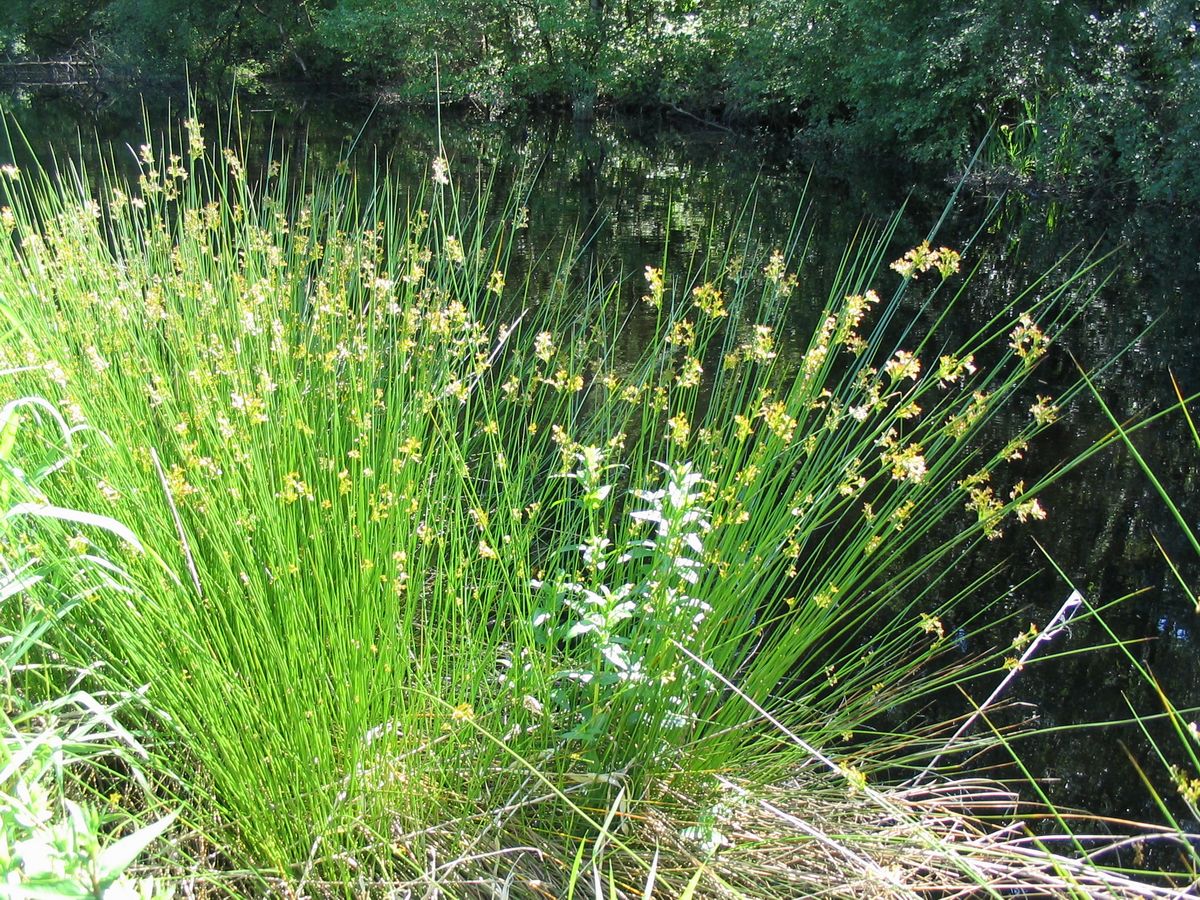
Common rush (Juncus effusus) is an upright, clump-forming wetland perennial found across temperate regions worldwide, recognized by its smooth, cylindrical green stems that lack true leaf blades. The center of each stem contains a continuous white spongy pith that historically served as a wick for rushlights.
This plant thrives in waterlogged ground and can tolerate standing water up to 10 cm (4 in) deep where terrestrial grasses perish. Without seasonal thinning or confined borders, its rhizomes and windblown seed allow it to spread across damp soil rapidly.
Key Facts
- Water: Keep soil constantly wet; tolerates shallow standing water
- Light: Full sun to partial shade
- Pruning: Cut stems back to 5 cm (2 in) in late winter
- Soil: Heavy clay, loamy muck, or silty aquatic substrate
- Hardiness: USDA Zones 4 through 9
- Spread: Clumps reach 45–90 cm (18–36 in) across
Is Common Rush Right for Your Garden?
Common rush suits rain gardens, pond margins, and bioswales where soil stays permanently wet or temporarily flooded. It anchors shifting mud on banks and filters stormwater runoff efficiently.
Do not plant soft rush in dry borders, rock gardens, or unlined ornamental ponds with gravel beds. Its dense, fibrous root mass binds tenaciously to pond liners and silt, making removal labor-intensive once established.
Botanical Description of Soft Rush
Soft rush forms dense, upright tussocks measuring 60–120 cm (24–48 in) in height with an equal spread. The leafless flowering stems are round, ungrooved, bright green, and 2–4 mm (0.08–0.16 in) thick.
True leaf blades are absent; instead, leaves are reduced to papery, reddish-brown sheaths hugging the stem base. When sliced open lengthwise, each stem reveals uninterrupted, white pith without the ladder-like air gaps found in slender rush (Juncus tenuis).
Where to Position Common Rush
Plant common rush in a site that receives at least six hours of direct sunlight each day. While it tolerates light afternoon shade, low-light positions cause the cylindrical stems to flop horizontally.
Select wet ground at the water’s edge or position the plant on the shallow marginal shelf of a pond. The root crown survives when submerged beneath 5–10 cm (2–4 in) of still or slow-moving fresh water.
How to Plant Common Rush in Ponds and Mud
Plant soft rush with the crown sitting flush with the soil line or up to 8 cm (3 in) underwater. Use heavy topsoil rather than commercial peat potting mixes that float away in water.
- In natural soil, dig a hole twice the width of the root ball and firm heavy mud over the roots.
- In garden ponds, set divisions into heavy plastic aquatic baskets lined with hessian to limit root spread.
- Top aquatic baskets with 2 cm (0.8 in) of washed pea gravel to prevent fish from unearthing roots.
- Space multiple crowns 45–60 cm (18–24 in) apart to allow for lateral rhizome growth.
Watering and Feeding Requirements
Common rush requires permanently saturated soil and should never be allowed to dry out completely. Drought turns stem tips brown and induces premature dormancy.
Supplemental feeding is unnecessary in garden soil or active ponds where natural silt and organic detritus supply ample nutrients. Avoid chemical fertilizers, which trigger algae blooms in adjacent pond water and produce weak, weak-walled stems.
How to Prune Common Rush
Prune common rush by shearing the entire clump back to 5 cm (2 in) above the crown in late winter. This clears out dead, straw-colored stems before fresh green shoots emerge in spring.
Use sharp hedge shears or a curved harvest sickle to cut through the fibrous tussock. Wear thick gloves, as repeated handling of dry rushes can cause skin irritation from friction.
How to Propagate Common Rush
Propagate soft rush by dividing the rhizomatous root crown in early spring as new growth begins. Spring divisions establish root systems within four to six weeks.
- Lift an established clump using a sharp garden spade.
- Slice the dense root mass into segments containing at least 5–10 active green stems and vigorous roots.
- Discard the hollow, woody center of very old tussocks.
- Replant divisions immediately into saturated soil and water them thoroughly.
Common Rush Problems and How to Control It
The main challenge with soft rush is uncontrolled self-seeding in damp lawns and wetland margins. Seeds disperse via wind and water, colonizing open wet earth rapidly.
To eradicate unwanted stands in pasture or turf, cut stems to soil level repeatedly to deplete root reserves, or dig out the entire rhizome crown with a mattock before seed capsules ripen in July. Fungal rust (Uromyces junci) occasionally causes brown pustules on stems; shear infected foliage to the ground and dispose of it away from the pond.
Winter Care and Frost Tolerance
Common rush is cold-hardy down to -34 °C (-30 °F), surviving without protection throughout USDA Zone 4. Foliage stays green in mild southern winters but turns copper-bronze after hard frosts in northern climates.
In container ponds, lower planting baskets to a depth of 20–30 cm (8–12 in) before the water surface freezes solid. Root crowns remain viable beneath surface ice as long as the surrounding mud does not freeze solid for weeks at a time.
Flowers and Seed Production
Flowers appear from late spring to mid-summer as branched, greenish-brown clusters measuring 2–8 cm (0.8–3.1 in) across. The inflorescence emerges from what appears to be the side of the stem, 5–15 cm (2–6 in) below the pointed stem tip.
The tip above the flower cluster is actually an upright bract that mimics a continuation of the stem. Each fertilized flower forms an obovoid, three-valved capsule containing hundreds of microscopic amber seeds that drop by late summer.
Seasonal Care for Common Rush
| Spring | Cut away brown, winter-damaged stems down to 5 cm (2 in) before new shoots appear. Lift and divide overcrowded root crowns as water temperatures warm. |
|---|---|
| Summer | Maintain water levels so the crown stays submerged or saturated under 5–10 cm (2–4 in) of water. Snip off fading flower clusters before seed capsules brown to prevent unwanted spreading. |
| Autumn | Clear away fallen tree leaves that collect in the center of the tussock. Collect seed heads if propagating new batches in seed flats. |
| Winter | Lower potted specimens below the winter ice line in northern pond zones. Leave dry foliage standing through midwinter to shelter overwintering aquatic insects. |
Diagnosing Common Rush Problems
| What you see | Likely cause | What to do |
|---|---|---|
| Brown, crispy stem tips | Substrate dried out completely or received sustained dry wind | Saturate the root zone immediately and keep the soil submerged under 2–5 cm (1–2 in) of water. |
| Stems flopping or leaning horizontally | Insufficient direct sunlight or excessive runoff fertilizers | Relocate the plant to a position receiving at least six hours of sun and cease any fertilizer use. |
| Small orange or dark brown spots along the stems | Rush rust fungus (Uromyces junci) | Cut the entire tussock back to the ground in late winter and clear away all debris. |
| Unwanted seedlings sprouting across adjacent wet ground | Prolific seed dispersal from unpruned summer flowers | Deadhead spent flower clusters in July before seed capsules ripen, and pull young seedlings by hand. |
Popular Soft Rush Cultivars
- ‘Spiralis’ – stems curl and twist in tight corkscrews
- ‘Blue Dart’ – compact upright stems with blue-green coloration
- ‘Unicorn’ – thick, strongly twisted upright stems reaching 60 cm
- ‘Big Twister’ – robust corkscrew form with thicker, curling stems
Companion Plants for Soft Rush in Bog Gardens
Pair common rush with broad-leaved wetland perennials that contrast against its stiff, vertical green spikes. Contrasting foliage shapes highlight the rush’s clean architectural lines.
- Marsh marigold (Caltha palustris) offers broad, glossy foliage and early yellow spring blossoms.
- Yellow iris (Iris pseudacorus) matches the height of soft rush while adding sword-like foliage.
- Water forget-me-not (Myosotis scorpioides) forms low creeping mats of sky-blue flowers around the tussock base.
- Sweet flag (Acorus calamus) provides fragrant, reed-like foliage that shares the same water depth requirements.
Frequently Asked Questions
Is common rush edible?
No, common rush is not considered edible for humans. The tough, fibrous stems are unpalatable, though the white inner pith was historically dried and soaked in fat to make rushlight candles.
Is common rush invasive?
Common rush is native across vast temperate areas but behaves aggressively in wet pastures, drainage ditches, and pond edges. It establishes dense monotypic stands that crowd out forage grasses if left unmanaged.
How to get rid of common rush?
Dig out the dense rhizome crowns completely with a sharp spade or mattock before seed heads mature in summer. Improving soil drainage and repeatedly cutting stems down to soil level also weakens and eventually eliminates unwanted patches.
What are common rush uses?
Common rush is used for pond edging, wetland restoration, and soil erosion control on water banks. Historically, dried stems were woven into mats, floor coverings, and baskets, and the continuous pith was used as candle wicks.
How do you tell a rush from a sedge?
Rushes like common rush have round, cylindrical stems containing pith, summarized by the traditional rhyme 'rushes are round.' Sedges belong to the Cyperaceae family and feature solid, triangular stems with edges ('sedges have edges').
Information about traditional or historical uses is provided for educational interest only and is not medical advice. Do not use any plant to treat a condition without speaking to a qualified professional.
Sources & Verification
Taxonomy and distribution are checked against the databases below. Care guidance is written for cultivated species only and reviewed by our editor. How We Build Plant Profiles →
- Kew Plants of the World OnlineTaxonomic status, global distribution, and morphological description.
- Missouri Botanical GardenHorticultural landscape uses, moisture requirements, and hardiness ranges.
- RHS GardeningGarden care, planting depth, and pruning advice.
- USDA PLANTS DatabaseEcological status, native range, and pasture management.
- GBIF — Global Biodiversity Information Facilitytaxonomy, synonyms, occurrence records
- Wikipediageneral reference


