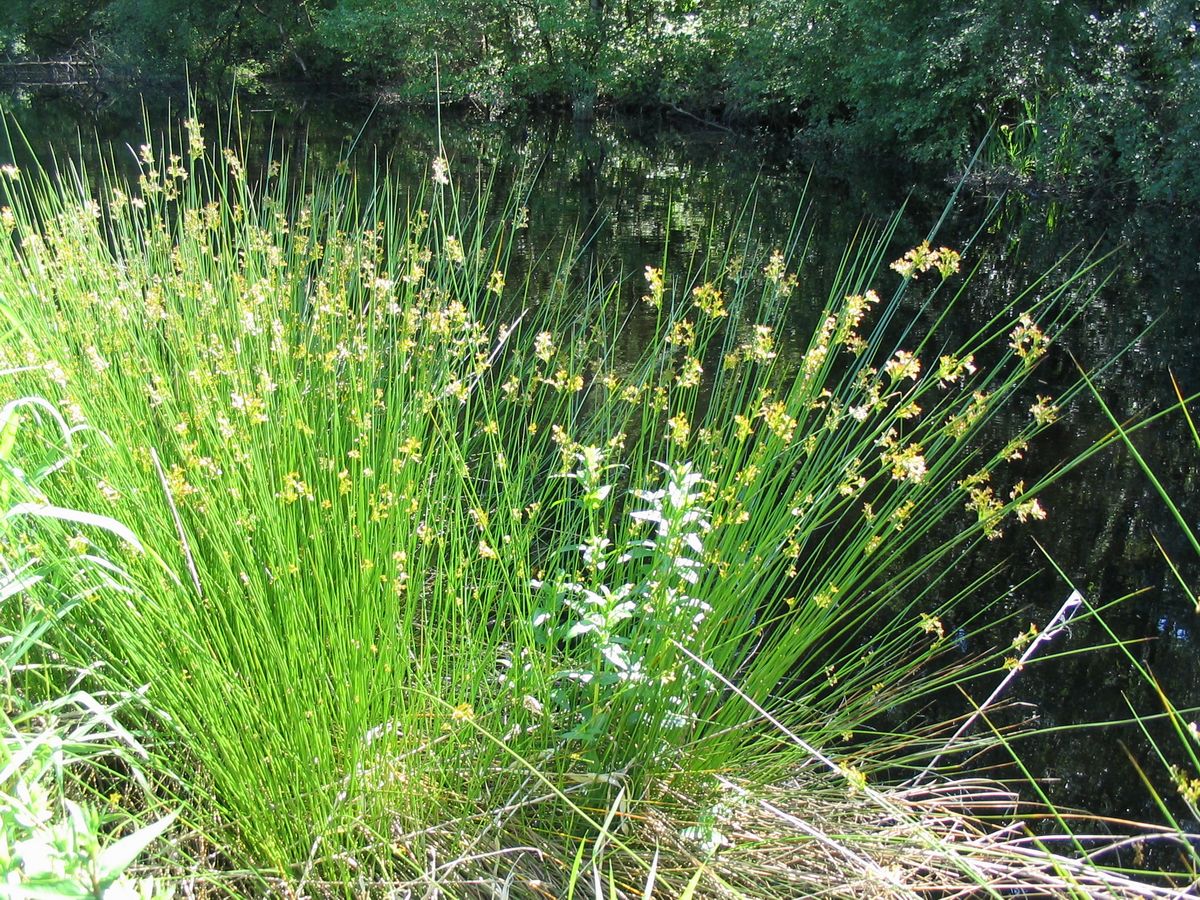
Slender rush (Juncus tenuis) is a native North American perennial rush that forms tough, wiry clumps along trodden paths and compacted fields.
It survives heavy foot traffic and high soil compaction where typical turfgrasses fail. Its seeds become sticky when wet, clinging to boots and animal hooves to spread rapidly across disturbed ground.
Key Facts
- Height: 15 to 60 cm (6 to 24 in)
- Native range: North America, naturalised in Europe and Asia
- Soil preference: Heavy clay, compacted paths, acidic ground
- Wetland status: Facultative Upland (FACU) to Facultative (FAC)
- Lifespan: Perennial tufted rush
Managing Slender Rush in Turf and Bare Soil
Slender rush functions as a coloniser of disturbed, heavily compacted soils rather than a cultivated garden plant. It thrives along footpaths, driveway edges, and overgrazed pastures where soil aeration is low. While turf managers treat it as an weed in manicured lawns, restoration ecologists value its ability to bind soil on eroded slopes.
It rarely invades healthy, uncompacted turf because grass root networks outcompete young seedlings. Core aeration and soil decompaction naturally reduce its presence over two to three seasons.
How to Identify Path Rush
Path rush grows in tight tufts reaching 15 to 60 cm (6 to 24 in) tall, characterized by round, unbranched stems and dry leaf sheaths with long, clear auricles. Leaves emerge primarily from the base, measuring 0.5 to 1.5 mm (0.02 to 0.06 in) wide. The leaf sheath ends in two distinct, papery projection lobes called auricles that measure 1 to 3 mm (0.04 to 0.12 in) long.
Flowers appear from May through September in loose clusters near stem tips, topped by one or two leaf-like bracts:
- Stems: Solid, wiry, round in cross-section, dark green
- Auricles: Translucent, silvery-white, longer than broad
- Flowers: Green to light brown with 6 tepals measuring 3 to 4.5 mm (0.12 to 0.18 in) long
- Fruit: Oval capsule containing hundreds of microscopic amber seeds
Juncus tenuis Native Range and Habitat
The native range of Juncus tenuis covers all 50 US states, Canada, and Northern Mexico, extending into parts of Central America. Human trade introduced this plant to Europe, Australia, Japan, and Southern Africa during the 19th century. In its native habitat, it grows from sea level up to 2,500 m (8,200 ft) elevation.
It tolerates full sun to moderate shade, acidic soil pH from 4.5 to 7.0, and seasonal flooding followed by summer drought. Its presence frequently signals historical soil compaction or heavy foot traffic.
Wetland Indicator Status and Ecological Role
In North American wetland delineation, path rush holds a Wetland Indicator Status of Facultative Upland (FACU) or Facultative (FAC) depending on the region. This designation indicates that while it occurs in wetlands 1 to 33% of the time, it frequently grows in non-wetland soils. The seeds absorb water and develop a gelatinous, sticky outer coating, allowing them to hitch rides on bird feet, deer hooves, and vehicle tires.
Small granivorous birds like song sparrows (Melospiza melodia) consume the tiny seeds during autumn. Waterfowl also ingest the ripe capsules, spreading seeds to distant wetland margins.
Controlling Poverty Rush in Lawns
Eliminating poverty rush requires mechanical soil aeration combined with dense turfgrass overseeding rather than heavy chemical herbicides. Herbicide sprays often roll off its waxy, vertical stems, requiring specialized surfactants if chemical control is attempted. Mowing alone fails to eradicate the plant because its growing points rest flush with the soil surface.
Implement these physical management practices to clear persistent patches:
- Aeration: Core-aerate soil to a depth of 7 to 10 cm (3 to 4 in) every autumn
- Mowing height: Maintain turf height above 7.5 cm (3 in) to shade out light-sensitive seedlings
- Soil pH correction: Apply agricultural lime if soil pH drops below 5.5
- Hand pulling: Dig individual clumps out by root crowns before flower capsules open in June
Traditional Uses of Slender Rush
Indigenous North American tribes traditionally braided slender rush stems into durable cordage, basketry, and small floor mats. Its tough, fibrous stems resist snapping when dried and rehydrated, making them suitable for binding materials. Native weavers combined slender rush with broadleaf cattail (Typha latifolia) to reinforce container rims.
Modern uses focus primarily on soil stabilization along ditch banks and bioswales. Land managers sow seed mixtures containing this rush to bind soil along footpaths exposed to water runoff.
Slender Rush Lookalikes and Comparison
Telling slender rush apart from soft rush (Juncus effusus) relies on examining plant height, stem structure, and flower cluster positions. Soft rush reaches 1.5 m (5 ft) tall with smooth, unbranched stems and lateral flowers, whereas path rush stays under 60 cm (24 in) with terminal flower clusters overtopped by leaf-like bracts.
Dudley’s rush (Juncus dudleyi) appears almost identical but features short, rounded, yellowish auricles rather than the long, silvery papery auricles of path rush. Grasses like Kentucky bluegrass (Poa pratensis) have flat, folded leaves and jointed stems, unlike the round, solid stems of rushes. To distinguish them:
- Soft rush (Juncus effusus): Taller habit up to 150 cm (60 in), flowers burst laterally from stem side
- Dudley’s rush (Juncus dudleyi): Rigid yellowish auricles under 1 mm long at sheath tip
- Toad rush (Juncus bufonius): Annual growth habit, smaller height under 20 cm (8 in), branched stem structure
- Path rush (Juncus tenuis): Silvery, membranous auricles up to 3 mm long, terminal flower cluster
Frequently Asked Questions
Is Juncus tenuis a weed in lawns?
Yes, Juncus tenuis is commonly considered a lawn weed in turfgrass because it forms stiff, wire-like tufts that resist lawnmowers. It thrives in compacted soil areas where grass dies out. Aerating the soil and overseeding with turf species naturally suppresses it over time.
What is the difference between Juncus dudleyi and Juncus tenuis?
The primary difference is the structure of the leaf auricles at the stem sheath base. Juncus tenuis has long, silvery-white, membranous auricles that are flexible and 1-3 mm long. Juncus dudleyi has short, rigid, yellowish auricles under 1 mm long.
Is Juncus tenuis Blue Dart a real variety?
No, 'Blue Dart' is a cultivar of blue rush (Juncus inflexus), not Juncus tenuis. Commercial nurseries frequently mislabel blue rush varieties under other Juncus species names. Juncus tenuis foliage is true green rather than glaucous blue.
What is the wetland indicator status of Juncus tenuis?
The wetland indicator status of Juncus tenuis ranges from Facultative Upland (FACU) to Facultative (FAC) depending on the regional flora index. This status means it commonly grows in upland, non-wetland habitats as well as moist ditch edges.
How does slender rush spread?
Slender rush spreads primarily through microscopic seeds that become sticky when wet and adhere to animals, shoes, and tires. Each plant produces thousands of seeds annually that remain viable in the soil seed bank for several years.
Sources & Verification
Taxonomy and distribution are checked against the databases below. Care guidance is written for cultivated species only and reviewed by our editor. How We Build Plant Profiles →