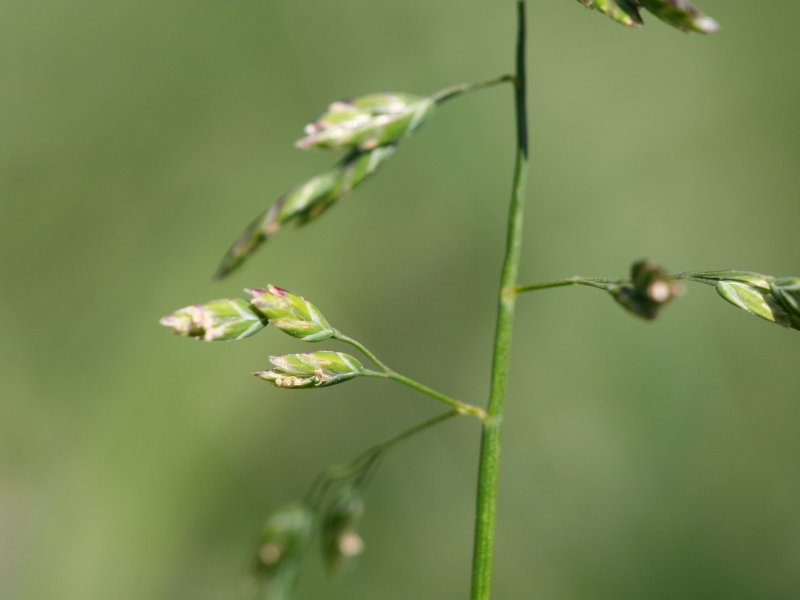
Kentucky bluegrass (Poa pratensis) is a cool-season perennial turfgrass native to Europe, Northern Asia, and North Africa. It forms a dense sod through underground rhizomes and displays distinctive boat-shaped leaf tips.
Homeowners and groundskeepers plant it for fine-textured residential lawns, athletic fields, and golf tees across temperate climates. Success depends on maintaining consistent moisture and high nitrogen levels during the cool spring and autumn months.
Key Facts
- Mowing height: 6.5 to 7.5 cm (2.5 to 3 in)
- Water requirement: 25 to 38 mm (1 to 1.5 in) weekly
- Germination time: 14 to 28 days
- Fertiliser rate: 1.5 to 2.0 kg N per 100 m² yearly
- Sunlight: 6 or more hours of direct sun
Growing a Kentucky Bluegrass Lawn
A Kentucky bluegrass lawn demands high maintenance inputs in exchange for an exceptionally dense, self-repairing turf. It spreads via creeping rhizomes that knit together, filling divots and bare patches without requiring manual reseeding.
This grass suits temperate regions with warm summers and cold winters, spanning USDA hardiness zones 2 through 7. Southern heat zones cause it to enter drought dormancy unless supplied with continuous irrigation.
- Demands 25 to 38 mm (1 to 1.5 in) of water each week during summer.
- Requires at least 6 hours of unshaded sunlight daily to avoid fungal thinning.
- Needs 3 to 4 fertilizer applications annually to maintain colour and density.
Kentucky Bluegrass Plant Identification
You can identify Poa pratensis in the field by its folded leaf vernation and cupped, boat-shaped leaf tips. Running your fingers along the blade reveals a smooth upper surface with two distinct parallel light lines along the midrib.
Unmown culms reach 30 to 70 cm (12 to 28 in) in height with narrow, flat blades measuring 2 to 4 mm (0.08 to 0.16 in) wide. Below ground, an extensive network of slender horizontal rhizomes anchors the base, producing shoots at irregular nodes to form a tight sod layer.
In late spring, flowering stems develop open, pyramidal panicles 5 to 20 cm (2 to 8 in) long bearing 3 to 5 spikelets per branch.
Sun and Soil Requirements
Kentucky bluegrass performs best in full sun with fertile, well-draining loam. Heavy clay slows rhizome expansion, while coarse sand drains moisture faster than the shallow root system can absorb it.
Keep soil pH between 6.0 and 7.0 for optimal uptake of micronutrients. Shaded sites receiving under 4 to 5 hours of direct sun prompt slender, pale leaves that succumb rapidly to powdery mildew.
- Test soil texture and amend heavy clays with compost before seeding.
- Apply agricultural limestone if pH falls below 6.0.
- Ensure subsoil drainage prevents standing water around root crowns.
Planting Kentucky Bluegrass Seed and Sod
The optimal window for planting Kentucky bluegrass seed is late summer to early autumn, when soil temperatures range between 15 and 21 °C (60 and 70 °F). Spring sowings face aggressive competition from germinating crabgrass and summer heat stress.
For establishing lawns from seed, broadcast 1.0 to 1.5 kg per 100 m² (2 to 3 lbs per 1,000 sq ft). When installing mature sod, lay rolls within 24 hours of delivery across moist, graded soil with staggered seams.
- Rake seed to a depth of 3 to 6 mm (0.12 to 0.25 in) and roll lightly for soil contact.
- Irrigate 2 to 3 times daily with light mists to prevent surface drying.
- Water freshly laid sod deeply so moisture penetrates 10 cm (4 in) into the subsoil.
Watering Schedule and Fertilizer Rates
Apply 25 to 38 mm (1 to 1.5 in) of water weekly in one or two deep soakings rather than brief daily sprinklings. Deep watering encourages roots to penetrate 15 to 20 cm (6 to 8 in) into the soil profile.
Supply 1.5 to 2.0 kg of actual nitrogen per 100 m² (3 to 4 lbs N per 1,000 sq ft) split across the growing season. Deliver the largest nitrogen fraction in September and October, which builds root carbohydrate reserves for early spring green-up.
- Irrigate between 4:00 AM and 9:00 AM to minimise surface evaporation and fungal growth.
- Apply 0.5 kg N per 100 m² in late spring after initial flush growth slows.
- Apply 0.75 kg N per 100 m² in early autumn during active tillering.
- Apply 0.5 kg N per 100 m² in late autumn before the ground freezes.
Mowing Height and Turf Pruning
Maintain a mowing height of 6.5 to 7.5 cm (2.5 to 3 in) during active growth periods. Never remove more than one-third of the total leaf blade length in a single cut to avoid carbohydrate depletion.
Raise cutting decks to 8.5 cm (3.5 in) during midsummer heat spikes. Taller leaf canopy shades the soil surface, cooling root zones and reducing evaporation rates.
- Sharpen mower blades every 25 hours of engine operation to prevent ragged leaf tears.
- Mow every 5 to 7 days during peak spring and autumn growth surges.
- Leave clippings on the lawn to recycle up to 25% of annual nitrogen inputs.
Kentucky Bluegrass Germination and Propagation
Expect a germination time of 14 to 28 days, which is substantially slower than companion turf species. Soil moisture must remain uniform throughout this four-week window to avoid seed desiccation.
Once established, the plant spreads vegetatively through underground rhizomes that branch outward, pushing up new crowns called tillers. To overseed a thin lawn, core-aerate first to create 50 to 70 holes per square metre before spreading seed.
- Pre-germinate or blend with quick-starting species if erosion is a risk.
- Keep the top 12 mm (0.5 in) of soil continuously damp until shoots reach 2 cm (0.8 in).
- Withhold the first mowing until seedlings reach 7.5 cm (3 in) tall.
Weeds, Diseases, and Pest Problems
Kentucky bluegrass suffers primarily from summer patch, necrotic ring spot, and dollar spot under improper irrigation and thatch build-up. Maintain thatch layers below 12 mm (0.5 in) by mechanical dethatching or core aeration every autumn.
White grubs (larvae of Japanese beetles) sever roots beneath the surface in late summer, causing turf to lift like a loose rug. Drench affected zones when sampling reveals more than 6 to 10 grubs per square foot.
- Powdery mildew: appears as white dust in damp shade; thin tree canopies to increase light.
- Rust fungus: produces orange powder on leaves during autumn; apply light nitrogen to accelerate leaf turnover.
- Broadleaf weeds: spot-treat dandelions and clover in early autumn when weeds store sugars downward.
Winter Care and Dormancy
Kentucky bluegrass enters winter dormancy by halting leaf extension and storing soluble carbohydrates within root crowns. It tolerates prolonged sub-zero temperatures beneath snow cover without root mortality.
Mow the final cut of the year down to 5 cm (2 in) in November to deter gray and pink snow mold fungi under winter snowpacks. Avoid parking vehicles or walking repeatedly across frosted or waterlogged winter turf to prevent crown crushing.
Flowering Season and Seedhead Formation
Unmown plants produce open panicles from late May to June, earning the species its regional name June grass. Flowering stems develop tough, fibrous stalks that resist clean mower blade cuts.
Lawns naturally develop scattered seedheads during this four-week seasonal transition even when cut regularly. Continue standard mowing routines at recommended heights; seedhead production ceases naturally once temperatures warm in summer.
Year-Round Lawn Care Calendar
| Spring | Rake winter debris and apply pre-emergent herbicide when soil temperatures reach 12 °C (55 °F). Apply 0.5 kg N per 100 m² in late spring once early growth slows. |
|---|---|
| Summer | Raise mowing height to 7.5 or 8.5 cm (3 or 3.5 in). Deliver 25 to 38 mm (1 to 1.5 in) of irrigation weekly, or allow turf to enter natural heat dormancy without traffic. |
| Autumn | Aerate compacted lawns in September and apply 0.75 kg N per 100 m². Overseed bare patches early and follow with a final fertilizer application in late October. |
| Winter | Complete the season's final mow at 5 cm (2 in) to prevent snow mold. Avoid walking or storing heavy snow piles on frozen, frosted turf. |
Diagnosing Kentucky Bluegrass Problems
| What you see | Likely cause | What to do |
|---|---|---|
| Turf turns straw-brown and pulls up like a carpet | White grub infestation severing roots | Check root zone for white C-shaped grubs and apply beneficial nematodes or targeted grub control in late summer. |
| Circular yellow patches fading to bleached sunken depressions in heat | Summer patch fungus (Magnaporthiopsis poae) | Avoid excessive spring nitrogen, reduce soil compaction with autumn aeration, and water deeply before sunrise. |
| Orange or reddish-brown powder rubs off leaves onto shoes | Lawn rust fungus during warm, dry late-summer spells | Apply 0.25 to 0.5 kg N per 100 m² to stimulate growth and mow regularly with a sharp blade. |
| Seedlings fail to appear 14 days after sowing | Normal germination delay or dry seedbed | Maintain constant surface moisture; Kentucky bluegrass requires 14 to 28 days to sprout. |
| Turf thins and develops powdery white coating under trees | Powdery mildew due to inadequate sunlight and damp air | Prune lower tree branches to admit 5 or more hours of direct sun or overseed with shade-tolerant fine fescue. |
Top Kentucky Bluegrass Cultivars
- 'Midnight' – compact habit, dark slate-blue colour, dwarf growth
- 'Baron' – rapid germination, reliable turf density, broad adaptation
- 'Bewitched' – superior shade tolerance and resistance to dollar spot
- 'Mazama' – low-mow tolerance and exceptional rust disease resistance
- 'Prosperity' – fine leaf texture, fast recovery from summer dormancy
Lawn Mixes and Companion Grasses
Formulate lawn seed mixes with perennial ryegrass and fine fescues to balance slow establishment and provide shade resilience. Blends leverage the distinct strengths of complementary cool-season turf species.
Combine species based on site microclimates across your property:
- Perennial ryegrass (Lolium perenne): germinates in 5 to 7 days, stabilising slopes while bluegrass establishes over 3 weeks.
- Tall fescue (Schedonorus arundinaceus): provides deep rooting and superior heat tolerance in transitional border zones.
- Strong creeping red fescue (Festuca rubra subsp. rubra): fills dry, shaded ground under mature deciduous trees where bluegrass fails.
- Chewings fescue (Festuca rubra subsp. fallax): adds needle-fine texture and tolerates lower soil fertility on sandy slopes.
Frequently Asked Questions
What is the difference between Kentucky bluegrass and tall fescue?
Kentucky bluegrass spreads via rhizomes, has boat-shaped leaf tips, and requires 14 to 28 days to germinate, whereas tall fescue (Schedonorus arundinaceus) grows in clumps, has pointed blades with coarse veins, germinates in 7 to 10 days, and tolerates drought better.
How long does Kentucky bluegrass seed take to germinate?
Kentucky bluegrass seed takes between 14 and 28 days to germinate. Soil temperatures must stay between 15 and 21 °C (60 and 70 °F) with constant surface moisture throughout this period.
How much seed is in a 50 lb bag and what area does it cover?
A 50 lb (22.7 kg) bag covers approximately 1,500 to 2,300 m² (16,000 to 25,000 sq ft) for a new lawn seeded at 2 to 3 lbs per 1,000 sq ft. For overseeding an existing lawn, that same bag covers up to 4,600 m² (50,000 sq ft).
Why combine Kentucky bluegrass and perennial ryegrass in a mix?
Perennial ryegrass (Lolium perenne) sprouts within 5 to 7 days to protect soil from erosion and weed invasion while slower Kentucky bluegrass takes a month to establish and knit its spreading sod.
Where can I find a lawn clinic to diagnose turf problems?
University cooperative extension offices operate plant diagnostic clinics that analyze physical turf plug and soil samples to confirm specific fungal pathogens or grub infestations.
What is the Bluegrass Kentucky Career Center?
The Bluegrass Kentucky Career Center is a state employment agency serving central Kentucky and is completely unrelated to the turfgrass plant.
Sources & Verification
Taxonomy and distribution are checked against the databases below. Care guidance is written for cultivated species only and reviewed by our editor. How We Build Plant Profiles →