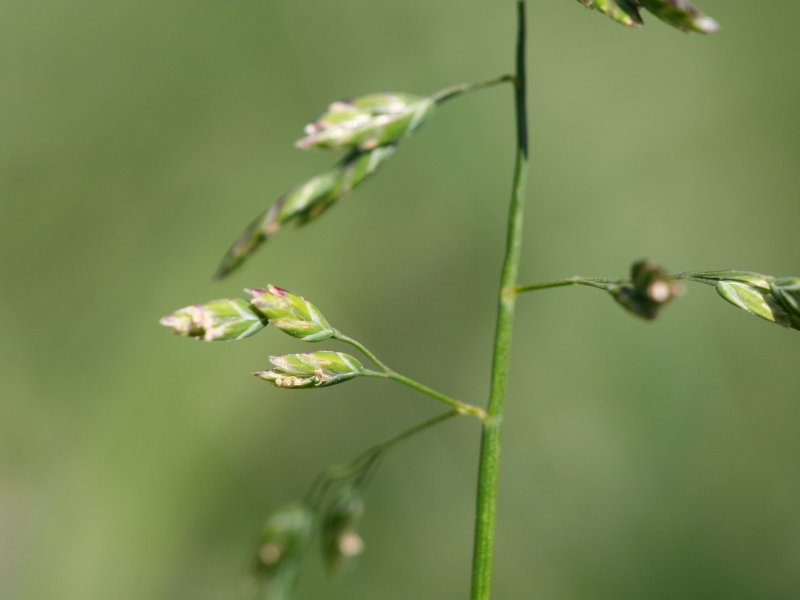
Sandberg bluegrass (Poa secunda) is a perennial bunchgrass native to North and South America, widely recognized for its extreme drought tolerance and early spring growth. It is one of the first species to turn green in the Great Basin and Columbia Plateau, providing critical early-season forage for wildlife.
This species is frequently used in restoration projects because it establishes quickly on disturbed or burnt soils. Unlike many lawn grasses, it enters a dormant state during the peak of summer to survive intense heat and lack of moisture.
Key Facts
- Water: Low; requires almost no supplemental water once established
- Height: 15 to 60 cm (6 to 24 in) depending on variety
- Soil: Well-drained, rocky, or sandy; tolerates alkaline conditions
- Hardiness: USDA zones 3 to 9
- Growth Rate: Fast establishment from seed in early spring
Is Sandberg Bluegrass Right for Your Garden?
Sandberg bluegrass is best suited for arid, low-maintenance landscapes or rock gardens where water conservation is a priority. It functions as a cool-season bunchgrass, meaning it does most of its growing while the ground is still moist from winter rains. It is an ideal choice for gardeners in the Intermountain West or High Plains who need a plant that can survive on natural rainfall alone.
This grass is not a traditional turf species and will not form a continuous carpet. Instead, it grows in distinct, tight tufts that leave space for other native wildflowers. It is particularly useful for:
- Stabilizing steep, rocky slopes prone to erosion
- Creating a naturalistic meadow look in USDA zones 4-7
- Filling gaps in xeriscapes where other grasses fail due to heat
- Providing early spring color before warm-season grasses wake up
How to Identify Poa secunda
You can identify Poa secunda by its compact, tufted growth habit and narrow, boat-shaped leaf tips common to the genus. The foliage is typically a soft blue-green or grey-green, with blades measuring only 1 to 2 mm (0.04 to 0.08 in) wide. These leaves often roll inward during dry spells to reduce water loss.
The flowering stems are upright and slender, reaching heights of 15 to 60 cm (6 to 24 in). The seed heads are narrow panicles that may appear slightly purple when young before turning a straw-tan color. Unlike the spreading rhizomes of Kentucky bluegrass (Poa pratensis), this species remains in a tight bunch.
Choosing the Best Site for Pine Bluegrass
Pine bluegrass requires full sun and excellent drainage to prevent root rot during the winter months. It thrives in shallow, rocky soils where more aggressive grasses struggle to compete. While it can tolerate some partial shade, the tufts will often become leggy and prone to flopping without at least 6 hours of direct light.
The subspecies juncifolia, often called alkali bluegrass, is more tolerant of heavy, saline, or alkaline soils than the standard variety. If your site has high clay content, consider amending the planting area with grit or planting on a slight mound. It is naturally found on windswept ridges and open prairies across the Western United States.
Sowing Poa secunda Seed and Planting
For best results, sow seeds in late autumn or very early spring to take advantage of cool, moist soil conditions. The seeds require cold stratification or simply the natural freeze-thaw cycle of winter to break dormancy. Lightly rake the seeds into the soil surface, as they require some light to germinate but should not be buried deeper than 6 mm (0.25 in).
If you are planting nursery-grown plugs, space them 20 to 30 cm (8 to 12 in) apart to allow the individual bunches to develop their characteristic shape. New plants need regular watering for their first season. Once the root system reaches its mature depth, usually by the second year, supplemental irrigation is rarely necessary.
Watering and Feeding Requirements
Water this grass only during the establishment phase or during extreme multi-year droughts. Overwatering, especially during the summer, can force the plant out of its natural dormancy and lead to fungal diseases. In most temperate climates, natural rainfall provides sufficient moisture for this species to complete its lifecycle.
Fertilizer is generally unnecessary and can actually harm the plant by encouraging excessive soft growth that attracts aphids. If your soil is exceptionally poor, a light application of organic compost in early spring is sufficient. Avoid high-nitrogen lawn fertilizers, which can cause the bunchgrass to lose its compact form and die back prematurely.
Pruning and Managing Bunchgrass Growth
Cut back the dried foliage to 5 cm (2 in) above the ground in late winter before new green shoots appear. This removes the previous year’s straw-colored debris and allows sunlight to reach the crown of the plant. Because it is a bunchgrass, you should never use a mower on a low setting, as this can damage the growing point located near the base.
During the summer, the plant will naturally turn brown and appear dead. This is a survival mechanism, and you should resist the urge to prune it during this time. The dried stalks provide structural interest and protect the crown from intense solar radiation until the autumn rains arrive.
Propagating Sandberg Bluegrass from Seed
The most effective way to propagate is by collecting and sowing ripe seeds in the autumn. Seeds are ready for harvest when the panicles turn light tan and the grains feel hard when pressed with a fingernail. Store the seeds in a cool, dry place if you are not sowing them immediately, though fresh sowing often yields higher germination rates.
Division is possible but less common for this species. If you choose to divide, do so in very early spring just as the first green blades emerge. Ensure each section has a substantial portion of the root mass and replant immediately to prevent the fine roots from drying out.
Common Problems and Pests
The most frequent issue is root rot caused by overwatering or poorly drained soil. If the center of the bunch turns black or mushy, the plant is likely receiving too much moisture. Rust fungi can occasionally appear on the leaves during unusually humid springs, manifesting as small orange or brown pustules.
- Summer Dormancy: Often mistaken for death; the plant is simply resting
- Aphids: May cluster on new spring growth; usually controlled by ladybugs
- Invasive Competition: Cheatgrass (Bromus tectorum) can outcompete young seedlings
- Over-mulching: Heavy wood mulch can trap moisture against the crown and cause rot
Flowering and Seed Production
Sandberg bluegrass produces flowers on slender, upright stalks starting in April or May. The inflorescence is a contracted panicle that stays close to the stem, giving it a sleek appearance. Each spikelet contains 2 to 5 florets, which are approximately 3 to 5 mm (0.12 to 0.2 in) long.
Seed production is prolific, which is why it is so effective for revegetating scorched earth after wildfires. The seeds are a significant food source for small mammals and birds like the dark-eyed junco (Junco hyemalis). Historically, the Gosiute people of the Great Basin harvested these seeds to grind into a nutritious meal.
Year-Round Care for Sandberg Bluegrass
| Spring | Monitor for new green growth and ensure seedlings are not smothered by weeds. This is the primary growing season. |
|---|---|
| Summer | Allow the plant to enter dormancy. Do not overwater or fertilize during this period, even if the grass turns brown. |
| Autumn | Sow fresh seeds on bare soil. The plant may show a small flush of green growth if autumn rains are heavy. |
| Winter | Cut back dead foliage to 5 cm (2 in) in late February. The cold temperatures help prime seeds for spring germination. |
Common Sandberg Bluegrass Problems Explained
| What you see | Likely cause | What to do |
|---|---|---|
| Grass turns brown in July | Natural summer dormancy | Stop watering and wait for cooler autumn temperatures. |
| Center of the bunch is rotting | Excessive soil moisture | Improve drainage or reduce irrigation frequency immediately. |
| Orange spots on leaves | Rust fungus | Increase airflow and avoid overhead watering in the morning. |
Popular Poa secunda Cultivars
- ‘Sherman’ – a robust selection used for high-yield forage
- ‘Canbar’ – known for excellent seedling vigor and drought resistance
- ‘Service’ – selected for long-term persistence in restoration sites
- ‘Supernova’ – a high-seed-yielding variety for commercial production
Companion Plants for Sandberg Bluegrass
Pair this grass with drought-tolerant Western natives that share its preference for dry, sunny sites. It looks particularly effective when interspersed with flowering perennials that bloom in late spring and summer. This creates a layered look that remains interesting even when the grass goes dormant.
- Big sagebrush (Artemisia tridentata) for structural contrast
- Scarlet globemallow (Sphaeralcea coccinea) for vibrant orange flowers
- Bluebunch wheatgrass (Pseudoroegneria spicata) for varied grass textures
- Rubber rabbitbrush (Ericameria nauseosa) for late-season yellow blooms
- Blanketflower (Gaillardia aristata) for long-lasting summer color
Frequently Asked Questions
How tall does Poa secunda get?
It typically reaches 15 to 60 cm (6 to 24 in) in height, with the 'Sherman' cultivar being on the taller end of the spectrum.
Is Sandberg bluegrass invasive?
No, it is a native species in North and South America and is often used to compete against invasive species like cheatgrass.
Can I mow Sandberg bluegrass like a lawn?
It is not recommended for traditional lawns as it grows in clumps and does not tolerate frequent, low mowing.
Is Sandberg bluegrass good for livestock?
Yes, it provides excellent early-season fodder for cattle and sheep before other grasses have matured.
Where is Sandberg bluegrass native to?
It is native to a wide range across North and South America, particularly in the western half of the United States and Canada.
Information about traditional or historical uses is provided for educational interest only and is not medical advice. Do not use any plant to treat a condition without speaking to a qualified professional.
Sources & Verification
Taxonomy and distribution are checked against the databases below. Care guidance is written for cultivated species only and reviewed by our editor. How We Build Plant Profiles →