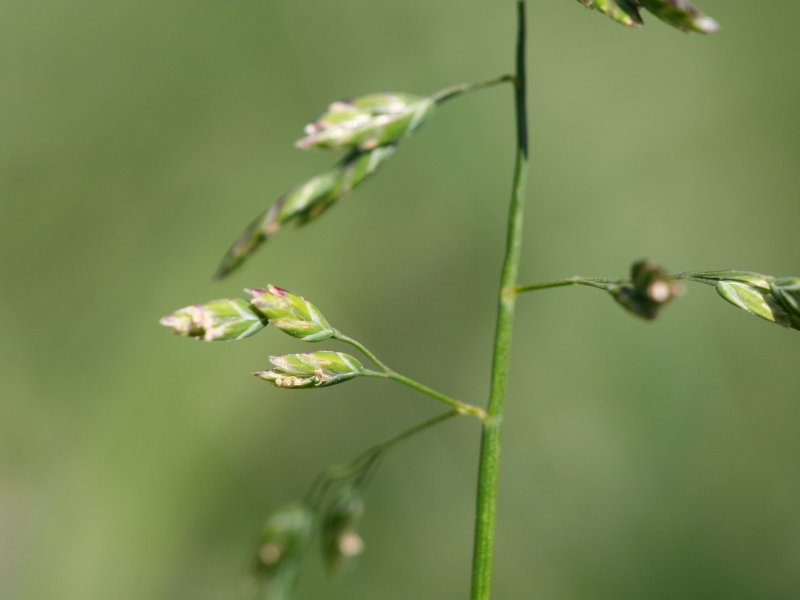
Alpine meadow-grass (Poa alpina) is a perennial tufted grass native to Arctic and alpine tundras across Europe, northern Asia, and North America. It forms dense, low tussocks that anchor thin, windswept scree soils at elevations up to 4,000 m (13,000 ft).
In extreme alpine climates, many populations bypass standard seed production entirely by developing miniature leafy plantlets inside their spikelets. These pre-formed vegetative clones drop directly onto gravel benches to establish immediately during brief mountain summers.
Key Facts
- Native range: Circumpolar Holarctic mountains and Arctic tundra
- Plant type: Perennial caespitose tussock grass
- Mature height: 10–40 cm (4–16 in)
- Key feature: Pseudovivipary replacing flowers with leafy bulbils
- Soil preference: Base-rich, rocky gravels and calcareous scree
Ecological Role of Alpine Meadow-Grass
Alpine meadow-grass acts as a pioneer soil stabiliser in high-altitude and subarctic ecosystems. Its compact root masses hold mobile rock debris in place, creating sheltered micro-sites where slower-growing mountain forbs can establish.
Because it tolerates extreme frost-heaving and sustained snow cover, the species forms a dominant component of late-melting snowbed fringes. Grazing herbivores such as reindeer, mountain sheep, and marmots feed on its foliage early in the season when surrounding vegetation remains dormant under snow.
Identifying Alpine Bluegrass in the Field
Alpine bluegrass forms tight basal tufts clothed in thick, persistent, straw-coloured leaf sheaths from previous growing seasons. These fibrous leaf bases shield the overwintering shoot crowns from sub-zero temperatures and desiccation.
To confirm the identity of this grass in mountain habitats, look for these morphological traits:
- Basal leaves: Flat or folded blades 2–5 mm (0.08–0.2 in) wide with hooded, boat-shaped tips.
- Stem ligules: Prominent, pointed membranous structures measuring 2–4 mm (0.08–0.16 in) long on upper leaves.
- Panicles: Pyramidal to egg-shaped flower heads 2–7 cm (0.8–2.8 in) long with spreading lower branches.
- Spikelets: Egg-shaped clusters 4–7 mm (0.16–0.28 in) long, tinged with dark purple, green, and bronze margins.
Natural Habitat and Alpine Meadows and Grasslands
Alpine meadow-grass thrives primarily on calcareous screes, rocky ledges, and fellfields where winter snowpack melts late in the season. It is common across the Rocky Mountains, the Alps, the Pyrenees, the Scandinavian Scandes, and high Arctic archipelagos like Svalbard.
Within alpine meadows and grasslands, the grass typically settles into moisture-retentive hollows, solifluction lobes, and crevices in limestone and dolomite bedrock. The plants avoid waterlogged, acidic bog soils, requiring freely draining coarse substrate that prevents rot while supplying dissolved calcium and magnesium.
Vivipary in Poa alpina Var. Vivipara
True asexual vivipary, or pseudovivipary, occurs when spikelets transform into vegetative plantlets instead of normal floral organs. In Poa alpina var. vivipara, the floral bracts elongate into green, miniature leaves while still attached to the parent stem.
This reproduction mechanism provides a direct survival advantage in harsh northern climates:
- No pollination delay: Plants reproduce without needing insect pollinators or extended warm periods required for pollen maturation.
- Immediate root initiation: Falling bulbils produce adventitious roots within days of touching moist mineral soil.
- Pre-loaded energy: Plantlets contain active chlorophyll and carbohydrates synthesized by the parent plant before dispersal.
Conservation Status and Climate Vulnerability
Alpine meadow-grass is assessed as Least Concern (LC) globally due to its circumpolar distribution and abundant high-latitude populations. Its broad geographic spread protects it from immediate threat of worldwide extinction.
At regional southern margins, such as isolated massifs in central Europe or the southern Rocky Mountains, peripheral colonies face habitat reduction. Warmer summers and declining snow cover allow lower-elevation grasses to move upward, displacing high-alpine tussock specialists that rely on prolonged cold conditions.
Poa alpina Research and Land Reclamation
Botanical research on alpine meadow-grass focuses heavily on ecological restoration of damaged mountain landscapes such as ski runs, road cuts, and mine tailings. Because wild accessions survive extreme wind shear and nutrient-poor substrate, researchers select regional ecotypes for stabilizing eroded high-elevation soils.
Studies published in plant physiology and biosphere journals investigate its metabolic cold-hardening, non-photochemical quenching, and proline accumulation. Understanding how its vegetative bulbils survive multiple deep-freeze events informs conservation management for vulnerable alpine tundra biomes.
Similar Mountain Grasses and Field Distinctions
Alpine meadow-grass is distinguished from related species by its broad, flat leaves and swollen, persistent sheath bases. Several other high-elevation grasses occupy similar rocky terrain across the northern hemisphere.
Examine these structural differences when separating look-alikes:
- Annual meadow-grass (Poa annua): Lacks thick persistent leaf sheaths at the base, features soft bright green leaves, and behaves as a shallow-rooted annual or short-lived perennial without viviparous spikelets.
- Wavy hair-grass (Avenella flexuosa): Features very narrow, needle-like leaves, thin hair-like panicle branches, and prefers acidic granitic substrates rather than base-rich rocks.
- Alpine fescue (Festuca brachyphylla): Forms compact, stiff cushions with tightly rolled bristly foliage and spikelets bearing short, distinct terminal awns.
- Glaucous meadow-grass (Poa glauca): Has powdery blue-grey foliage, an upright non-spreading inflorescence, and narrower ligules without the bulbous sheath remnants characteristic of mountain speargrass.
Frequently Asked Questions
What is the meaning of the name Poa alpina?
The genus name Poa comes from the ancient Greek word for 'fodder' or 'grass', while the specific epithet alpina refers directly to its native habitat in the Alps and high-elevation mountain zones.
What is Poa alpina var. vivipara?
It is a recognized botanical variety in which the flower spikelets convert directly into miniature, leafy plantlets rather than producing seeds. These clonal bulbils detach and grow into new plants as an adaptation to short alpine growing seasons.
Why is alpine meadow-grass important in research?
Scientists study the species to understand cold tolerance, alpine genetics, and the physiological triggers of vegetative vivipary. Its ability to grow on raw mineral gravel also makes it a valuable subject for high-altitude erosion and revegetation studies.
Can you grow alpine meadow-grass in a regular garden lawn?
No, it fails in lowland lawns because it requires freezing winter temperatures, porous mineral soil, and lack of competition from aggressive warm-climate grasses. It will rot in damp, warm lowland soil.
Sources & Verification
Taxonomy and distribution are checked against the databases below. Care guidance is written for cultivated species only and reviewed by our editor. How We Build Plant Profiles →