
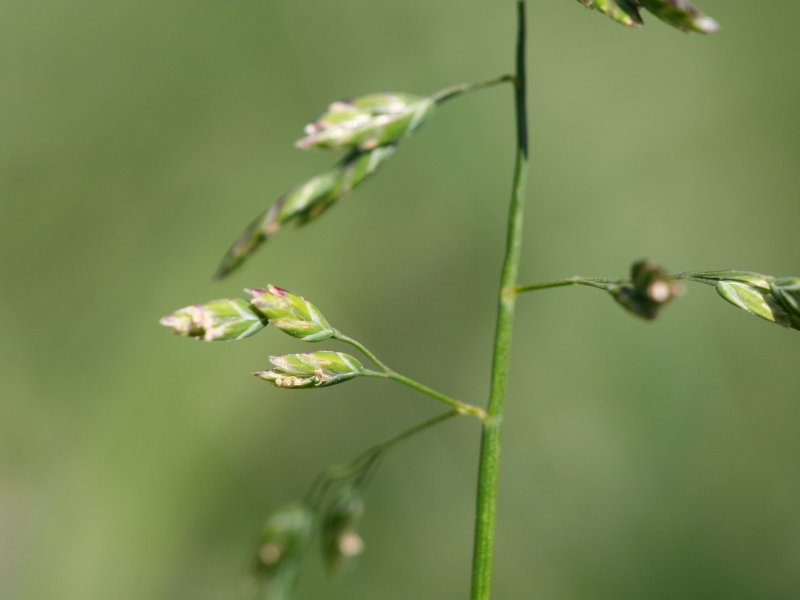
Annual bluegrass (Poa annua) is a low-growing, cool-season grass native to Eurasia that has colonised disturbed ground, turf, and agricultural soils worldwide. It forms pale green clumps with folded leaf blades and prolific whitish flower panicles.
A single plant can produce up to 2,000 viable seeds in one season, allowing it to rapidly overrun compacted home lawns, golf greens, and sports fields. It thrives under close mowing where desirable turf species struggle.
Key Facts
- Life Cycle: Mostly winter annual, with some perennial biotypes
- Height: 5–30 cm (2–12 in) unmown, survives at 3 mm (0.1 in)
- Seed Production: Up to 2,000 seeds per plant
- Germination Temp: 13–21 °C (55–70 °F) in autumn
- Identification: Boat-shaped leaf tips and long, pointed ligules
Why Annual Bluegrass Invades Lawns
Annual bluegrass invades cultivated turf because it germinates rapidly in cool, moist, compacted soil when standard lawn grasses slow their growth. While perennial grasses go semi-dormant during autumn rains, this species colonises thin patches and aerification holes.
It tolerates extreme mowing heights down to 3 mm (0.1 in), which makes it a persistent presence on golf putting greens. In domestic lawns, it creates uneven colour and dies back abruptly during summer heat spikes, leaving bare patches.
How to Identify Annual Bluegrass
You can identify annual bluegrass by its pale apple-green colour, boat-shaped leaf tip, and prominent silvery-white ligule. The leaf blades are soft, hairless, and often show crosswise wrinkles or puckering along the surface.
Key botanical identification markers include:
- Leaf tip: Keeled and curved like the prow of a canoe.
- Ligule: Pointed, membranous collar measuring 2–3 mm (0.08–0.12 in) long at the junction of blade and sheath.
- Inflorescence: Open, pyramidal panicle 2.5–10 cm (1–4 in) long, bearing small, greenish-white spikelets.
- Growth habit: Shallow-rooted tufts that pull out of damp ground with minimal effort.
Annual Bluegrass vs Kentucky Bluegrass
Annual bluegrass differs from Kentucky bluegrass (Poa pratensis) primarily by its lighter yellowish-green foliage, bunch-type growth, and continuous seed head production. Kentucky bluegrass produces deep blue-green leaves and spreads via dense, underground rhizomes.
The anatomical distinctions between the two species include:
- Ligule length: Kentucky bluegrass has a very short, squared ligule under 1 mm (0.04 in), while annual bluegrass has an elongated, pointed ligule reaching up to 3 mm (0.12 in).
- Seed heads: Annual bluegrass flowers at mowing heights of just 5 mm (0.2 in) throughout spring, while Kentucky bluegrass only flowers once per season on tall, unmown stems.
- Root system: Annual bluegrass forms weak, shallow fibrous roots under 5 cm (2 in) deep, whereas Kentucky bluegrass builds a deep rhizome network.
Native Range and Typical Habitat
Annual bluegrass is native to temperate Eurasia and the Mediterranean basin, but human trade has distributed it to every continent, including sub-Antarctic islands. It originated as an allotetraploid hybrid between Poa infirma and Poa supina.
In the wild and urban landscape, it thrives in damp, disturbed habitats:
- Footpaths, sidewalk cracks, and paved track margins.
- Over-irrigated residential lawns and shaded sports pitches.
- Agricultural headlands, ditch banks, and bare vegetable beds.
- Riverbanks and wet meadows with frequent livestock trampling.
Annual Bluegrass Weevil Damage and Ecology
The plant serves as the primary host for the annual bluegrass weevil (Listronotus maculicollis), a pest that causes severe crown mortality in short-mown turf across eastern North America. Adult weevils chew notches in leaf sheaths, but the yellow, legless larvae cause the bulk of the destruction by feeding directly inside grass stems and severing the crown.
Symptoms of weevil feeding appear as yellowing turf patches that fail to pull moisture from the soil and lift easily like loose carpet. Beyond turf pest interactions, the seeds provide seasonal food for small songbirds, including tree sparrows and goldfinches, during late spring.
How Annual Bluegrass Spreads and Reproduces
Annual bluegrass spreads almost entirely through prolific seed dissemination, with individual plants flowering within six weeks of germination. The seeds disperse on mower blades, irrigation water, aerification equipment, footwear, and the fur of domestic pets.
Seeds remain viable in the soil seedbank for 2 to 6 years, germinating in distinct flushes once soil temperatures drop below 21 °C (70 °F) in late summer or autumn. In cool coastal climates, perennial ecotypes (Poa annua var. reptans) develop short stolons that creep laterally across wet, compacted ground.
How to Control and Prevent Annual Bluegrass
To eliminate annual bluegrass, apply a pre-emergent herbicide in late summer before soil temperatures drop below 21 °C (70 °F). Mechanical and cultural controls must accompany chemical treatments to stop recurring flushes from the seedbank.
Follow these steps to eliminate and prevent infestations:
- Apply pre-emergent barriers: Use prodiamine or dithiopyr in late summer (late August to September) to block seed germination.
- Raise mowing heights: Maintain home lawns at 7.5–9 cm (3–3.5 in) to allow desirable turf grasses to shade out emerging seedlings.
- Aerate and dry: Alleviate soil compaction with core aeration in spring, and reduce irrigation frequency so the top 2.5 cm (1 in) of soil dries between waterings.
- Hand-pulling: Manually extract small patches before flower panicles open, ensuring you remove the entire shallow root system.
- Post-emergent herbicide: Apply targeted selective herbicides such as ethofumesate or bispyribac-sodium in cool seasons where labeled for your specific turf species.
Conservation Status and Grazing Value
Annual bluegrass is categorised as Least Concern (LC) on the IUCN Red List due to its immense global population and aggressive colonising behaviour. There are no conservation measures required or enacted for this species.
While despised on golf greens, it provides moderate forage value in early spring pastures. Cattle and sheep readily graze the tender foliage before it sets seed, though its shallow root system makes it vulnerable to being pulled up entirely during heavy grazing.
Similar Wild Grasses and Look-Alikes
Annual bluegrass is commonly confused with rough bluegrass, perennial ryegrass, and smooth meadow-grass in lawns and meadows. Distinguishing them requires close inspection of ligules, leaf tips, and vernation.
Compare these species when identifying wild grasses:
- Rough bluegrass (Poa trivialis): Has similar boat-shaped leaf tips and long ligules, but produces reddish-purple sheaths and creeping stolons.
- Perennial ryegrass (Lolium perenne): Exhibits bright red stem bases and sharply pointed leaves with glossy undersides, lacking boat-shaped tips.
- Large crabgrass (Digitaria sanguinalis): A warm-season annual with broad, hairy leaf blades that germinates in late spring rather than autumn.
Frequently Asked Questions
Is annual bluegrass bad for lawns?
Yes, annual bluegrass is considered a damaging lawn weed because its light green colour clashes with uniform turf and its shallow roots die during summer heat, leaving bare soil patches.
Is annual bluegrass the same as Kentucky bluegrass?
No, annual bluegrass (Poa annua) is a lighter-green bunching annual that flowers continuously at low heights, while Kentucky bluegrass (Poa pratensis) is a dark blue-green perennial that spreads via rhizomes.
What is the best annual bluegrass killer?
The most effective control combines a late-summer pre-emergent herbicide containing prodiamine or dithiopyr with targeted post-emergent selective herbicides like ethofumesate for established infestations.
How does annual bluegrass spread so fast?
It spreads by producing up to 2,000 seeds per plant per season, which easily attach to mower blades, shoes, and pets, germinating in cool autumn weather.
Why does annual bluegrass produce seed heads when mowed short?
Annual bluegrass can initiate flowering and produce viable seed heads at heights as low as 3 mm (0.1 in), an adaptation that ensures reproduction even on tightly clipped golf putting greens.
Sources & Verification
Taxonomy and distribution are checked against the databases below. Care guidance is written for cultivated species only and reviewed by our editor. How We Build Plant Profiles →
- Kew Plants of the World OnlineTaxonomic baseline, native distribution, and synonymy
- NC State Extension Gardener Plant ToolboxWeed identification, lifecycle details, and turf cultural management
- University of California Statewide Integrated Pest Management ProgramPre-emergent timing and annual bluegrass weevil life cycle
- GBIF — Global Biodiversity Information Facilitytaxonomy, synonyms, occurrence records
- Wikipediageneral reference


