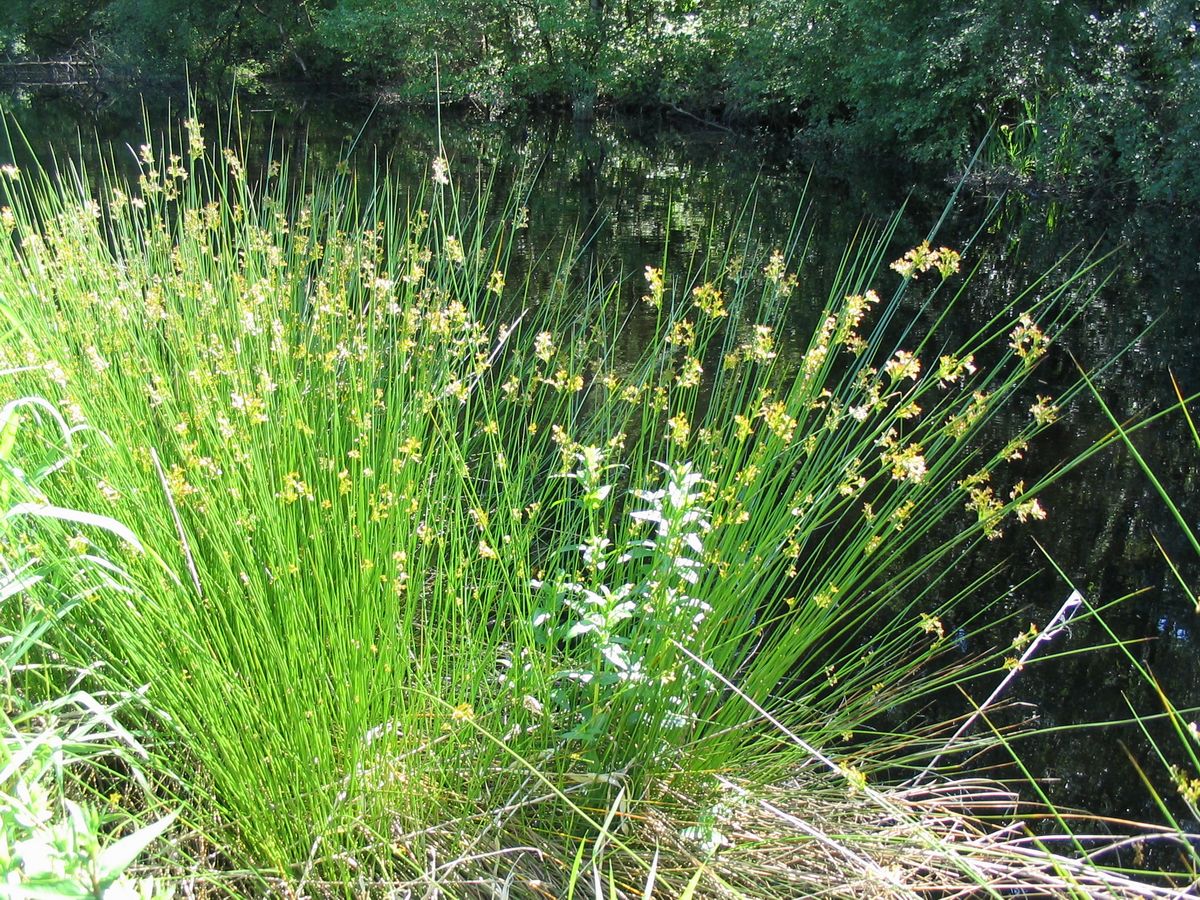
Hard rush (Juncus inflexus) is an upright perennial rush native to Europe, western Asia, and northern Africa, recognized by its dense tussocks of slender, stiff, blue-grey stems. Unlike softer wetland grasses, its wiry foliage resists crushing and maintains structure in boggy ground through four seasons.
It thrives in wet, heavy clay where most garden plants rot, surviving standing water up to 8 cm (3 in) deep or dry spells once established. Plant it along pond margins, rain gardens, or damp swales where erosion control and architectural vertical lines are required.
Key Facts
- Soil: heavy clay, loam, or damp sand
- Water: moist to wet, tolerant of shallow water
- Sunlight: full sun to partial shade
- Mature Size: 60–100 cm (24–40 in) tall and wide
- Hardiness: USDA Zones 4–9
- Foliage: evergreen in mild winters, glaucous blue-green
Growing Hard Rush in Gardens
Hard rush provides architectural structure in poorly drained soil where traditional garden perennials fail from root rot. It forms a dense, non-running clump that stays in place rather than spreading invasively by runaway runners like some sedges. If you need low-maintenance planting for water runoff zones or pond shelves, this plant establishes without fuss.
The plant suits container planting on patios just as well as open ground, provided the saucer never completely dries out. It handles exposed, windy settings because its round, wiry stems bend without snapping.
How to Identify Juncus inflexus
Hard rush is distinguished by stiff, chalky blue-grey stems with an interrupted, chambered white pith inside when split lengthwise. The smooth, cylindrical stems grow 60–100 cm (24–40 in) tall, emerging directly from tight basal clusters wrapped in purplish or dark chestnut-brown basal sheaths.
True leaf blades are reduced to small basal bristles, leaving the photosynthesizing stems to do the work. To tell it apart from common soft rush (Juncus effusus):
- Stem colour: blue-green to chalky grey instead of grass green
- Internal pith: visibly broken into discrete interrupted chambers, whereas soft rush has continuous, solid white pith
- Texture: hard and ridged with 12 to 18 fine longitudinal ribs
- Flowering cluster: loose cymes that burst sideways from a false stem tip 5–15 cm (2–6 in) below the apex
Where to Plant Hard Rush
Plant hard rush in full sun with at least six hours of direct light to develop the most intense blue-slate foliage colour. It tolerates partial shade, though the stems lean towards the light and thin out in deep shade.
Select damp borders, marshy margins of garden ponds, retention basins, or seasonal rain gardens. While it prefers neutral to slightly acidic wet soil, it tolerates alkaline marl and heavy, unamended subsoil clay without skipping a beat.
Planting and Spacing Guidelines
Space plants 45 to 60 cm (18 to 24 in) apart to allow the mature fountain-like clumps room to spread. Dig a planting hole equal to the depth of the root ball and twice as wide.
- Water the nursery pot thoroughly before sliding the root ball out
- Set the crown level with the surrounding soil or submerged under no more than 8 cm (3 in) of water
- Firm heavy soil around the root clump to eliminate air pockets
- Soak immediately with 4–5 litres of water to settle the root system
Hard Rush Watering and Soil Needs
Keep the soil consistently moist to waterlogged during the active growing season. The plant tolerates short dry spells once mature, but extended drought causes stem tips to brown and shrivel back.
Hard rush needs no supplemental fertiliser when grown in garden soil or pond silt. Adding rich chemical feeds often encourages weak, flopping stems and promotes unwanted algae bloom in adjacent pond water.
Pruning and Maintenance
Cut the entire clump down to 5–10 cm (2–4 in) above ground level in late winter or early spring before fresh green spikes emerge. Removing old foliage clears out winter-weathered, browned straw and opens the crown for clean spring growth.
Do not prune hard rush in late autumn; retaining the stems over winter protects the central crown from freezing and provides architectural shape in frosted gardens. Use sharp bypass shears or hedge clippers, as the fibrous stems quickly dull blades.
How to Propagate Juncus inflexus
Propagate hard rush by crown division in spring just as the root mass begins active growth. Clumps can also be grown from seed, which germinates readily under warm, wet conditions.
- Lift the clump: lever established 3-to-4-year-old tussocks out of the mud with a spade
- Divide: slice the root mass into quarters using a sharp spade or garden saw, ensuring each section has 10 or more intact stems
- Replant: place divisions immediately into moist soil at their original depth
- Seed sowing: press seeds into wet, peaty compost at 20 °C (68 °F); do not bury them, as they require light to germinate
Flowers and Seed Heads
Flowering occurs from June to August, producing branching clusters of small, brownish-green blossoms that erupt from the side of the stems. Each individual flower has six pointed, brown-striped tepals that protect tiny capsules containing microscopic seeds.
The flowers are wind-pollinated and transform into dark brown, oval seed capsules by late summer. The heads remain decorative through autumn, attracting small seed-eating wetland birds.
Year-Round Hard Rush Care
| Spring | Cut old stems down to 5–10 cm (2–4 in) before new shoots push up. Divide overcrowded crowns now to start new plants. |
|---|---|
| Summer | Check that water levels remain between damp and 8 cm (3 in) of standing water during heat waves. Remove spent flower spikes if self-seeding is not desired. |
| Autumn | Rake away fallen tree leaves trapped in the dense stem base to prevent fungal rot. Leave vertical stems standing to create winter interest. |
| Winter | No regular watering or maintenance needed in dormant outdoor plantings. Check that container-grown specimens do not dry out completely during extended dry freezes. |
Hard Rush Problems and Fixes
| What you see | Likely cause | What to do |
|---|---|---|
| Brown or straw-coloured stem tips | Soil drying out or severe summer drought | Saturate the root zone immediately and keep the soil damp or mulch with 5 cm (2 in) of compost. |
| Stems flopping and sprawling outwards | Excess nitrogen fertiliser or insufficient direct sunlight | Move to a full-sun site with at least six hours of light and cease all fertilising. |
| Blackened or mushy stem bases | Plant set deeper than 10 cm (4 in) of standing water | Elevate the planting container or transplant the rush to a shallower pond margin shelf. |
| Unwanted seedling patches nearby | Self-seeding via ripe summer capsules | Snip off brown seed heads in late summer before capsules split open. |
Hard Rush Cultivars to Look For
- ‘Blue Arrows’ – upright, intensely blue-grey stems to 90 cm (36 in)
- ‘Blue Dart’ – compact form under 45 cm (18 in) ideal for smaller containers
- ‘Afro’ – spiraling, corkscrew-curled blue stems forming unusual twisted mounds
- ‘Blue Mohawk’ – vigorous blue-green form often listed under J. effusus or J. inflexus
Companion Plants for Hard Rush
Combine hard rush with moisture-loving broadleaf perennials that contrast with its narrow, upright blue stems. Its steely colour pairs naturally with broad, flowering wetland plants along water edges.
- Yellow flag iris (Iris pseudacorus) for bold golden early summer flowers
- Marsh marigold (Caltha palustris) for spring ground coverage beneath upright rush tussocks
- Purple loosestrife (Lythrum salicaria) or swamp milkweed (Asclepias incarnata) for late-summer pollinator colour
- Water forget-me-not (Myosotis scorpioides) to weave low-growing sky-blue flowers around the base of the stems
Frequently Asked Questions
What is the native range of Juncus inflexus?
Hard rush is native across Europe, northern Africa, and temperate western and central Asia. It has naturalized in parts of eastern North America, Australia, New Zealand, and South America.
Can hard rush grow submerged in a pond?
Yes, hard rush grows submerged in water up to 8 cm (3 in) deep above its crown. Deeper water will drown the crown and rot the stem bases.
Is Juncus inflexus invasive?
Hard rush forms polite, expanding clumps rather than aggressive spreading runners, but it can self-seed in permanently damp soils. Deadhead the seed capsules in late summer to stop seed dispersal.
How do you distinguish Juncus inflexus from Juncus effusus?
Slice a mature stem lengthwise: Juncus inflexus has interrupted, chambered white pith with gaps, while Juncus effusus has a continuous solid core of pith. The stems of Juncus inflexus are also noticeably blue-grey and distinctly ridged.
Is hard rush toxic to dogs or cats?
Hard rush is non-toxic to dogs, cats, and humans. The tough, wiry stems are unpalatable to most pets, though swallowing large fibrous pieces may cause mild mechanical stomach upset.
Sources & Verification
Taxonomy and distribution are checked against the databases below. Care guidance is written for cultivated species only and reviewed by our editor. How We Build Plant Profiles →
- Kew Plants of the World OnlineTaxonomy, native distribution and synonyms
- Royal Horticultural SocietyCultivation, hardiness, and ornamental characteristics
- Missouri Botanical GardenGrowing conditions, landscape use, and cultivar profiles
- NC State ExtensionPlant attributes and garden tolerances
- GBIF — Global Biodiversity Information Facilitytaxonomy, synonyms, occurrence records
- Wikipediageneral reference