
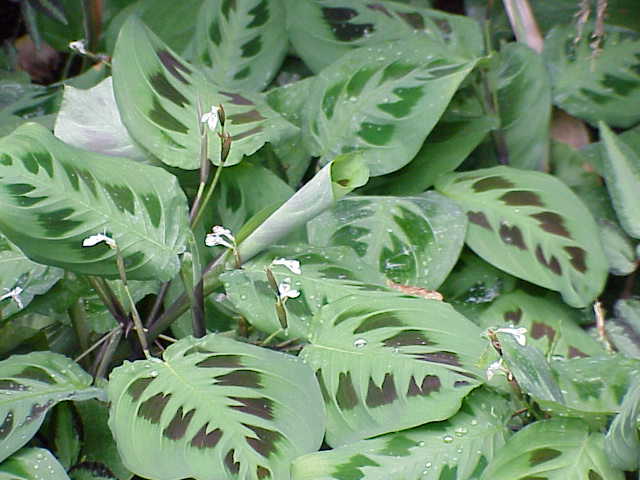
Prayer plant (Maranta leuconeura) is a rhizomatous evergreen perennial native to the tropical forest floors of Brazil, known for leaves that fold vertically together each night. Its horizontal, spreading stems form dense mats of patterned foliage that reach 30 cm (12 in) high and spread up to 45 cm (18 in) wide.
This plant demands consistently moist compost and high ambient humidity, frequently developing brown, crispy leaf margins if placed next to radiators or watered with cold, fluoridated tap water.
Key Facts
- Water: Keep soil evenly moist using room-temperature distilled water
- Light: Provide medium to bright indirect light without direct sun
- Humidity: Maintain indoor relative humidity levels above 50%
- Temperature: Keep between 18–27 °C (65–80 °F) year-round
- Safety: Non-toxic to domestic cats, dogs, and humans
Living with Prayer Plant: Indoor Fit and Difficulty
Prayer plant is an intermediate-difficulty houseplant suited to living spaces that maintain warm temperatures and steady humidity levels above 50%.
Its low, creeping profile works well on wide plant stands, low tables, or in shallow hanging baskets where the cascading stems have room to expand horizontally. The daily foliage movement, termed nyctinasty, causes the leaf blades to rise upright at dusk like hands folded in prayer, then flatten down as morning light returns.
Keep these points in mind when deciding where to place it:
- Needs stable room temperatures without sudden draughts from exterior doors
- Requires water devoid of chlorine, chloramine, and high fluoride concentrations
- Fits well into terrariums, humid bathrooms, and warm kitchens
Prayer Plant Appearance and Botanical Identification
You can identify Maranta leuconeura by its prostrate stems and oval leaves measuring 10–15 cm (4–6 in) long that carry distinct dark patches and contrasting veins.
The wild type produces broad, elliptical foliage with silvery-green central midribs flanked by deep olive or brown blotches on the upper surface, while the underside exhibits a uniform grey-green to dull purple wash. Swollen, node-like joints interrupt the sprawling green stems, and each node has the capacity to produce adventitious aerial roots when touching moist ground.
Key botanical traits include:
- Broadly ovate to oblong leaf blades with entire margins and obtuse bases
- Distinct jointed pulvini at leaf petioles that control nyctinastic movement
- Fibrous, rhizomatous root structures that spread horizontally beneath the soil
- Inconspicuous, two-lipped flowers carried on slender spike inflorescences
Prayer Plant Light Requirements
Position prayer plant in medium to bright indirect light receiving between 1,000 and 2,500 lux for healthy leaf coloration.
Direct sunlight quickly scorches the leaf surfaces, bleaching the deep green patches and causing the outer margins to curl into tight cylinders to reduce moisture loss. Deep shade causes the stems to stretch and become leggy, resulting in faded markings and smaller leaf blades.
Ideal indoor positions include:
- 1–2 m (3–6 ft) away from an unshaded south- or west-facing window
- Directly on the sill of a north-facing or lightly shaded east-facing window
- Under dedicated full-spectrum LED grow lamps run for 10–12 hours daily
Prayer Plant Care: Watering Routine
Water prayer plant when the top 2.5 cm (1 in) of potting soil feels dry to the touch, keeping the root ball consistently damp but never waterlogged.
This species is sensitive to chemical additives and dissolved mineral salts present in standard tap water. Using hard municipal water leads to irreversible leaf tip necrosis, where the tips and margins turn brown and brittle.
Watering best practices include:
- Use rainwater, distilled water, or reverse-osmosis water at room temperature
- Drench the pot thoroughly until liquid drains from the bottom holes
- Empty the drainage tray within 15 minutes to prevent saturated root systems
- Reduce watering frequency slightly during late autumn and winter
The Best Soil Mix for Prayer Plants
Provide an acidic to neutral potting mix with a pH between 5.5 and 6.5 that balances moisture retention with rapid drainage.
Standard heavy potting soils compact easily around the fine, fibrous roots of Maranta, suffocating the root system and causing basal rot. A porous, peat- or coco-coir-based growing medium allows oxygen to reach the rhizomes while retaining sufficient ambient moisture.
A reliable potting blend consists of:
- 2 parts sphagnum peat moss or washed coconut coir
- 1 part horticultural perlite or pumice
- 1 part coarse orchid bark chips for aeration
- A small handful of horticultural charcoal to help keep the substrate fresh
Humidity and Temperature for Maranta
Maintain indoor ambient humidity at 50% to 60% and keep temperatures between 18–27 °C (65–80 °F) for active growth.
When humidity drops below 40%, especially during winter heating seasons, the leaf edges turn dry and brown, and leaves fail to unfold smoothly. Temperatures falling below 15 °C (60 °F) trigger leaf dropping, systemic cold shock, and root decay.
Practical methods to support proper conditions:
- Group with companion foliage plants like rattlesnake plant (Goeppertia insignis)
- Run an ultrasonic room humidifier 1–2 m (3–6 ft) from the foliage
- Place the container over a shallow tray filled with pebbles and water
- Keep the pot away from cold window glass, air conditioners, and radiator vents
How and When to Feed Prayer Plants
Feed prayer plants every two to four weeks from April to September using a balanced liquid fertiliser diluted to half strength.
An equal-ratio houseplant fertiliser, such as a 10-10-10 or 20-20-20 water-soluble formulation, provides steady nitrogen, phosphorus, and potassium without overloading the delicate root system. Never fertilise dry soil, as the dissolved mineral salts will dehydrate and scorch the tender root tips.
Feeding rules:
- Apply fertiliser only when the potting medium is already moist
- Dilute the manufacturer’s recommended dose by 50%
- Flush the pot with pure distilled water every two months to leach out residual salts
- Cease all fertilising from October to February when vegetative growth slows
Prayer Plant Propagation by Stem Cuttings
Propagate prayer plants by taking 10–12 cm (4–5 in) stem cuttings with at least one leaf node in late spring or early summer.
Because prayer plant stems feature prominent nodes capable of forming adventitious roots, cuttings root easily in either water or moist potting substrate. Division is an equally dependable alternative when repotting large, mature clumps with multiple crowns.
Steps for propagation in water:
- Slice a healthy stem 1 cm (0.4 in) directly below a swollen node using sterilised shears
- Remove the lowest leaf so the node remains submerged without submerged foliage
- Place the cutting in a jar of room-temperature distilled water out of direct sun
- Refresh the water every 4–5 days until roots reach 3–5 cm (1–2 in) in length
- Pot the rooted cutting into a 9 cm (3.5 in) container of fresh potting mix
Common Prayer Plant Problems and Leaf Issues
The primary cultural problems affecting prayer plants stem from low ambient humidity and overwatering.
Leaves that curl inward during the middle of the day signal that the plant is losing water faster than its roots can supply it, usually caused by bright direct sunlight, low air moisture, or parched compost. Yellowing leaves across the lower stems, paired with soggy soil, point directly to poor drainage and early root rot.
Watch for these common issues:
- Curling leaf margins: Air is too dry or the root ball has dried out completely
- Brown leaf tips: High fluoride, chlorine, or dissolved salts in municipal tap water
- Spider mites: Fine webbing and stippled foliage appearing in hot, dry air
- Limp, yellowing stems: Root decay caused by poorly draining compost
Is Prayer Plant Toxic to Cats and Dogs?
Prayer plant is completely non-toxic to cats, dogs, and humans according to the ASPCA Animal Poison Control database.
Unlike members of the Araceae family such as dumb cane (Dieffenbachia seguine) and peace lily (Spathiphyllum wallisii), Maranta leuconeura does not contain insoluble calcium oxalate crystals. It is a safe foliage plant for homes with curious pets and young children.
While non-toxic, consuming large amounts of raw fibrous plant material may still cause mild stomach upset or regurgitation in domestic animals. Place the pot on elevated shelves if your pets chew decorative indoor leaves.
Prayer Plant Flower Care and Expectations
Prayer plants produce small, pale purple to white flowers measuring under 2 cm (0.8 in) across on slender spikes during late spring and summer.
The blooms are fleeting, each lasting only a single day, and carry little to no noticeable scent. In typical indoor settings, prayer plant blooms intermittently, but flowering confirms that the plant is receiving adequate light, proper warmth, and regular nutrients.
What to do when blooms appear:
- Allow the inflorescence to bloom naturally; it does not harm foliage health
- Deadhead individual spent blooms as they shrivel to keep the plant tidy
- Prune the entire flowering spike back to the base once all buds finish opening
- Do not alter your standard watering or feeding schedule while the plant is in flower
Year-Round Care for Prayer Plant
| Spring | Inspect root systems and repot into a container 2–5 cm (1–2 in) wider if crowded. Resume feeding with half-strength balanced fertiliser every 3–4 weeks as active leaf production restarts. |
|---|---|
| Summer | Monitor soil moisture every 3–4 days during heatwaves. Shield foliage from harsh midday sun, run a humidifier if relative humidity drops below 50%, and take stem cuttings for propagation. |
| Autumn | Gradually reduce watering frequency as daylight hours decrease. Wipe dust off leaf blades using a damp cloth and stop applying fertilisers by late October. |
| Winter | Move the container away from cold windowpanes and heating vents. Water only when the top 3 cm (1.2 in) of compost dries out, and group with other tropical houseplants to maintain localized humidity. |
Diagnosing Prayer Plant Leaf and Root Problems
| What you see | Likely cause | What to do |
|---|---|---|
| Leaves curling inwards into tubes | Air humidity below 40%, underwatering, or excessive direct sunlight | Move out of direct sun, soak the root ball thoroughly with distilled water, and increase humidity using a room humidifier. |
| Crispy brown tips and margins | Mineral, chlorine, or fluoride accumulation from tap water, or dry room air | Switch exclusively to rainwater or distilled water and flush the potting soil thoroughly to remove accumulated salts. |
| Lower leaves turning yellow and soft | Overwatering and saturated potting medium leading to root suffocation | Allow the top 2.5 cm (1 in) of compost to dry before watering again, and ensure the pot drains freely from the base. |
| Faded leaf patterns and washed-out color | Excessive indirect light or exposure to direct sun | Move the plant 1 m (3 ft) further back from the window into softer, filtered light. |
| Fine webbing beneath leaves with dusty leaf surfaces | Two-spotted spider mites thriving in warm, dry household conditions | Rinse the undersides of all leaves with tepid water and treat thoroughly with insecticidal soap or neem oil spray. |
Popular Prayer Plant Varieties and Cultivars
- var. erythroneura – red herringbone veins with deep green velvet patches
- var. kerchoveana – pale green leaves with chocolate-brown blotches
- ‘Marisela’ – cream-yellow herringbone veins on lighter green leaves
- ‘Black Prayer Plant’ – dark olive leaves with silver central bands
Frequently Asked Questions
Why are my prayer plant leaves curling?
Leaves curl into tight cylinders when the plant is conserving moisture due to dry indoor air, underwatering, or direct sunlight. Move the plant away from hot window glass, water thoroughly with distilled water, and raise room humidity above 50%.
Is prayer plant toxic to cats?
No, prayer plant is completely non-toxic to cats, dogs, and horses according to the ASPCA. It does not produce toxic oxalates or harmful alkaloids, making it safe to grow in pet-friendly homes.
Can prayer plant grow in low light?
Prayer plant tolerates moderate shade, but extended deep low light will fade its foliage patterns, slow leaf growth, and cause stems to stretch. Place it in medium to bright indirect light for the best leaf markings and compact growth.
Why is my prayer plant not folding its leaves at night?
Prayer plant stops folding its leaves if the room remains illuminated after dark or if the plant suffers from severe underwatering, cold temperatures, or root rot. Move it to a room with natural day-night light cycles and ensure the compost remains evenly moist.
What is the difference between Maranta and Calathea?
While both belong to the Marantaceae family, Maranta stems grow prostrate and produce distinct nodes along the branches that root easily in water. Most species historically classified as Calathea, such as zebra plant (Calathea zebrina) and peacock plant (Goeppertia makoyana), grow upright from clumping underground rhizomes without jointed trailing stems.
Sources & Verification
Taxonomy and distribution are checked against the databases below. Care guidance is written for cultivated species only and reviewed by our editor. How We Build Plant Profiles →
- Kew Plants of the World OnlineTaxonomic confirmation and native range data for Maranta leuconeura
- North Carolina State Extension Plant ToolboxHorticultural profile, indoor cultural requirements, and environmental tolerance
- ASPCA Animal Poison ControlToxicity status for domestic cats and dogs
- Missouri Botanical GardenGrowth habit, mature dimensions, and indoor potting recommendations
- GBIF — Global Biodiversity Information Facilitytaxonomy, synonyms, occurrence records
- Wikipediageneral reference
