
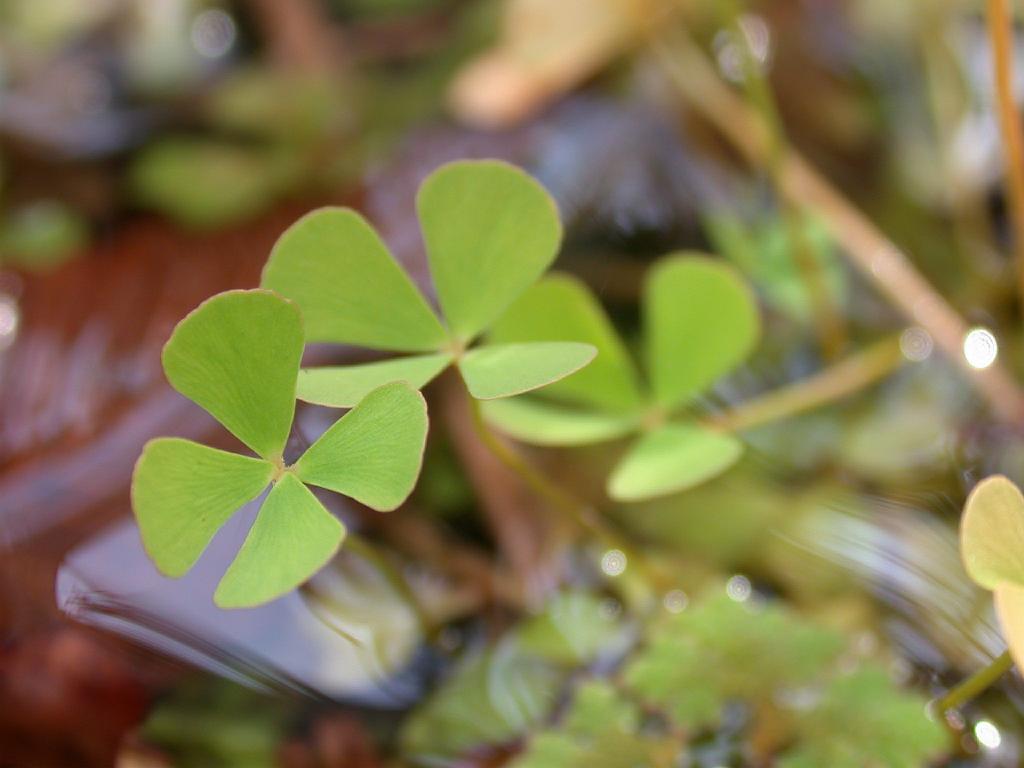
Four-leaf clover fern (Marsilea quadrifolia) is a deciduous aquatic fern native to central and southern Europe and temperate Asia, distinguished by floating or emergent fronds divided into four distinct wedge-shaped pinnae. Although it mimics a terrestrial clover in shape, it spreads via slender creeping rhizomes rooted in shallow water or shoreline mud.
This plant thrives in water depths between 0 and 30 cm (0 and 12 in), making it suitable for pond margins and freshwater aquariums alike. It spreads rapidly when unrestricted, so container planting is recommended in small garden ponds to prevent it from outcompeting slower aquatic vegetation.
Key Facts
- Light: Full sun to bright indirect light
- Water depth: Saturated mud to 30 cm (12 in)
- Hardiness: USDA zones 5 through 10
- Growth rate: Fast via submerged runners
- Reproduction: Spores formed in bean-shaped sporocarps
Where Water Clover Fits in Ponds and Aquariums
Four-leaf clover fern fits best as a shallow-water marginal plant or an aquarium foreground carpet where it can access moderate to strong light. It adapts to fully submerged life in an aquarium or emergent life in outdoor water gardens, changing its leaf texture depending on the water level.
In outdoor settings, it stabilises muddy banks and softens container pond edges. In indoor tanks, it forms a dense, low mat when trimmed regularly and provided with supplementary light.
- Marginal pond shelves at depths of 5-15 cm (2-6 in)
- Bog gardens with permanently waterlogged soil
- Freshwater tropical and coldwater aquarium foregrounds
- Patio bowl water gardens in non-draining containers
Identifying Marsilea quadrifolia: Leaves, Rhizomes, and Habit
A botanical diagram of four-leaf clover fern shows slender creeping rhizomes that produce four-lobed fronds at regular nodes. Each frond consists of an upright stipe ending in four obovate to wedge-shaped pinnae measuring 10-20 mm (0.4-0.8 in) across.
When grown emergent, the leaflets stand erect on petioles up to 20 cm (8 in) long and fold inward along the center at dusk. Submerged fronds remain shorter, between 2 and 5 cm (0.8 and 2.0 in), with thinner leaflets that often mimic small glossy clover carpets.
- Rhizomes: green to brown, 1-2 mm (0.04-0.08 in) thick, creeping horizontally
- Pinnae: four per stalk, glabrous, with faint radiating veins
- Night movements: leaflets fold upward together in darkness (nyctinasty)
- Base: dark brown, hard sporocarps 4-5 mm (0.16-0.20 in) long on short stalks
Sunlight and Water Depth Requirements
Four-leaf clover fern grows best in full sun to partial shade outdoors and under medium to high aquarium lighting indoors. Plants receiving at least 6 hours of direct solar exposure develop denser fronds and tighter rhizome branching than those grown in heavy shade.
Outdoor specimens tolerate water depths from zero (wet mud) up to 30 cm (12 in). If water depth exceeds 40 cm (16 in), the stipes stretch excessively, and the plant spends excess energy floating its leaves to the surface instead of thickening its runner network.
How to Plant Water Clover in Pots and Mud
Plant four-leaf clover fern by anchoring the rhizome horizontally under 1 cm (0.4 in) of aquatic soil or gravel, leaving the frond bases exposed. Burying the crown too deeply can cause young shoots to rot before reaching the light.
For garden ponds, plant the rhizome sections into mesh aquatic baskets filled with heavy, unfertilized topsoil topped with washed pea gravel to prevent substrate dispersal.
- Select an aquatic basket at least 20 cm (8 in) wide to allow horizontal spreading.
- Lay the rhizome across the soil surface and press it down gently.
- Cover with a 1 cm (0.4 in) layer of pea gravel to hold the roots in place.
- Lower the basket into water so that 5-10 cm (2-4 in) of water covers the gravel rim.
Water Chemistry and Fertilizer Needs
Supply outdoor water clover with neutral to slightly acidic water (pH 6.2 to 7.2) and avoid excess liquid fertilizers that fuel green water blooms. In pond margins, the plant extracts sufficient nutrients directly from pond silt and fish waste.
In an aquarium setup, root tabs inserted near the rhizomes encourage rapid carpeting. Water temperatures between 15 and 26 °C (59 and 79 °F) promote steady growth, though outdoor plants tolerate freezing surface water once rooted in base sediment.
Trimming and Containing Invasive Runners
Prune four-leaf clover fern by snipping creeping rhizomes every 4 to 6 weeks during active summer growth to keep it inside designated bounds. Unchecked rhizomes can escape open baskets and spread across the bottom of natural ponds.
For aquarium maintenance, thin dense patches using sharp aquascaping scissors to prevent lower leaves from suffocating and decaying. Always dispose of excess trimmings in municipal compost or household waste, never in local waterways, as fragments root readily in natural aquatic habitats.
Propagating Marsilea quadrifolia by Division and Sporocarps
Propagate water clover by slicing a healthy rhizome section containing at least 3 nodes and roots using sharp scissors. The cutting can be replanted immediately into wet substrate, where new shoots establish within 10 to 14 days.
Although commonly searched as water clover seeds, this fern does not produce seeds; it forms hard, nut-like structures called sporocarps near the leaf bases in late summer. These sporocarps contain microspores and megaspores that can remain viable in dried mud for several decades before germinating upon rehydration.
Common Water Clover Pests and Algae Problems
Inspect fronds regularly for filamentous algae smothering submerged leaves and aquatic snails chewing new growth. Submerged mats collect organic debris, making them prone to hair algae infestation under prolonged high lighting.
Address problems with mechanical removal rather than chemical controls, which can harm delicate fern tissues.
- Hair algae: reduce lighting duration to 8 hours daily and remove strands by hand.
- Snails: introduce manual traps or remove pond snails that rasp through emergent stipes.
- Yellowing fronds: insert an iron-rich root tablet 2 cm (0.8 in) beneath the affected runner.
- Rotting stems: verify that water depth does not exceed 30 cm (12 in) above the soil level.
Overwintering Water Clover Indoors and in Frozen Ponds
Prepare outdoor water clover for winter by lowering potted baskets below the pond freeze depth (at least 45 cm / 18 in) before the surface freezes solid. In USDA zones 5 through 8, the rhizomes survive comfortably in unfrozen bottom mud while the fronds die back completely.
In northern climates with shallow ponds that freeze entirely, lift the aquatic basket in October. Store it in a cool, frost-free basement inside a tub of shallow water at 4-10 °C (40-50 °F) until spring warming begins.
Do Water Clovers Produce Flowers? Sporocarps Explained
Four-leaf clover fern never produces flowers or true seeds because it is a member of the water-fern order Salviniales. Instead of blooms, mature plants develop small, bean-shaped sporocarps on 1-2 cm (0.4-0.8 in) stalks attached near the petiole bases.
These sporocarps measure 4 to 5 mm (0.16 to 0.20 in) in length and have a hard, drought-resistant outer shell. When submerged after a period of drying, the sporocarp splits open to release a gelatinous ring carrying male and female spore cases for sexual reproduction.
Seasonal Tasks for Outdoor Water Clover
| Spring | Divide overwintered rhizomes once water temperatures reach 12 °C (54 °F). Move baskets back to a depth of 5-15 cm (2-6 in) and insert one slow-release aquatic fertilizer tab per pot. |
|---|---|
| Summer | Trim running rhizomes every 4 weeks to prevent them escaping containers. Top up pond water levels during hot spells to ensure leaf stalks remain submerged or floating. |
| Autumn | Clear away dying emergent foliage in late October to prevent pond sludge build-up. Move shallow pots down to deeper pond shelves below the anticipated ice line. |
| Winter | Ensure rhizomes stay under unfrozen water or store container pots in a cool, lighted indoor tub at 5-10 °C (41-50 °F). Aquarium specimens continue growing under steady lighting. |
Diagnosing Water Clover Problems
| What you see | Likely cause | What to do |
|---|---|---|
| Pale, yellowing leaflets | Nitrogen or iron deficiency in the substrate | Push a slow-release aquatic root tablet into the substrate 2 cm from the affected runner. |
| Stretched, weak petioles with tiny leaves | Insufficient light or water planted too deep | Raise the pot to 5-10 cm (2-4 in) below the surface and clear overhanging floaters. |
| Submerged leaves covered in hairy slime | Filamentous green algae blooming in excess light | Manually swirl out the algae with a soft brush and shorten the photoperiod to 8 hours. |
| Leaflets fail to float or stay sunken | Abrupt change in water depth | Maintain a steady water level while new emergent stipes adjust and grow toward the surface. |
Best Pond and Aquarium Companion Plants
Pair water clover with slow-growing marginals and emergent wetland species that will not overtop its low floating foliage. Avoid aggressive spreaders that choke out creeping rhizomes along shallow pond shelves.
Complementary companion species include:
- Yellow iris (Iris pseudacorus): provides vertical structural contrast behind low clover mats.
- Water forget-me-not (Myosotis scorpioides): matches the shallow-water habitat and blooms alongside emergent foliage.
- Hornwort (Ceratophyllum demersum): absorbs excess water column nutrients to keep water clear around submerged clover runners.
- Java moss (Taxiphyllum barbieri): complements submerged clover mats in aquarium fore-to-midground layouts.
Frequently Asked Questions
What is the common name of Marsilea quadrifolia?
Its most widely used common name is European waterclover, though it is also known as four-leaf clover fern, water shamrock, and European pepperwort.
Can Marsilea quadrifolia grow fully submerged in an aquarium?
Yes, it grows well fully submerged in freshwater aquariums under moderate lighting, forming a dense foreground carpet of small fronds.
Does Marsilea quadrifolia have seeds?
No, it does not produce seeds because it is a fern. Instead, it reproduces through creeping rhizomes and resistant spore-bearing structures called sporocarps.
What are the traditional benefits of Marsilea quadrifolia?
The leaves and young shoots were traditionally consumed as a famine food in parts of Asia and used in traditional herbal medicine for fevers and inflammation. In modern ecological management, it is studied for its capacity to absorb excess heavy metals in wetland phytoremediation.
Is Marsilea quadrifolia invasive in garden ponds?
It spreads rapidly by horizontal runners and can choke shallow water bodies if unconfined. Keeping it planted inside non-draining aquatic baskets prevents rhizomes from overtaking the entire pond bottom.
Information about traditional or historical uses is provided for educational interest only and is not medical advice. Do not use any plant to treat a condition without speaking to a qualified professional.
Sources & Verification
Taxonomy and distribution are checked against the databases below. Care guidance is written for cultivated species only and reviewed by our editor. How We Build Plant Profiles →
- Kew Plants of the World OnlineTaxonomic status and native distribution record
- Global Biodiversity Information Facility (GBIF)Occurrence data and common names
- IUCN Red ListConservation status assessment: Least Concern
- USDA PLANTS DatabaseWetland indicator status and US naturalisation
- Wikipediageneral reference
