
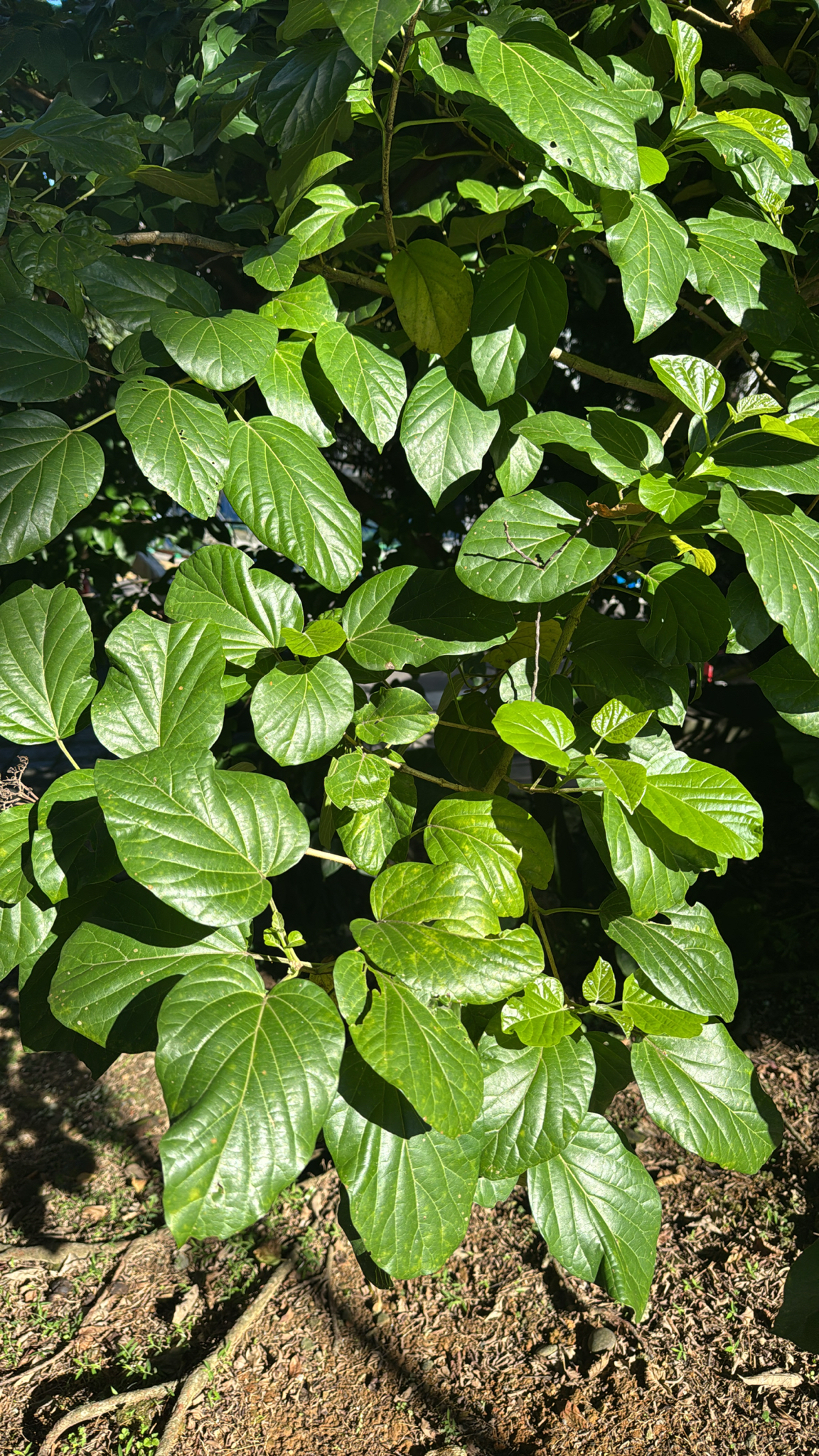
Coastal Premna is a hardy evergreen shrub or small tree native to the tropical and subtropical coasts of the Indo-Pacific region, belonging to the Premna serratifolia species. It is most easily recognised by its salt-tolerant nature and the small, greenish-white flowers that appear in flat-topped clusters during the warmer months.
This species is a staple in tropical bonsai collections due to its ability to develop a thick, gnarled trunk and significantly reduced leaf size with regular pruning. Unlike many other coastal trees, it maintains a dense canopy even when exposed to constant ocean breezes and salt spray.
Key Facts
- Light: Full sun to partial shade
- Water: Moderate; high drought tolerance once established
- Growth Rate: Fast in tropical climates
- Hardiness: USDA Zones 10 to 12
- Wildlife: Attracts numerous butterflies and bees
Is Coastal Premna Right for Your Garden?
Coastal Premna is an ideal choice for coastal landscapes and tropical bonsai enthusiasts who require a plant that thrives in salt spray and poor, sandy soils. This species belongs to the Lamiaceae family and is naturally adapted to the harsh conditions of the Indo-Pacific shoreline, making it a reliable windbreak. You will find it most successful if you live in a frost-free climate where humidity remains high year-round.
Because it is a fast-growing species, it suits gardeners who want quick privacy or a dense hedge, though it does require frequent trimming to keep it contained. It is particularly valued by those looking to support local biodiversity, as the flowers are a significant nectar source for coastal insects. If you have a small garden, you can easily maintain it as a large shrub rather than a tree.
- Salt Tolerance: Exceptionally high, suitable for beachfront planting.
- Wind Resistance: Strong; stems are flexible and resilient.
- Maintenance: High if used as a formal hedge or bonsai.
Identifying the Leaves, Flowers, and Bark
You can identify Premna serratifolia by its opposite, ovate leaves that often release a distinct, musky odour when crushed. The leaves typically measure 5-15 cm (2-6 in) in length and may have serrated or entire margins depending on the age of the branch and the specific specimen. Younger plants often show the serrated edges that give the species its name, while older growth may have smoother edges.
The flowers are small, greenish-white, and held in terminal clusters known as cymes, which appear most profusely between May and November. Following pollination, the tree produces small, globose drupes that turn from green to a deep, glossy black when ripe. The bark is typically smooth and light grey to brown, becoming slightly fissured and gnarled as the tree matures, which adds to its character as a specimen plant.
Mature Size and Growth Habit
In its natural habitat, Coastal Premna typically reaches a height of 3 to 7 metres (10 to 23 feet) with a similar or slightly narrower spread. Its growth habit is naturally bushy and multi-stemmed, often forming a dense, rounded crown that provides excellent shade. When grown in exposed coastal sites, it may take on a more stunted, windswept appearance, which is highly prized by collectors.
In a garden setting, you can easily control the size through regular pruning, and it is frequently kept at 1.5-2 metres (5-6 feet) for use as a hedge. For bonsai, the tree is intentionally restricted to heights of 20-60 cm (8-24 in), where its leaves can be trained to shrink to less than 1 cm (0.4 in) through consistent defoliation and pinching. The trunk thickens relatively quickly compared to other tropical hardwoods.
Choosing a Coastal or Inland Site
Coastal Premna performs best in full sun, though it can tolerate partial shade at the cost of a sparser canopy and fewer flowers. It is uniquely adapted to sandy, well-draining soils and can even tolerate brackish water or occasional flooding by seawater. If planting inland, ensure the soil is not overly heavy or clay-based, as the roots require good aeration to prevent rot.
While it is famous for its salt tolerance, it is quite sensitive to cold temperatures and will suffer damage if exposed to frost. Position it in the warmest part of your garden, ideally against a north-facing wall (in the southern hemisphere) or south-facing wall (in the northern hemisphere) to trap heat. It is an excellent choice for stabilizing dunes or preventing erosion in sandy areas.
Planting and Initial Care
When planting, dig a hole twice as wide as the root ball and just as deep, ensuring you do not bury the stem deeper than it was in its nursery pot. If your soil is extremely sandy, you can mix in a small amount of organic compost to help retain moisture during the first few months of growth. Water the plant deeply immediately after planting to settle the soil and remove air pockets around the roots.
During the first year, you should monitor the moisture levels closely, especially during dry spells, to help the root system establish itself. Once the tree has put on significant new growth, it becomes remarkably drought-tolerant. Mulching with organic matter can help maintain soil temperature and moisture, but keep the mulch a few centimetres away from the trunk to avoid bark rot.
Watering and Feeding Requirements
Water Coastal Premna once a week during the dry season, allowing the top 5 cm (2 in) of soil to dry out between applications. In very sandy soils or during extreme heat, you may need to increase this frequency to twice a week. If the leaves begin to wilt or lose their glossy sheen, it is usually a sign that the plant is thirsty, though it recovers quickly once hydrated.
For optimal growth, apply a balanced, slow-release fertiliser twice a year—once in early spring and again in mid-summer. If you are growing it as a bonsai, use a diluted liquid fertiliser every two weeks during the growing season to support the rapid foliage production. Avoid over-fertilising in late autumn, as this can stimulate soft new growth that is more susceptible to pests and environmental stress.
Pruning Coastal Premna for Bonsai and Shape
You should prune Coastal Premna regularly during the growing season to maintain a dense shape and encourage branching. This species is famous for its “back-budding” ability, meaning it will sprout new growth from old wood even after heavy pruning. For a garden hedge, use sharp shears to trim the new shoots every 2-3 months to maintain a clean, geometric form.
Bonsai practitioners use several specific techniques with this plant:
- Defoliation: Removing all leaves in early summer to force a new flush of smaller foliage.
- Wiring: Flexible branches can be wired into shape, but check every 4 weeks to prevent the wire from scarring the fast-growing wood.
- Pinching: Removing the terminal buds of new shoots to encourage secondary and tertiary ramification.
- Hard Pruning: Cutting back to the main trunk to create dramatic taper and character.
Common Pests and Leaf Problems
Coastal Premna is generally resistant to most major diseases, but you should watch for scale insects and mealybugs, which tend to hide in the leaf axils or under the foliage. These pests can cause yellowing of the leaves and the development of black sooty mould. If you notice sticky residue on the leaves, treat the plant with a neem oil spray or insecticidal soap, ensuring you cover both sides of the foliage.
Leaf spot fungi can occasionally occur during periods of high humidity and poor air circulation. To prevent this, ensure your plants are spaced correctly and avoid watering the leaves directly in the evening. If the foliage turns yellow and drops prematurely, check the soil drainage, as the roots are sensitive to waterlogged conditions which can lead to root rot.
Temperature and Winter Hardiness
Coastal Premna requires a minimum temperature of 15 °C (59 °F) to remain in active growth, and it is not frost-hardy. If temperatures drop below 5 °C (41 °F), the tree may shed its leaves as a stress response. In temperate zones, you must grow this species in a container and move it indoors or into a heated greenhouse before the first frost of autumn.
During the winter months, growth will slow significantly, and you should reduce your watering frequency accordingly. Avoid fertilising during this dormant period, as the plant cannot process the nutrients effectively. If kept indoors, place it in the brightest possible spot, such as a south-facing window, and use a humidity tray to combat the drying effects of indoor heating.
Traditional Medicinal and Ecological Uses
In traditional Ayurvedic medicine, the root of Premna serratifolia is known as Arani and is a vital component of the “Dashamoola” (ten roots) formulation. It was historically used to manage inflammation, fevers, and digestive issues. The leaves have also been used in various cultures as a poultice for headaches or boiled into a tea, though you should never consume wild plants without expert guidance.
Ecologically, the tree plays a vital role in coastal stabilization and provides a habitat for various marine-adjacent wildlife. The flowers attract a wide range of pollinators, including the Blue Tiger butterfly (Tirumala limniace) and various species of honeybees. In some Pacific island cultures, the wood was traditionally used for making fire-sticks due to its friction-generating properties.
Year-Round Care for Coastal Premna
| Spring | Apply a balanced slow-release fertiliser and perform a hard prune to shape the canopy. Increase watering frequency as new growth appears and temperatures rise. |
|---|---|
| Summer | Monitor for mealybugs and scale insects. For bonsai, this is the best time for defoliation and wiring. Ensure the soil remains moist but not waterlogged during heatwaves. |
| Autumn | Reduce fertiliser application and gradually decrease watering. Move container-grown plants indoors if night temperatures are predicted to fall below 10 °C (50 °F). |
| Winter | Maintain a minimum temperature of 15 °C (59 °F) for indoor plants. Water only when the top half of the soil is dry and avoid any heavy pruning or feeding. |
Common Coastal Premna Problems Explained
| What you see | Likely cause | What to do |
|---|---|---|
| Yellowing leaves and leaf drop | Overwatering or cold stress | Ensure the soil has excellent drainage and keep the plant in a location above 15 °C (59 °F). |
| Sticky residue on foliage | Scale or mealybug infestation | Spray the plant thoroughly with neem oil or insecticidal soap every 7-10 days until pests are gone. |
| Leaves turning brown at the edges | Low humidity or underwatering | Increase watering frequency and mist the foliage or use a humidity tray if the plant is indoors. |
Popular Premna Varieties
- ‘Microphylla’ – Often confused with the species, this variety has naturally smaller leaves.
- ‘Variegata’ – Features cream or white splashes on the green foliage.
Frequently Asked Questions
What is the common name for Premna serratifolia?
It is most commonly known as Coastal Premna, Creek Premna, or Arani in the context of Ayurvedic medicine.
Does Coastal Premna smell bad?
The leaves have a distinctive musky or foetid odour when crushed, which some people find unpleasant, but it is not noticeable from a distance.
Can I grow Premna serratifolia from seeds?
Yes, you can grow it from the small black seeds found inside the ripened fruit, though they should be sown fresh for the best germination rates.
Is Coastal Premna suitable for bonsai?
It is one of the best tropical species for bonsai because it responds well to heavy pruning and its leaves shrink significantly with training.
Is Premna serratifolia toxic to cats?
There is no documented evidence of toxicity to cats, but the strong-smelling leaves usually deter pets from chewing on them.
Information about traditional or historical uses is provided for educational interest only and is not medical advice. Do not use any plant to treat a condition without speaking to a qualified professional.
Sources & Verification
Taxonomy and distribution are checked against the databases below. Care guidance is written for cultivated species only and reviewed by our editor. How We Build Plant Profiles →