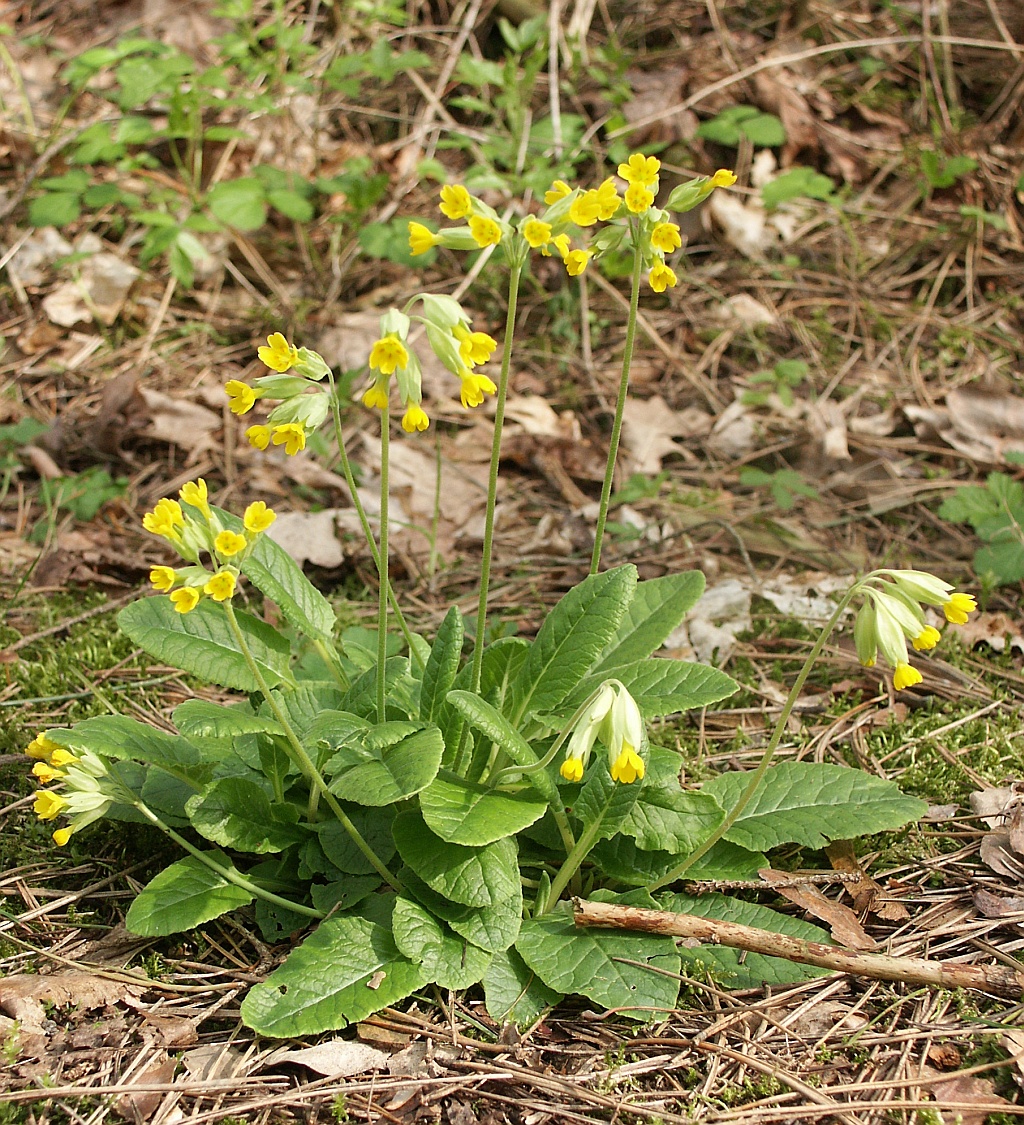
The oxlip, Primula elatior, is a perennial flowering plant in the Primulaceae family that thrives in damp, calcium-rich soils across Europe. It is a woodland specialist that relies on specific forest management to maintain its population.
You will most commonly find this plant in ancient woodland sites where it forms clusters in the spring. It is distinct from its cousins due to its preference for heavy, moisture-retentive soils rather than the drier, sandy banks favoured by other primroses.
Key Facts
- Bloom Season: Flowers appear from March to May.
- Native Range: Distributed from the British Isles to the Altai Mountains.
- Habitat: Found in damp, nutrient-poor, and calcium-rich woodlands.
- Growth Habit: Herbaceous perennial reaching 10-30 cm (4-12 in) tall.
How to Identify Oxlip
You can identify an oxlip by its pale yellow, nodding flowers that grow in a one-sided cluster at the top of a single, leafless stalk. The individual flowers measure 10-20 mm (0.4-0.8 in) across and feature a distinct, deep yellow ring at the throat.
The leaves are arranged in a basal rosette, are wrinkled in texture, and taper gradually into the stalk. In contrast to the common primrose, the oxlip stalk is clearly elongated, holding the flowers well above the foliage. Each plant typically produces 5 to 15 flowers per stem.
Oxlip vs Cowslip and Primrose
Distinguishing the oxlip from its relatives relies on flower shape and stem height. The true oxlip is often confused with the cowslip (Primula veris) and the common primrose (Primula vulgaris).
- Oxlip (Primula elatior): Flowers are pale yellow, nodding, and arranged in a one-sided cluster on a tall stalk.
- Cowslip (Primula veris): Flowers are deep golden yellow, bell-shaped, and hang in a cluster on a tall stalk.
- Primrose (Primula vulgaris): Flowers are pale yellow with a flat face, growing individually on short stalks directly from the base.
Native Habitat and Distribution
The oxlip is primarily found in ancient, damp woodland with a history of traditional coppicing. It requires soils that are high in calcium, often thriving on boulder clay or limestone-derived substrates.
Its range spans from the British Isles, particularly in East Anglia, through central Europe to the Altai Mountains in Russia. It is rarely found in open, dry meadows, preferring the dappled shade provided by trees like the ash (Fraxinus excelsior) or hazel (Corylus avellana).
Ecology and Pollinators
Oxlips provide a vital early-season nectar source for long-tongued bees and butterflies as they emerge in early spring. Because it flowers before the woodland canopy fully closes, the plant takes advantage of the high light levels reaching the forest floor.
It is known to hybridise with the common primrose where their ranges overlap, creating a plant often referred to as a ‘false oxlip’. This hybridization can make identification difficult in areas where the two species grow in close proximity.
Conservation Status
The oxlip is considered locally common in specific regions but faces threats from habitat fragmentation and changes in woodland management. It is listed as Least Concern globally, but remains a key indicator species for the health of ancient woodland habitats.
Conservation efforts focus on maintaining the open, damp conditions that the species requires. Protecting existing woodland sites from drainage and excessive shading is essential for the continued survival of local populations.
Is Oxlip Used in Medicine
There is no modern clinical evidence to support the use of oxlip for treating any medical condition. While it has been historically grouped with other Primula species in traditional herbalism, it is not a standard medicinal plant.
Historically, various primrose species were used in infusions for respiratory ailments, but these practices are not supported by scientific research. Avoid attempting to use this plant for medicinal purposes due to the risk of misidentification and the lack of safety data.
Frequently Asked Questions
What is the meaning of oxlip?
The name oxlip is derived from Old English, combining 'ox' and 'lip', likely referring to the shape of the flower or its occurrence in cow pastures.
Is oxlip a primrose?
Yes, the oxlip is a member of the genus Primula and is closely related to the common primrose, but it is a distinct species with unique morphological traits.
Is oxlip a Scrabble word?
Yes, 'oxlip' is a valid word in Scrabble and most English dictionaries.
Can you buy oxlip plug plants?
While some native plant nurseries sell Primula elatior, ensure they are sourced from reputable growers who do not collect plants from the wild.
Information about traditional or historical uses is provided for educational interest only and is not medical advice. Do not use any plant to treat a condition without speaking to a qualified professional.
Sources & Verification
Taxonomy and distribution are checked against the databases below. Care guidance is written for cultivated species only and reviewed by our editor. How We Build Plant Profiles →