
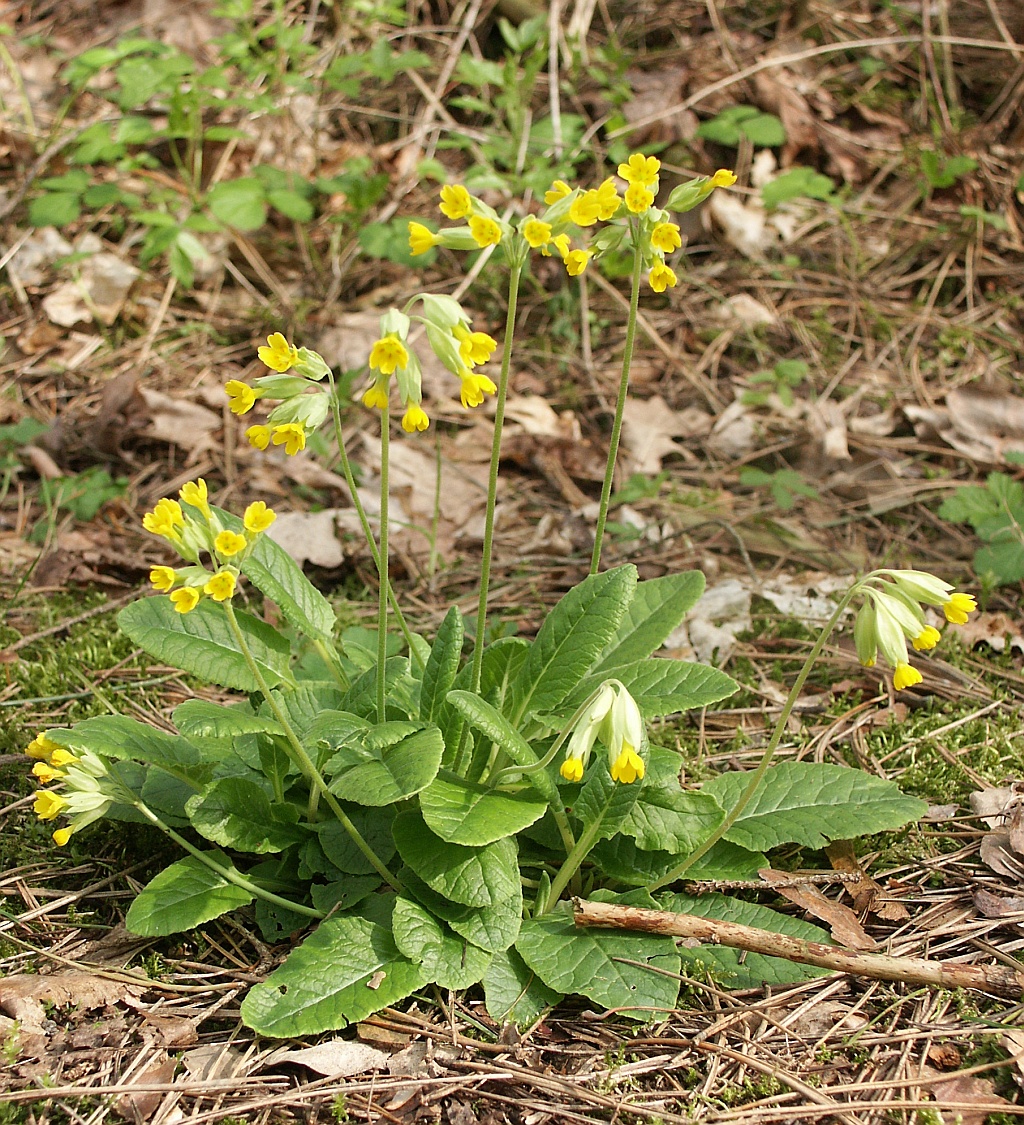
Cowslip (Primula veris) is a herbaceous spring-flowering perennial native to meadows and open woodland margins across Europe and western Asia, recognised by its one-sided nodding umbels of rich yellow, cupped blossoms. It forms low-growing rosettes of crinkled, paddle-shaped green leaves that emerge as early winter recedes.
This plant requires moisture-retentive, alkaline to neutral ground and fails quickly in waterlogged winter mud or arid, acidic sand. Placed in undisturbed orchard turf, cottage beds, or dappled clearings, established clumps self-sow steadily without invading surrounding plantings.
Key Facts
- Height: 15–25 cm (6–10 in)
- Flowering period: April to May
- Light: Full sun to dappled shade
- Soil: Moist, well-drained, chalky or loamy
- Hardiness: USDA Zones 3–8
Growing Cowslip in Gardens and Meadows
Cowslip suits managed wildflower meadows, orchard underplantings, and sunny cottage borders where the soil retains steady moisture through spring. Because its foliage remains low and tidy until late summer, it integrates neatly beneath deciduous shrubs that leaf out after the spring bloom finishes.
You should give this plant an undisturbed patch where grass is kept thin. Vigorous, fertilised turf grasses will outcompete young seedlings within two seasons.
- Traditional grass meadows cut once annually in late summer
- Understorey borders beneath fruit trees or hazel
- Rock gardens and gravel beds with reliable subsurface moisture
- Pollinator borders designed for early spring foraging
Sun and Soil Requirements for Cowslips
Cowslip grows best in moist, well-drained loam or chalk with a pH between 6.5 and 8.0. It tolerates heavy clay provided water drains freely during winter wet spells.
Position plants in full sun across northern regions or in dappled shade in hotter southern climates. Direct midday sun during prolonged summer heat causes the foliage to scorch and go dormant prematurely.
Planting Cowslip Plugs and Seedlings
Plant container-grown cowslip plugs in autumn between September and November so roots establish while soils remain warm and moist. Spring planting between March and April also works if you water them consistently through early dry spells.
Space individual crowns 20–25 cm (8–10 in) apart to allow room for the spreading rootstocks. Keep the crown flush with the soil line, firm the surrounding earth gently, and soak thoroughly after planting.
Watering and Feeding Cowslip
Provide 2.5 cm (1 in) of water per week while plants develop flower buds in spring whenever rainfall is scarce. Once flowering finishes, established clumps require minimal supplementary watering unless summer drought threatens to dry out the root zone completely.
Avoid chemical fertilisers with high nitrogen content, which encourage lush foliage at the expense of floral stems. A thin mulch of garden compost or decayed leaf mould applied each autumn provides all the necessary nutrients.
How to Deadhead and Cut Back Cowslip
Leave spent flower stems untouched until late July if you want cowslips to self-seed across your garden or meadow. The dry seed capsules split open naturally at maturity to scatter their contents into the surrounding turf.
If you prefer a tidy border and wish to limit spreading, prune the flowering stems right down to the basal rosette immediately after the petals drop in late spring. In wild meadows, delay mowing until midsummer so the dropped seeds have settled onto the soil surface.
How to Propagate Cowslips from Seed and Division
Sow cowslip seeds outdoors in autumn between October and December because they require 4 to 6 weeks of cold temperatures below 5 °C (41 °F) to break seed dormancy. If sowing in spring, place the seed tray in a sealed plastic bag inside a refrigerator for six weeks before moving it to a warm, bright room at 15–18 °C (59–64 °F).
Surface-sow the seeds onto moist, peat-free seed compost and dust with a bare 2 mm layer of vermiculite, as light aids germination. You can also divide mature crowns in late summer:
- Lift thick clumps every 3 to 4 years using a garden fork after flowering ends.
- Shake off loose soil and ease individual crowns apart by hand or with a sharp knife.
- Ensure each separated section retains a healthy tuft of leaves and a fibrous root cluster.
- Replant immediately into prepared ground at the original planting depth and water well.
Pests, Diseases, and Common Cowslip Problems
Cowslips are resilient plants, but they suffer when vine weevil larvae devour root systems beneath the soil surface in autumn and winter. Damaged plants wilt suddenly in spring and pull away from the earth with no roots attached.
Slugs and snails feed on tender emerging foliage in March and April, leaving large, irregular perforations in young leaves. In hot, unventilated conditions or humid late summers, powdery mildew may form a dull greyish-white coating across the foliage.
Bloom Season and Pollinators
Cowslip blooms continuously for three to four weeks across April and May, providing early nectar when few other meadow flowers are open. The slightly musky, sweet fragrance attracts queen bumblebees (Bombus terrestris) and bee-flies (Bombylius major).
The species exhibits heterostyly, carrying two distinct floral forms to ensure cross-pollination: “pin” flowers with a high stigma and low anthers, and “thrum” flowers with high anthers and a recessed stigma. Seed forms only when pollen transfers between opposite types.
Cowslip Care Through the Seasons
| Spring | Inspect emerging rosettes for slug damage in March. Water weekly if spring rains fail, and enjoy the blossoms from April through May. |
|---|---|
| Summer | Allow seed capsules to ripen and shatter naturally throughout June and July. Mow meadow areas only after seeds have dropped in late summer. |
| Autumn | Divide overgrown clumps every 3 to 4 years from September to October. Direct-sow fresh seeds onto cleared soil patches, and top-dress with leaf mould. |
| Winter | Leave plants undisturbed through winter cold; frost naturally stratifies fallen seed. Clear heavy fallen leaves off crowns to prevent rot. |
Diagnosing Common Cowslip Problems
| What you see | Likely cause | What to do |
|---|---|---|
| Plant wilts and lifts cleanly with no roots | Vine weevil grubs (Otiorhynchus sulcatus) chewing root systems | Drench surrounding soil with parasitic nematodes in late spring or early autumn. |
| Ragged holes in young spring foliage | Slug or snail browsing | Apply beer traps or wool mulch pellets around crowns as growth emerges in March. |
| White powdery film on leaves in midsummer | Powdery mildew during warm, dry spells | Cut affected foliage back to the base and ensure the soil remains consistently moist. |
| Seeds fail to sprout in spring | Lack of winter cold stratification | Refrigerate dampened seed at 2–4 °C (36–39 °F) for 4 to 6 weeks before sowing. |
Cowslip Varieties and Selections
- ‘Sunset Shades’ – red, copper, and apricot blossoms on 20 cm stems
- ‘Katy McSparron’ – double yellow flowers with intense citrus scent
- ‘Cabrillo’ – uniform, compact yellow selection suited to garden containers
- subsp. veris – standard native wild form bearing clear yellow flower umbels
Identifying Cowslip Flowers, Leaves, and Lookalikes
Cowslip produces nodding clusters of 5 to 30 cup-shaped yellow flowers held on one side of a sturdy, downy stem that rises 15–25 cm (6–10 in) above the basal rosette. Each tubular flower measures 9–15 mm (0.35–0.6 in) across and displays five small orange-red marks inside the throat, framed by a pale green, inflated, angular calyx.
The leaves are ovate-oblong, measuring 5–15 cm (2–6 in) long and 2–6 cm (0.8–2.4 in) wide. They have a distinctly wrinkled surface, finely toothed edges, and narrow abruptly into a winged stalk.
- Cowslip (Primula veris): Flowers in a nodding, one-sided umbel atop a tall stalk; inflated, pale calyx; deep yellow petals.
- Common Primrose (Primula vulgaris): Solitary pale-yellow flowers borne on individual slender stalks straight from the leaf base.
- True Oxlip (Primula elatior): Taller flower stalk; pale yellow, broader blossoms facing mostly downward; tight, non-inflated calyx.
- False Oxlip (Primula × polyantha): A natural hybrid between cowslip and primrose showing intermediate flower size and apricot-to-yellow shades.
Companion Plants for Cowslip
Pair cowslip with low-growing spring perennials and native woodland bulbs that share a preference for calcareous or neutral soils. Avoid aggressive, mat-forming groundcovers that smother its small basal rosette.
- Wood anemone (Anemone nemorosa) creates a clean carpet of white blossoms around yellow cowslip umbels.
- Wild daffodil (Narcissus pseudonarcissus) flowers alongside cowslip at matching heights in semi-shaded grass.
- Snake’s head fritillary (Fritillaria meleagris) offers checkered purple bells that contrast directly with cowslip’s yellow cups.
- Common bluebell (Hyacinthoides non-scripta) blooms slightly later, extending colour into woodland margins.
Frequently Asked Questions
Is cowslip dangerous to humans or pets?
Cowslip is mildly toxic if eaten in volume, as the plant contains triterpenoid saponins that can cause nausea or vomiting in dogs, cats, and humans. The leaves also produce primin, which can trigger mild skin rash or dermatitis in people with sensitive skin.
How do you collect cowslip seeds?
Collect seeds in July when the capsules turn pale brown and dry out. Snip the seed heads on a dry morning, tip the tiny brown seeds into a paper bag, and store them in a cool, dry envelope until autumn sowing.
What are the traditional benefits of cowslip?
Cowslip flowers were traditionally brewed into wine or sedative teas across Europe to alleviate headaches, restlessness, and coughs. The roots were historically boiled as an expectorant due to their natural saponin content.
What does the cowslip flower mean or symbolize?
In European folklore, cowslip represents grace, youth, and the arrival of spring. It was nicknamed "Peter's keys" or "keyflower" because its nodding cluster of golden blossoms resembles a hanging ring of antique keys.
What is cape cowslip?
Cape cowslip is an unrelated South African bulb from the genus Lachenalia, most commonly Lachenalia aloides. It produces tubular multicoloured spikes and requires frost-free, indoor or greenhouse conditions, unlike the fully hardy wild cowslip.
Information about traditional or historical uses is provided for educational interest only and is not medical advice. Do not use any plant to treat a condition without speaking to a qualified professional.
Sources & Verification
Taxonomy and distribution are checked against the databases below. Care guidance is written for cultivated species only and reviewed by our editor. How We Build Plant Profiles →

