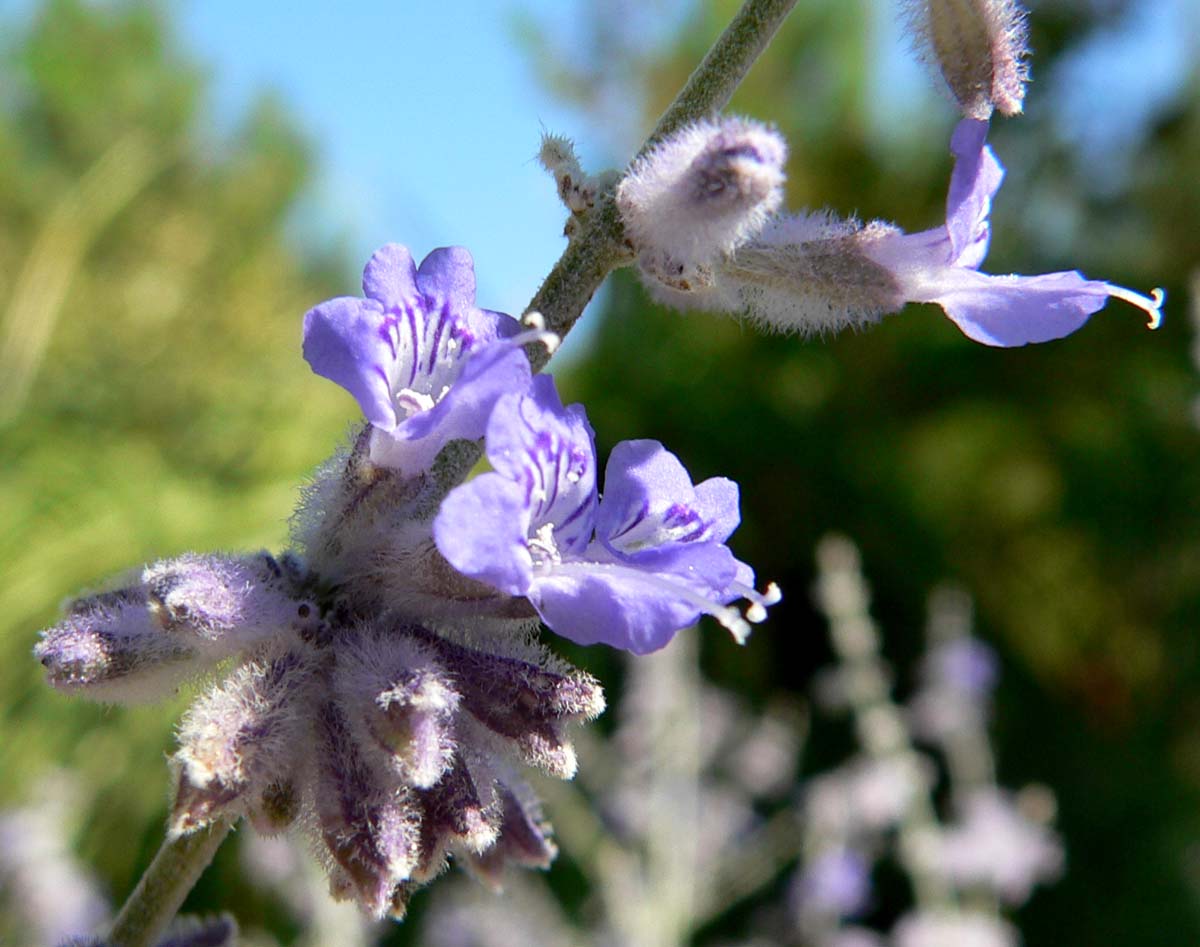
Nodding Sage (Salvia nutans) is a herbaceous perennial belonging to the mint family, Lamiaceae. It originates from the steppe regions and grasslands of Central and Eastern Europe, the Caucasus, and parts of Siberia, and is distinct for its sharply curving flower stems.
You will spot this species by its characteristic nodding inflorescences, which distinguish it from many upright cousins like woodland sage (Salvia nemorosa). It occasionally appears in North America as an escapee from garden cultivation.
Key Facts
- Type: Herbaceous perennial
- Family: Lamiaceae
- Native Range: Central and Eastern Europe to Caucasus
- Flower Color: Violet-blue
- Growth Habit: Upright stems with nodding apexes
Where Nodding Sage Fits in the Landscape
Nodding Sage suits dry meadows, steppe restorations, and wild gardens seeking drought-tolerant perennial species. It performs best in open, sunny locations where surrounding vegetation remains low enough to prevent shading out its basal rosette.
You should place this plant away from damp spots, as it rots rapidly in winter wetness. Its unique architecture makes it a natural focal point in gravel gardens or native plant borders.
Botanical Look and Identification
Nodding Sage reaches a mature height of 50-90 cm (20-35 in) with a spread of roughly 30-50 cm (12-20 in). The dark green leaves form a low basal rosette, featuring crinkled textures and prominent veining.
- Stems: Slender, branching, and glandular-hairy toward the upper sections
- Flowers: Deep violet-blue tubes arranged in whorls along a distinctive downward-curving tip
- Bloom period: Appears from early to late summer, typically June through August
- Roots: Deep taproot system that aids in drought survival
Natural Habitat and Soil Preferences
Nodding Sage naturally inhabits dry steppes, rocky limestone slopes, and scrubby margins across Eastern Europe and the Caucasus. It thrives in soils that dry out thoroughly between rainfall events.
- Soil type: Highly permeable, gritty, or sandy loam
- pH requirement: Neutral to slightly alkaline, roughly 6.0 to 7.5
- Sun exposure: Full sun for at least six hours daily
The species struggles in heavy clay soils or regions with high summer humidity coupled with stagnant air.
Ecology and Pollinator Interactions
Nodding Sage provides a reliable nectar source for long-tongued bees, bumblebees, and various beneficial butterflies during the summer months. The drooping floral design specifically accommodates medium to large insect pollinators.
Pollinators must push past the hinged stamen mechanism to access nectar, which ensures effective cross-pollination. Seed heads later supply foraging food for small seed-eating birds as autumn approaches.
Conservation Status and Distribution
Nodding Sage maintains stable wild populations across its vast native range spanning from Eastern Europe into western Siberia. It currently holds no global IUCN threatened status, though localized losses occur due to agricultural expansion.
Populations introduced to North America remain localized and sparse, showing no aggressive invasive traits in foreign climates. Seeds occasionally disperse via wind or clinging to animal fur near established colonies.
Is Nodding Sage Edible or Medicinal
Nodding Sage has no documented history as a primary culinary herb or modern pharmaceutical crop. Unlike common sage (Salvia officinalis), it lacks the strong aromatic volatile oils valued in cooking.
Traditional herbal practices rarely utilize this specific wild species, focusing instead on other members of the genus. You should avoid consuming wild plants unless positively identified and confirmed safe by a certified botanist.
Similar Sage Species to Know
Nodding Sage shares its genus with hundreds of perennial relatives, several of which display similar growth habits in the wild or garden settings. Telling them apart relies heavily on inflorescence structure and leaf shape.
- Woodland sage (Salvia nemorosa): Features stiffly upright, pointed purple spikes rather than drooping tips
- Meadow clary (Salvia pratensis): Displays larger, brighter blue-violet flowers on taller, erect stems
- Whorled sage (Salvia verticillata): Exhibits dense, congested whorls of small lilac flowers tightly hugging the stem
- Jerusalem sage (Phlomis tuberosa): Often confused by casual observers due to similar height, but belongs to a different genus
Frequently Asked Questions
Is nodding sage invasive?
Nodding sage is not considered invasive in North America or Europe, though it can occasionally escape cultivation into nearby dry grasslands. It lacks the aggressive spreading roots of truly invasive weeds.
How tall does nodding sage grow?
Nodding sage reaches a mature height of 50-90 cm (20-35 in). The flowering stalks add most of this height during the summer bloom cycle.
What zone is nodding sage hardy in?
Nodding sage is reliably hardy in USDA zones 5 through 9. It requires cold winter dormant periods to perform well the following year.
How do you grow nodding sage from seeds?
Sow nodding sage seeds in spring on the surface of well-drained potting mix, as light aids germination. Keep the medium lightly moist until seedlings emerge in 14 to 21 days at 18-20 °C (64-68 °F).
Sources & Verification
Taxonomy and distribution are checked against the databases below. Care guidance is written for cultivated species only and reviewed by our editor. How We Build Plant Profiles →