
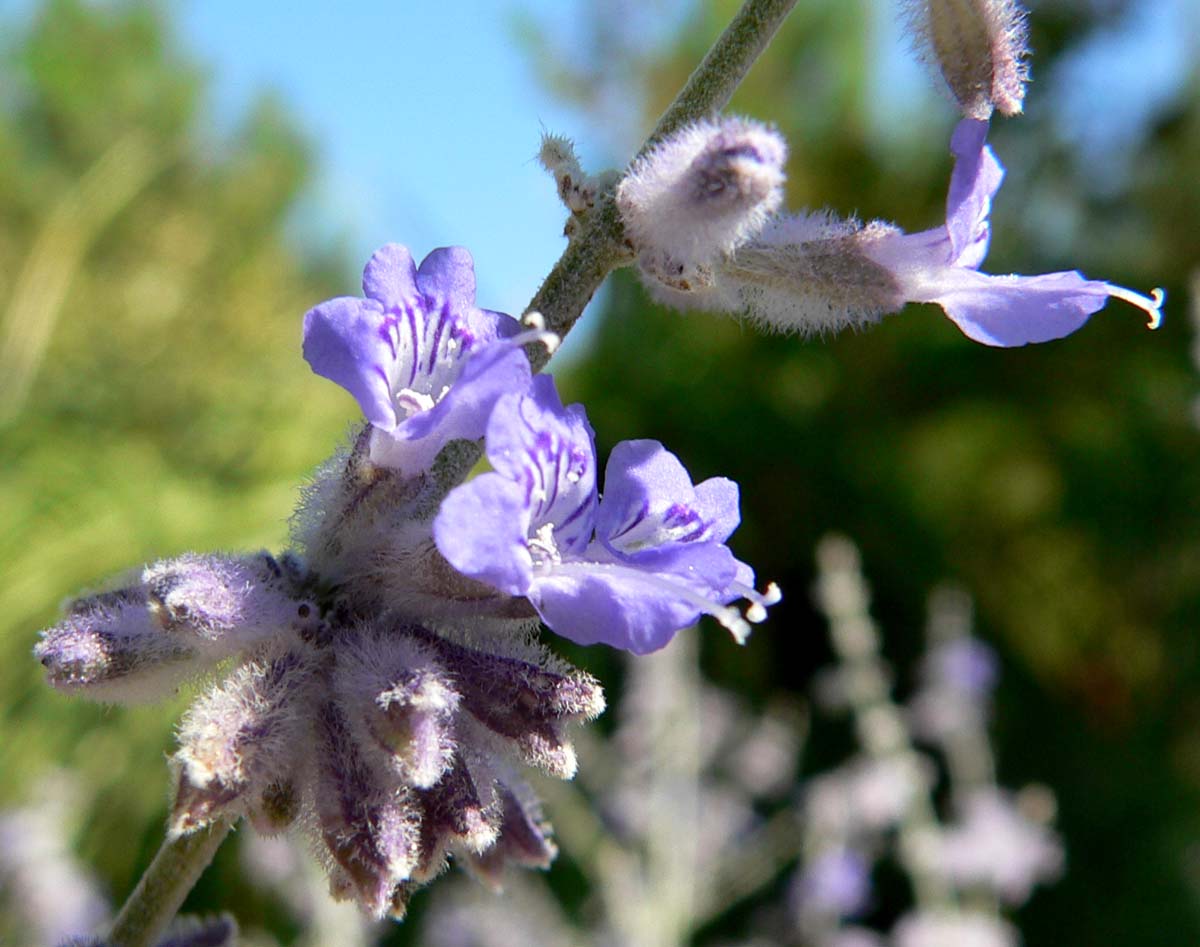
Russian sage (Salvia yangii) is a woody-based perennial subshrub native to the dry plains and hills of Central Asia, known for its fine-textured silver-white stems and hazy purple-blue blooms. Botanists previously classified the plant as Perovskia atriplicifolia before genetic analysis moved it into the sage genus in 2017.
This plant thrives in harsh, exposed spots where richer soils fail, though excess nitrogen or partial shade causes the upright stems to collapse. Heavy pruning right down to a low framework each spring keeps growth dense and prevents leggy, sprawling centres.
Key Facts
- Light: Full sun; at least 6 to 8 hours daily
- Water: Low; allow soil to dry out between soakings
- Height: 0.6–1.5 m (2–5 ft)
- Spread: 0.6–1.2 m (2–4 ft)
- Hardiness: USDA zones 5 to 9 (down to -29 °C)
- Soil: Lean, dry to medium, sharply drained alkaline or neutral
Is Russian Sage Right for Your Garden?
Russian sage suits hot, open sites with poor, rocky, or chalky soil where moisture-loving perennials struggle to establish. If you garden in heavy, waterlogged clay or have a shaded courtyard, this plant will decline quickly from root rot or flop onto its neighbours.
It works well in gravel gardens, dry borders, south-facing slopes, and modern matrix plantings. Once established after its first growing season, it requires minimal input beyond an annual spring cutback, making it practical for low-maintenance coastal or drought-prone landscapes.
Russian Sage Size and Botanical Appearance
Russian sage reaches a mature height of 0.9 to 1.5 m (3 to 5 ft) with an equal or slightly narrower spread, depending on the cultivar. Compact selections like ‘Little Spire’ remain smaller, maturing between 60 and 80 cm (24 and 31 in) tall.
The plant grows as a woody subshrub with stiff, upright, square stems coated in fine white hairs that give the entire plant a pale, chalky cast. Its leaves are opposite, grayish-green, 3–6 cm (1.2–2.4 in) long, and deeply lobed or pinnate with a pungent herbal scent when crushed.
- Stems: Silver-white, square in cross-section, becoming woody at the base.
- Foliage: Feathered, aromatic, aromatic, 3–6 cm (1.2–2.4 in) long.
- Flowers: Two-lipped violet-blue florets in terminal tiered panicles up to 30 cm (12 in) long.
- Habit: Vase-shaped, multi-stemmed clump spreading slowly via underground suckers.
Sun and Soil Requirements
Russian sage requires full sun for at least six hours each day to develop sturdy stems that do not require staking. Any planting location in partial or dappled shade weakens shoot development, forcing stems to stretch horizontally toward the light.
The soil must drain quickly after rainfall, with a neutral to alkaline pH between 7.0 and 8.5. Heavy clay soils hold winter moisture that suffocates the dormant root crown; you can amend heavy areas with coarse horticultural grit or install plants in raised berms.
Russian Sage Planting Instructions and Care in Pots
Set new nursery plants into the ground at the exact depth they were sitting in their original nursery container, spacing them 60 to 90 cm (24 to 36 in) apart. Dig a hole twice as wide as the root mass, backfill with unamended native soil, and water deeply to settle air pockets.
Do not add rich compost, manure, or peat moss into the planting hole, as organic amendments encourage soft, floppy growth. If planting Russian sage in pots, select a heavy terracotta container at least 40 cm (16 in) wide with large drainage holes. Use a gritty container mix formulated with two parts standard potting loam to one part coarse grit or perlite.
Russian Sage Care Watering and Feeding
Water young plants once a week during their first summer, then eliminate routine supplemental watering once root systems establish in year two. Deep, infrequent soakings during extended dry spells are preferable to shallow, daily sprinklers.
Never apply high-nitrogen chemical fertilisers or rich top-dressings to established borders. Excess soil fertility spurs rapid, weak foliage at the expense of flower panicles, causing the mature crown to split open under its own weight during midsummer rainstorms.
How and When to Prune Russian Sage
Prune Russian sage in early spring just as new green shoots appear, cutting all old stems back to 10–15 cm (4–6 in) from ground level. This annual renewal encourages strong new branching from the woody base and maintains an upright, tidy form.
Always cut just above a set of active emerging buds using clean, sharp bypass secateurs. Leave the pale, dried stems standing throughout autumn and winter to protect the woody crown from freeze damage and provide structural habitat for beneficial insects.
Propagating Russian Sage from Seeds and Cuttings
Russian sage propagates most reliably from semi-ripe stem cuttings taken in midsummer, which root within three to four weeks. While propagation from seed is possible, cultivars such as ‘Blue Spire’ do not come true from seed.
- Take cuttings: Snip 10 cm (4 in) non-flowering shoots in July or August with a firm base.
- Strip lower foliage: Remove the bottom leaves and insert cuttings into a 50:50 perlite and peat-free potting mix.
- Maintain humidity: Cover pots with a clear plastic dome away from direct sun until roots form.
- Sow seeds: If using species seed, cold-stratify at 4 °C (39 °F) for 30 days before sowing at 20 °C (68 °F).
Russian Sage Care in Winter
Winter survival relies entirely on sharp soil drainage around the dormant root system rather than thermal insulation. In cold zones from USDA 5 to 6, tops may die back to the soil line during hard freezes below -20 °C (-4 °F), but crowns sprout vigorously once soil warms in May.
Avoid applying heavy wood chip mulches or moisture-retentive organic matter over the crown before winter. If growing in containers in zones 5 or 6, move the pots against a sheltered house wall or into an unheated garage to prevent root damage from repeated freeze-thaw cycles.
Flowering Season and Blooming Performance
Russian sage blooms continuously from July through October, producing hundreds of tiny tubular flowers along branching terminal spikes. The calyces remain purple long after the petals drop, maintaining colour well into late autumn frosts.
Deadheading individual spent florets is unnecessary due to their diminutive size. If flowering slows in late August, shear back the upper third of the flower spikes to stimulate a secondary flush of compact terminal panicles before the first frost.
Best Companion Plants for Russian Sage
Pair Russian sage with drought-tolerant perennials and ornamental grasses that share its requirements for low water and lean, free-draining soil. The silvery framework complements broad foliage textures and warm floral tones.
Excellent garden companions include coneflower (Echinacea purpurea), black-eyed Susan (Rudbeckia fulgida), and stonecrop (Hylotelephium spectabile). Combining it with ornamental grasses like feather reed grass (Calamagrostis x acutiflora) and Mexican feather grass (Stipa tenuissima) mimics a natural steppe plant community.
Frequently Asked Questions
What is the difference between Russian sage vs lavender?
Russian sage grows much taller at 0.9–1.5 m (3–5 ft) with deeply lobed leaves and airy panicles, whereas English lavender (Lavandula angustifolia) remains compact at 30–60 cm (12–24 in) with narrow, unlobed linear foliage and tight flower spikes.
Why is my Russian sage flopping over?
Stems flop over when plants receive less than six hours of direct sunlight or grow in rich soil containing excessive nitrogen. Move flopping plants to full sun and withhold all fertilisers.
Does Russian sage spread aggressively?
Russian sage forms slowly expanding clumps via underground rhizomes, but it is not considered invasive in typical garden soils. You can easily remove stray runner shoots in spring with a sharp spade.
Can you grow Russian sage from seeds?
Yes, but seeds require a 30-day cold stratification period at 4 °C (39 °F) to break dormancy and take several months to establish. Cultivars like 'Little Spire' must be grown from cuttings to remain true to type.
Is Russian sage toxic to dogs and cats?
Russian sage is non-toxic to dogs, cats, and horses according to the ASPCA. The pungent aromatic foliage generally discourages pets and deer from browsing the stems.
Sources & Verification
Taxonomy and distribution are checked against the databases below. Care guidance is written for cultivated species only and reviewed by our editor. How We Build Plant Profiles →
- Royal Horticultural SocietyTaxonomy and cultivation advice under Salvia yangii
- Missouri Botanical GardenGrowing characteristics and cultivar notes
- Kew Plants of the World OnlineDistribution, nomenclature, and synonymy
- North Carolina State Extension Gardener Plant ToolboxIdentification, landscape usage, and cultural conditions
- GBIF — Global Biodiversity Information Facilitytaxonomy, synonyms, occurrence records
- Wikipediageneral reference


