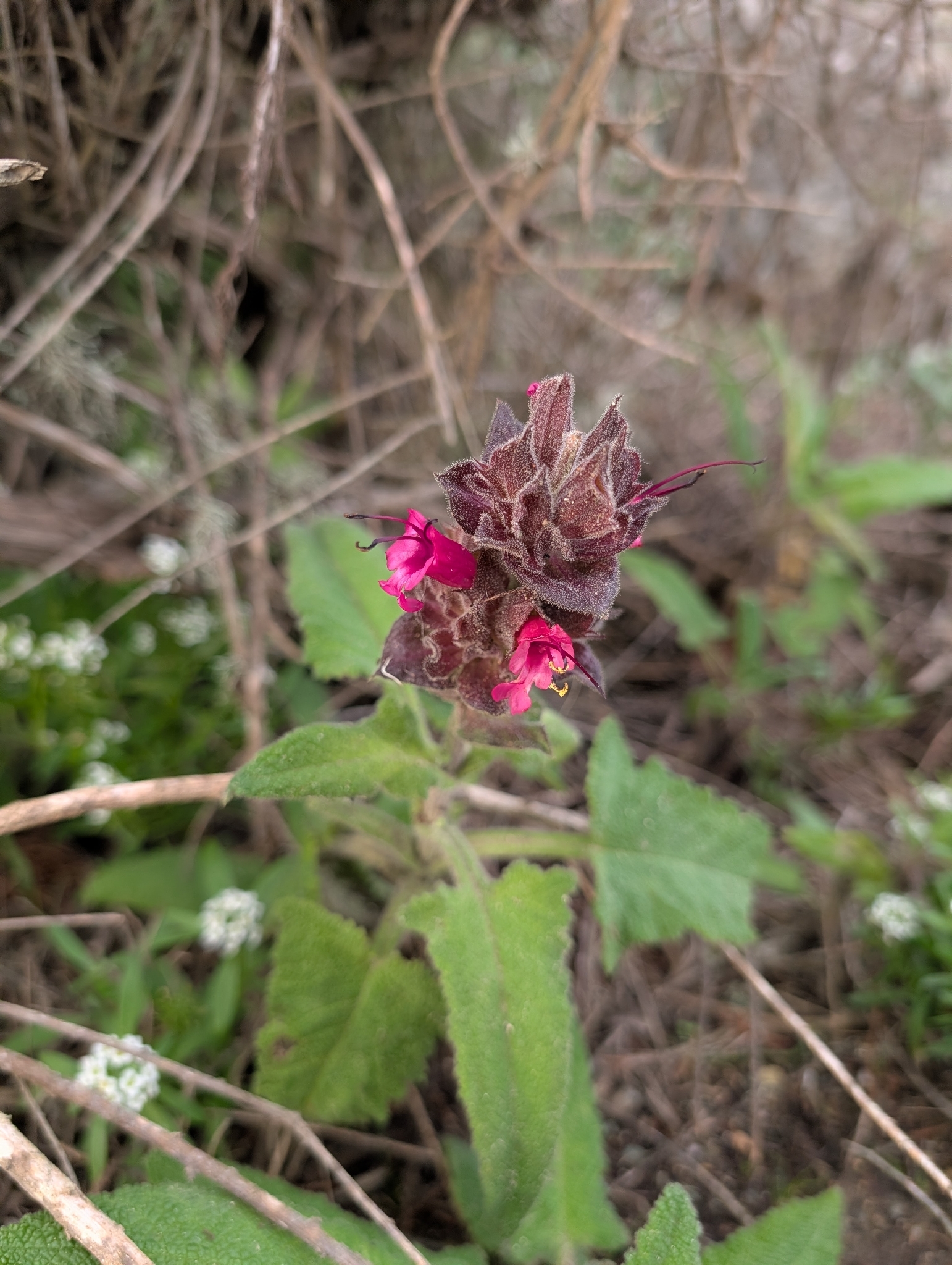
Red sage (Salvia miltiorrhiza) is a deciduous perennial herb native to China and Japan, recognised for its branched spikes of purple-blue flowers and thick, scarlet-barked taproots. It belongs to the mint family, Lamiaceae, and naturally inhabits grassy hillsides, stream banks, and forest edges between 90 and 1,200 m (300 and 3,940 ft) elevation.
Unlike culinary garden sages, you cultivate red sage primarily as a root crop that requires deep, sandy loam and two to three growing seasons before digging. It will rot rapidly in heavy winter clay.
Key Facts
- Type: Herbaceous perennial root crop
- Hardiness: USDA Zones 6–9
- Root harvest: After 2 to 3 years
- Sun: Full sun to light partial shade
- Soil: Deep, loose, free-draining sandy loam
Growing Red Sage: What to Expect
Red sage is a hardy perennial root crop suited for gardeners who have deep, gritty soil and the patience to wait multiple seasons before digging. The aboveground canopy reaches 30–80 cm (12–31 in) in height, forming a modest clump that dies back completely to the crown after the first hard autumn frost.
This plant suits herb growers, medicinal plant collectors, and pollinator gardens in temperate climates. It struggles in containers shallower than 40 cm (16 in) because the taproots need vertical run to develop their characteristic thickness.
- Requires two to three seasons to yield mature, harvestable roots.
- Needs winter dormancy below 5 °C (41 °F) to reset bud production reliably.
- Does not tolerate wet soil during winter freeze-thaw cycles.
Identifying Red Sage: Foliage, Flowers, and Roots
Red sage displays square, multi-branched stems covered in dense glandular hairs, paired with compound odd-pinnate leaves and brick-red roots. The leaves hold 3 to 7 ovate leaflets measuring 2–8 cm (0.8–3.1 in) long with crenate margins and a wrinkled, pubescent surface.
In mid-summer, terminal racemes 10–20 cm (4–8 in) long produce whorls of two-lipped, bluish-purple corollas measuring 2.5–3 cm (1–1.2 in) long. The lower lip is broad and pale, while the upper falcate hood encloses the stamens, attracting native bumblebees and honeybees.
Below ground lies the plant’s hallmark feature: a branched cluster of fleshy cylindrical roots 15–30 cm (6–12 in) long and 0.5–1.5 cm (0.2–0.6 in) thick. The outer epidermis is cinnabar or reddish-brown, wrapping a fibrous yellow-white central vascular core.
Soil, Light, and Temperature Requirements
Red sage thrives best in full sun with at least six hours of direct sunlight daily and soil with rapid drainage. While it tolerates light afternoon shade in hot inland climates, shade reduces root expansion and slows essential oil and tanshinone accumulation.
Soil structure dictates the shape of the taproot. Plant in a sandy loam or gravelly mix with a pH between 6.0 and 7.5; compacted clay causes the taproots to branch horizontally, stunt, or rot during summer storms.
- Minimum temperature: Hardy to -15 °C (5 °F) when dormant.
- Optimum growing range: 18–26 °C (64–79 °F) during the active vegetative period.
- Bed preparation: Loosen the top 35 cm (14 in) of soil and mix in coarse grit or decomposed granite.
Sowing Seeds and Propagating Red Sage
Sow red sage seeds indoors six to eight weeks before your last spring frost at a depth of 3 mm (0.1 in). Seeds require light and steady soil temperatures around 20–22 °C (68–72 °F) to germinate within 10 to 18 days.
Keep the germination medium damp with a misting bottle rather than a heavy pour to avoid dislodging fine seeds. Harden off seedlings gradually over seven days after the final frost date before transplanting outdoors at 30 cm (12 in) spacing.
- Root crown divisions can be taken in early spring just as buds break dormancy.
- Each division piece must retain at least one viable shoot eye and a 5 cm (2 in) root segment.
- Semi-ripe stem cuttings 8–10 cm (3–4 in) long root in perlite within three weeks in early summer.
Watering, Feeding, and Pruning Red Sage
Water red sage only when the top 5 cm (2 in) of soil feels completely dry. Established plants tolerate moderate dry spells, while prolonged standing moisture encourages fatal crown necrosis.
Fertiliser should remain low in nitrogen. Excess nitrogen promotes weak, floppy stems and lush leaves at the expense of root density and active chemical constituent concentration.
- Apply a thin 2 cm (0.8 in) layer of mature compost around the base each spring.
- Prune spent flower stalks down to the basal foliage in late summer to redirect energy into root storage.
- Cut all dead top growth down to 3 cm (1.2 in) above the soil line in late autumn after frost.
Harvesting Danshen Roots
Harvest red sage roots in late autumn of the second or third year, after the aerial foliage has completely died back. At this point, the root reserves hold their highest concentration of active compounds, including tanshinones and salvianolic acid.
Use a garden fork rather than a spade to avoid slicing the long taproots. Insert the tines 25 cm (10 in) away from the crown, lever gently upwards, and loosen the surrounding soil before lifting the intact root system.
Shake off loose dirt immediately, taking care not to scrape away the thin, bright red outer bark. Wash the roots thoroughly under cold running water with a soft nylon brush to remove soil particles from crevices.
Traditional and Herbal Uses of Red Sage
In traditional Chinese medicine, the dried root is known as danshen and has been recorded in pharmacopoeias for over two thousand years. Historical practitioners traditionally used the decocted root to invigorate blood circulation, dispel blood stasis, and calm the spirit.
Modern phytochemistry focuses on its lipid-soluble diterpenes, known as tanshinones, and water-soluble salvianolic acids. Laboratory studies investigate these compounds for cardiovascular and antioxidant activity.
- Roots were traditionally sliced and simmered into decoctions or prepared as alcohol tinctures.
- The aerial foliage is not consumed culinary-style like common sage (Salvia officinalis).
- The flowers produce copious nectar that attracts domestic honeybees and solitary pollinators.
Red Sage Pests, Diseases, and Problems
The primary threat to red sage is root rot caused by poor drainage and excessive moisture. Plants grown in poorly aerated beds collapse rapidly as the cortical root tissue decays into a dark mush.
Foliar problems are infrequent thanks to aromatic terpenes in the foliage, but high humidity and overcrowded spacing can invite opportunistic fungi. Inspect plants weekly during damp spells.
- Powdery mildew: Gray-white patches on upper leaf surfaces; improve air circulation and space plants 40 cm (16 in) apart.
- Aphids: Clustered on soft young spring shoots; rinse off with a firm jet of water.
- Slugs and snails: Eat young emerging shoot tips in April; protect young plants with gravel mulch or copper barriers.
- Root-knot nematodes: Can cause galls on root fibers in warm, sandy soils; rotate beds periodically.
Processing and Storing Red Sage Roots
Dry fresh red sage roots in a well-ventilated dehydrator at 40–45 °C (104–113 °F) until brittle. Clean roots can also be sliced diagonally while fresh into 2–3 mm (0.1 in) thick rounds before drying, which speeds up moisture loss and makes future extraction easier.
If drying naturally, lay whole roots on wire mesh screens in a shaded, well-aired space out of direct sunlight for 10 to 14 days. Sun exposure degrades photolabile diterpenes in the root skin.
Store fully dried root chips in airtight amber glass jars away from light and humidity. Properly dried roots remain aromatic and usable for up to two years when stored below 20 °C (68 °F).
Frequently Asked Questions
Is red sage a perennial?
Yes, red sage is a long-lived herbaceous perennial in USDA zones 6 through 9. Its foliage dies back completely to the root crown during freezing winter temperatures and re-emerges vigorously in spring.
What is the difference between red sage and Texas red sage?
Red sage (Salvia miltiorrhiza) is grown for its bright red roots and has blue-purple flowers, whereas Texas red sage (Salvia coccinea) or autumn sage (Salvia greggii) is grown for showy red blossoms and does not produce harvestable medicinal roots.
Can you eat red sage leaves like garden sage?
No, the leaves of red sage are not used as a culinary seasoning. Cultivators grow red sage exclusively for its thick roots, unlike common sage (Salvia officinalis), which provides culinary leaves.
Is the red sage in video games like Red Dead Redemption a real plant?
The red sage featured in the Red Dead Redemption games is modeled on desert sages or autumn sage (Salvia greggii) native to the American Southwest, not the Asian root-crop red sage (Salvia miltiorrhiza) documented in botany.
What are the traditional benefits of red sage?
In traditional Chinese medicine, the dried root (danshen) was traditionally used to promote blood circulation, resolve stagnation, and support cardiovascular health. Modern clinical research studies its active tanshinones and salvianolic acids for antioxidant and vascular mechanisms.
Information about traditional or historical uses is provided for educational interest only and is not medical advice. Do not use any plant to treat a condition without speaking to a qualified professional.
Sources & Verification
Taxonomy and distribution are checked against the databases below. Care guidance is written for cultivated species only and reviewed by our editor. How We Build Plant Profiles →
- Kew Plants of the World OnlineTaxonomic baseline and distribution data
- Flora of ChinaMorphological description and native habitat range
- Missouri Botanical Garden Plant FinderCultivation habits and USDA zone tolerances
- GBIF — Global Biodiversity Information Facilitytaxonomy, synonyms, occurrence records
- Wikipediageneral reference