
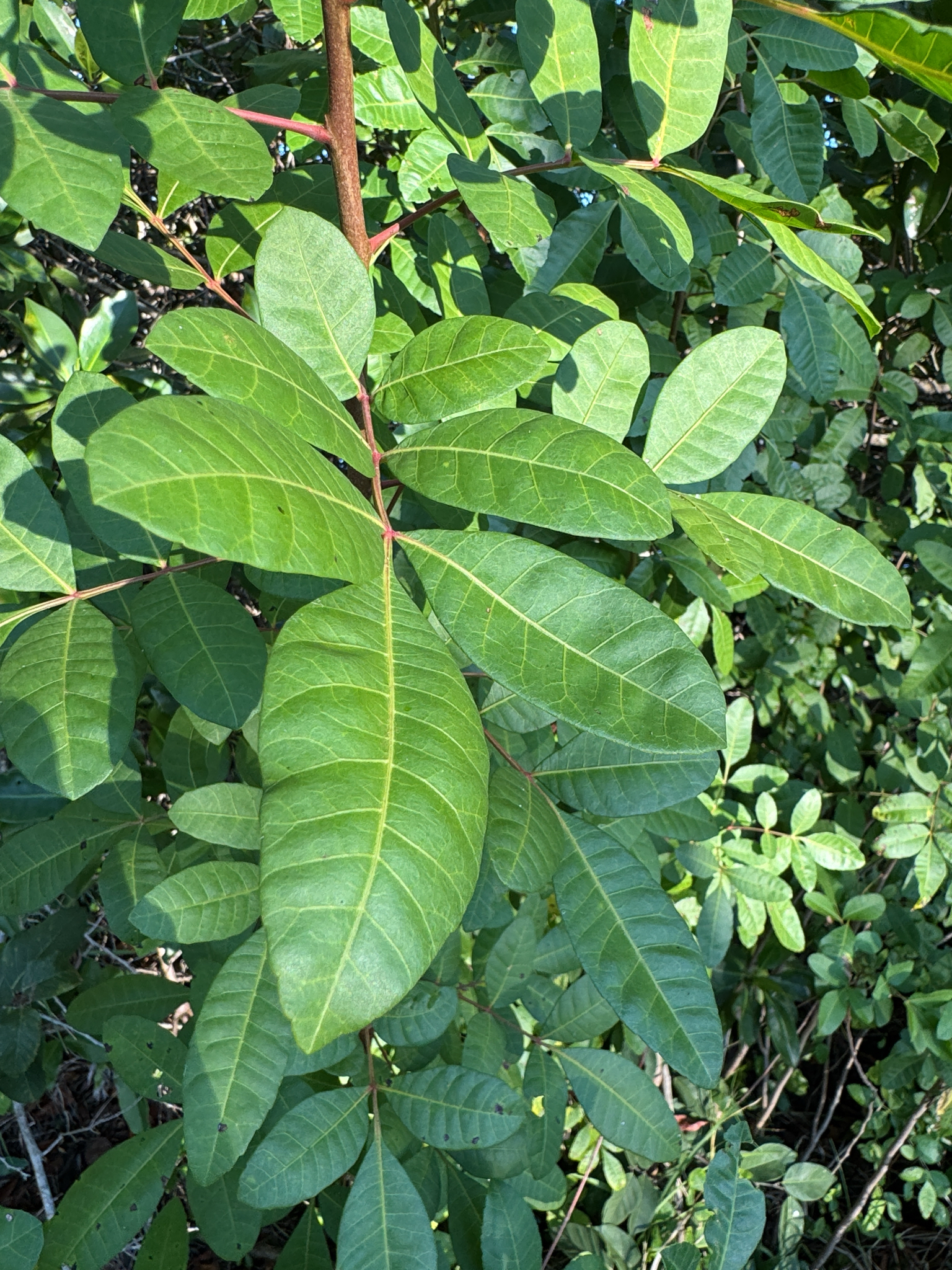
Brazilian pepper is a multi-stemmed evergreen shrub or small tree in the cashew family, Schinus terebinthifolia, native to the subtropical and tropical regions of Brazil, Argentina, and Paraguay. It is widely recognised for its dense canopy of compound leaves and clusters of bright red berries that ripen during the winter months.
While used as an ornamental for its festive appearance, this species is a highly aggressive coloniser that outcompetes native vegetation in Florida, Hawaii, and Australia. It produces a resinous sap that can cause skin irritation similar to its relative, poison ivy (Toxicodendron radicans).
Key Facts
- Light: thrives in full sun but tolerates deep shade
- Hardiness: USDA zones 9 to 11; damaged by hard freezes
- Size: typically reaches 3 to 10 m (10-33 ft) in height
- Water: extremely drought-tolerant once established in sandy soils
- Toxicity: sap causes dermatitis; berries are toxic to some birds
Fitting Brazilian Pepper into Your Landscape
Living with Brazilian pepper often means managing an aggressive coloniser rather than nurturing a delicate specimen. In many regions, including Florida and parts of Australia, planting this tree is prohibited due to its ability to displace native ecosystems like mangroves and pine rocklands. It is best suited for large, contained areas where its spread can be strictly monitored.
Because it grows quickly and forms dense thickets, it was historically used as a privacy screen or hedge. However, its brittle wood and shallow root system make it prone to wind damage during tropical storms. If you have an existing tree, ensure it is not located near sensitive natural water bodies where its seeds can easily travel.
- Avoid planting near native hammocks or wetlands
- Check local invasive species ordinances before planting
- Use as a standalone specimen only in non-sensitive urban zones
- Be prepared for significant seedling cleanup every spring
Brazilian Pepper Tree Identification Guide
You can identify Brazilian pepper by its pinnately compound leaves which usually consist of 7 to 9 leaflets. Each leaflet measures 2-7 cm (0.8-2.8 in) in length and has a finely toothed margin, though some varieties have smooth edges. When crushed, the leaves emit a distinct peppery or turpentine-like aroma characteristic of the Schinus genus.
The tree’s structure is typically multi-trunked with arching branches that create a tangled, messy appearance. The bark is grey and relatively smooth on young branches, becoming furrowed and darker as the tree ages. In late autumn, female trees produce heavy clusters of green berries that turn a glossy, bright red by December.
- Leaflets: 7-9 per leaf, opposite arrangement
- Rachis: often winged or slightly flattened
- Flowers: small, 5-petaled white clusters
- Fruit: red drupes, 4-5 mm (0.2 in) diameter
- Sap: clear but turns black upon exposure to air
Size and Growth Habit
A mature Brazilian pepper tree usually reaches a height of 3 to 10 m (10-33 ft) with a similar or greater spread. It is a fast-growing species, capable of adding 1 m (3.3 ft) of height per year in ideal conditions. The growth habit is sprawling, with low-hanging branches that often touch the ground and take root, a process known as layering.
In its native South American habitat, it may grow taller as a single-trunked tree, but in invasive contexts, it almost always forms a dense, impenetrable shrubby mass. This growth pattern allows it to shade out smaller plants and prevents the germination of competing species. Pruning can force a more upright, tree-like form, but the plant will constantly produce basal sprouts from the root crown.
Ideal Growing Sites
This species is highly adaptable and thrives in full sun to partial shade across various soil types. It is particularly successful in disturbed sites, such as roadsides, abandoned pastures, and canal banks. While it prefers moist, well-drained soil, it is remarkably salt-tolerant and can grow near coastal mangroves (Rhizophora mangle).
It is not picky about soil pH, growing equally well in acidic sands or alkaline limestone soils. The only condition it truly dislikes is permanent deep flooding, although it can survive seasonal inundation for several weeks. In the garden, it requires almost no supplemental care once the root system reaches 1 m (3.3 ft) in depth.
Planting History and Warnings
Brazilian pepper was introduced to the United States in the mid-1800s as an ornamental substitute for holly. It was widely distributed by nurseries for its winter berries, earning the name “Florida Holly.” Today, it is listed as a Category I invasive species by the Florida Exotic Pest Plant Council, meaning it is altering native plant communities.
If you are looking for a similar aesthetic without the invasive risk, consider planting Dahoon holly (Ilex cassine) or Yaupon holly (Ilex vomitoria). These native alternatives provide similar red berries for wildlife without the aggressive spreading habit. Never transport the seeds or soil from an area where Brazilian pepper is growing, as even small root fragments can regenerate.
Watering and General Care
Established trees require zero supplemental irrigation in most climates within USDA zones 9-11. During the first year after planting or sprouting, watering once a week during dry spells helps establish the taproot. Overwatering is rarely an issue for the tree itself, but it can encourage even faster, weaker wood growth.
Fertilisation is unnecessary and discouraged, as the tree is already a vigorous grower that efficiently extracts nutrients from poor soils. If the tree is being kept as an ornamental, focus care on removing the thousands of seedlings that will appear beneath the canopy. These seedlings should be pulled by hand while the soil is moist to ensure the entire root is removed.
Pruning for Control
Pruning should focus on removing low-hanging branches and suckers to maintain a single-trunk appearance. Because the wood is brittle, thinning the inner canopy can help reduce wind resistance during storms. Always wear gloves and long sleeves when pruning, as the sap contains urushiol-like compounds that cause severe skin blistering.
The best time to prune for berry control is in late summer before the green fruit develops. By removing the flower spikes, you prevent the production of seeds that birds would otherwise disperse. If a major limb is removed, the tree will likely respond with a flush of water sprouts at the cut site, which must be rubbed off immediately.
- Wear protective gear to avoid sap contact
- Dispose of clippings in sealed bags; do not mulch
- Sterilise tools with 10% bleach after use
- Prune in late summer to reduce seed set
How to Remove Brazilian Pepper Trees
To kill a Brazilian pepper tree effectively, you must use a basal bark or cut-stump herbicide treatment. Simply cutting the tree down will result in massive regrowth from the stump and roots. Applying a herbicide containing triclopyr ester directly to the bark of the bottom 30-45 cm (12-18 in) of the trunk is the most common professional method.
For the cut-stump method, fell the tree and immediately (within 1 minute) paint the outer ring of the stump with a concentrated glyphosate or triclopyr solution. Hand-pulling is only effective for seedlings less than 60 cm (2 ft) tall. Large-scale infestations often require heavy machinery to grind the stumps, followed by repeated foliar sprays on any new sprouts that emerge.
- Use triclopyr-based herbicides for best results
- Apply herbicide immediately after cutting the stump
- Monitor the site for 2 years for new seedlings
- Hire a licensed professional for trees near water
Winter Survival and Berry Season
The berries of the Brazilian pepper ripen into a bright red colour in December, providing a food source for birds like the American Robin (Turdus migratorius). While the tree is evergreen, it may drop some leaves during exceptionally dry winters or after a light frost. It can survive temperatures down to -6 °C (20 °F), but sustained freezes will kill the tree to the ground.
In colder parts of zone 9, the tree acts more like a perennial shrub, dying back in winter and regrowing from the roots in spring. The berries often persist on the branches through February unless consumed by wildlife. Note that while birds eat the berries, the seeds pass through their systems unharmed, which is the primary way the plant invades new territories.
Harvesting and Using Peppercorns
The dried berries are sold as pink peppercorns, though they are more accurately a spice than a true pepper. They have a sweet, pine-like flavour with a mild heat. While the related Peruvian pepper (Schinus molle) is the primary commercial source, Schinus terebinthifolia berries are also harvested for this purpose.
In traditional South American medicine, various parts of the tree were used to treat wounds, ulcers, and respiratory issues. The bark was often prepared as a decoction for its astringent properties. However, caution is required as the plant contains phenols that can cause allergic reactions in people sensitive to cashews (Anacardium occidentale) or mangoes (Mangifera indica).
- Harvest only bright red, firm berries
- Dry berries in a single layer at room temperature
- Avoid consumption if you have a nut allergy
- Berries were traditionally used as a topical antiseptic
Year-Round Management of Brazilian Pepper
| Spring | Hand-pull new seedlings that emerge after winter berry drop. Monitor for basal sprouts and rub them off the main trunk. |
|---|---|
| Summer | Prune back overhanging branches to improve air circulation. Identify and remove male trees if you wish to stop berry production. |
| Autumn | Apply basal bark herbicide treatments if removal is planned. Watch for flowering spikes in late September. |
| Winter | Harvest berries for decorative or culinary use in December. Check for frost damage after cold snaps and prune dead wood in late February. |
Common Brazilian Pepper Problems and Removal Tips
| What you see | Likely cause | What to do |
|---|---|---|
| Skin blistering or itching | Contact with resinous sap | Wash skin immediately with soap and cold water; avoid touching eyes. |
| Massive regrowth after cutting | Failure to treat stump with herbicide | Apply triclopyr to the new sprouts or re-cut and treat the stump. |
| Brittle, breaking branches | Rapid growth or storm stress | Thin the canopy to reduce wind load and prune to a single leader. |
| Yellowing leaves in winter | Cold stress or drought | No action needed; the tree will recover when temperatures rise. |
Botanical Varieties of Schinus terebinthifolia
- var. terebinthifolia – the standard invasive form with broad leaflets
- var. acutifolia – features narrower, pointed leaflets and smaller fruit
Frequently Asked Questions
Is Brazilian pepper tree poisonous?
Yes, it contains sap that causes skin irritation and respiratory distress in some people. The berries can also be toxic to livestock and birds if consumed in very large quantities.
What kills Brazilian pepper trees?
Herbicides containing triclopyr or glyphosate are the most effective way to kill the tree. You must apply these directly to the stump or bark to prevent the roots from resprouting.
Are the berries of Brazilian pepper edible?
The berries are used as pink peppercorns, but they should be consumed in moderation. People with nut allergies, specifically to cashews or pistachios, should avoid them entirely.
How can I tell Brazilian pepper from Dahoon holly?
Brazilian pepper has compound leaves with multiple leaflets, whereas Dahoon holly (Ilex cassine) has simple, single leaves. Crushing a Brazilian pepper leaf also produces a strong peppery smell.
Why is Brazilian pepper considered invasive?
It grows extremely fast, produces thousands of seeds dispersed by birds, and forms dense thickets that block sunlight from reaching native plants. It also releases chemicals into the soil that inhibit the growth of other species.
Information about traditional or historical uses is provided for educational interest only and is not medical advice. Do not use any plant to treat a condition without speaking to a qualified professional.
Sources & Verification
Taxonomy and distribution are checked against the databases below. Care guidance is written for cultivated species only and reviewed by our editor. How We Build Plant Profiles →
